
 Search Articles


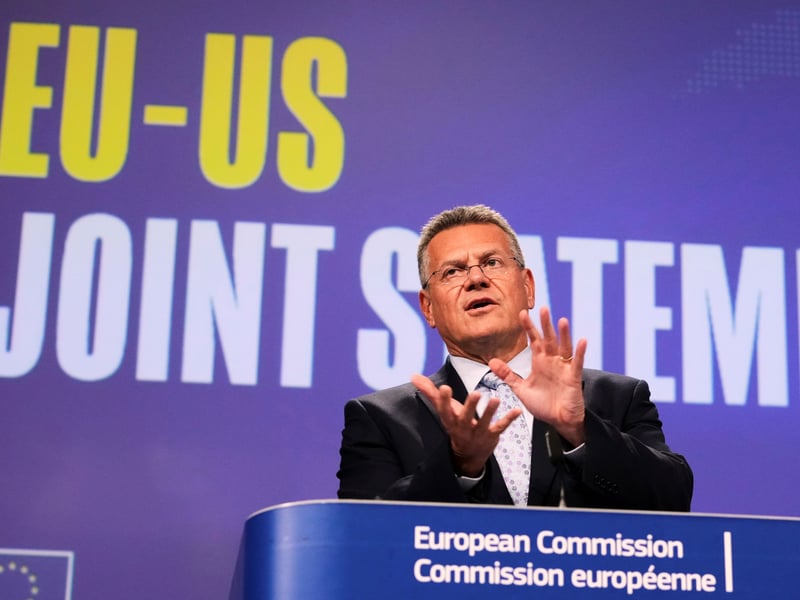
BRUSSELS (CN) — The European Union and United States put pen to paper Thursday on a deal capping American tariffs at 15% for most European exports, with the EU’s top trade official calling it “the most favorable trade deal the U.S. has extended to any partner.”
The “Framework on an Agreement on Reciprocal, Fair, and Balanced Trade” establishes what both sides call a ceiling for U.S. duties on the vast majority of EU goods, including cars, pharmaceuticals, semiconductors and lumber.
The move caps off a dramatic summer that saw European Commission President Ursula von der Leyen rush to U.S. President Donald Trump’s Scottish golf resort in July to hammer out a last-minute deal before the president could slap 30% tariffs on European goods. A commission spokesperson confirmed Tuesday that the EU had sent its version of the agreement to the U.S. for approval, signaling the formal announcement was imminent.
Here’s what makes this deal different: “Unlike with other trading partners, the 15% cap does not come on top of existing most favored nation tariffs. Instead, it includes them,” EU Trade Commissioner Maroš Šefčovič — the bloc’s chief trade negotiator — explained at a surprise Brussels news conference Thursday.
Under the arrangement, Washington commits to impose either its standard trade tariffs or a maximum 15% duty, whichever is higher, according to the joint document. This means the EU will benefit from significantly lower effective tariffs compared to other countries, Šefčovič said.
Starting Sept. 1, certain products including aircraft, generic pharmaceuticals and natural resources like cork will face only standard U.S. tariffs, which are typically much lower. “This is just the first step. The EU and the U.S. will explore exempting additional sectors in the future,” Šefčovič said.
Spirits and wine were not part of the agreement and will need to be resolved later.
The clarification on pharmaceuticals resolves confusion from the July announcement, when Trump and von der Leyen offered conflicting accounts about whether drugs would be included in the tariff cap, raising fears among European producers about market access.
The numbers tell the story of just how much is at stake. The deal protects what EU sources call the world’s most valuable economic relationship, worth 1.6 trillion euros ($1.7 trillion) annually and supporting millions of jobs on both sides of the Atlantic. Companies and consumers trade more than $4.2 billion in goods and services across the ocean every day.
The deal comes as new trade data shows the economic pressure Europe was under. The EU’s trade surplus with the U.S. nearly halved from May to June, dropping from 18.4 billion euros ($20.1 billion) to 9.6 billion ($10.5 billion) as American imports from Europe fell 10.3% and European imports from the U.S. jumped 16.4%.
The economic stakes are real. Europe’s traditional export powerhouses took hits during the tariff standoff, with the chemicals sector seeing its trade surplus fall from 19.1 billion euros ($20.9 billion) to 14.3 billion ($15.6 billion) year-over-year, while machinery and vehicles dropped from a 21.3-billion-euro ($23.3 billion) surplus to 16.4 billion ($17.9 billion). Germany, Europe’s economic engine, actually contracted 0.1% in the second quarter as trade tensions peaked.
Economic analysts warn the deal won’t deliver quick relief. Oxford Economics noted in a brief released Thursday that while sentiment indicators had become “excessively optimistic” in the run-up to the trade agreement, recent data suggests meaningful economic recovery won’t materialize before 2026.
Implementation hurdles ahead
The automotive industry will see significant relief once Europe implements its side of the bargain. The agreement states that when the EU formally introduces legislation to cut its own tariffs on American goods, the U.S. will reduce automotive duties to the 15% ceiling.
Šefčovič said the commission plans to introduce that legislation this month, with the U.S. promising to apply the reduced car tariffs retroactively from Aug. 1.
In return, Europe has committed to eliminating all tariffs on American industrial goods and expanding market access for U.S. agricultural products including tree nuts, dairy items, processed foods, soybean oil and pork and bison meat, according to the agreement. The EU will also extend a lobster tariff deal that expired July 31.
The massive purchasing commitments could prove tricky to deliver. As part of the July deal, Europe promised $600 billion in U.S. investments and $750 billion in energy purchases through 2028 to help replace Russian supplies. But Brussels cannot force companies to spend that money — it’s up to individual businesses and national governments to follow through.
The agreement also calls for Europe to substantially increase military equipment purchases from the United States and to buy at least $40 billion worth of American artificial intelligence chips for computing centers.
Steel and aluminum remain subject to separate arrangements. The two sides plan to collaborate on protecting their markets from global overcapacity in those sectors while establishing quota systems for European steel and aluminum exports. Without the deal, European steel and aluminum would have faced tariffs as high as 50%.
But here’s the catch: This is still just a political agreement, not a legally binding treaty. That means both sides need to actually follow through on their promises — and there’s no guarantee they will.
However, the EU’s suspended retaliation measures remain on standby. The commission — the EU’s executive branch — had prepared countermeasures largely targeting American agricultural products worth billions of dollars before the Scotland breakthrough, and those could be reactivated if the U.S. fails to implement the agreement as outlined.
Despite the fanfare, some fundamental concerns remain unaddressed. The deal does not resolve disputes over EU digital regulations that have frustrated American tech companies, with Šefčovič confirming that issues like the EU’s Digital Markets Act and Digital Services Act “were kept out of the trade negotiations.”
Šefčovič didn’t mince words about what was at stake. “The alternative, a trade war with sky high tariffs and political escalation, helps no one,” he said. “Nearly 5 million European jobs, including many in SMEs, would be at risk.” SMEs are small and medium-sized enterprises.
The deal requires approval from EU member states and the European Parliament before full implementation, with Šefčovič acknowledging he spent Thursday morning “pleading” with lawmakers to work “constructively” and “swiftly” on the legislation. The ordinary legislative procedure could take months, potentially testing both sides’ patience.
Courthouse News correspondent Yuval Molina Obedman is based in Brussels, Belgium.
Subscribe to our free newsletters
Our weekly newsletter Closing Arguments offers the latest about ongoing trials, major litigation and rulings in courthouses around the U.S. and the world, while the monthly Under the Lights dishes the legal dirt from Hollywood, sports, Big Tech and the arts.