
 Search Articles


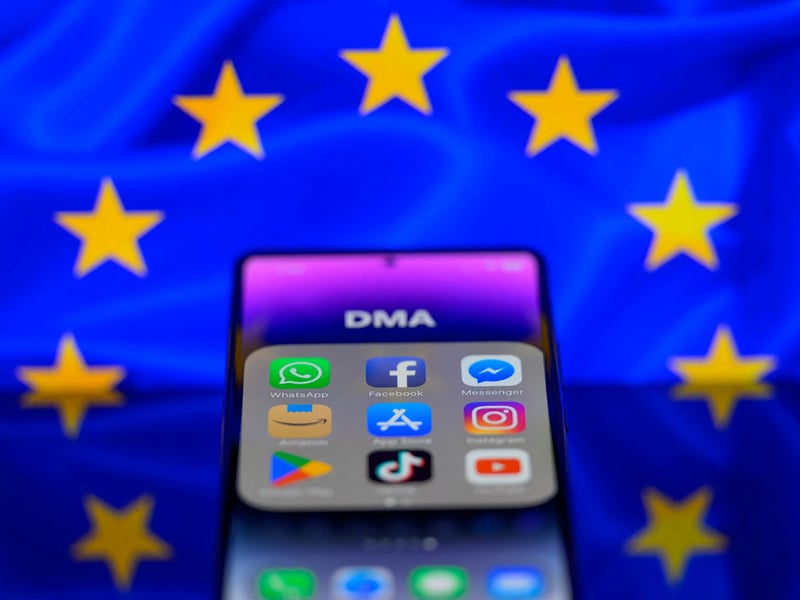
BRUSSELS (CN) — The European Union finds itself cornered by the Trump administration’s trade war, forced to choose between protecting its digital sovereignty and avoiding economic catastrophe as a July 9 deadline threatens to unleash 50% tariffs on EU goods.
The stakes became sharply clear over the weekend when Canada announced it would rescind its planned digital services tax to restart trade talks with the U.S.
“In anticipation of a mutually beneficial comprehensive trade arrangement with the United States,” Canadian Finance Minister François-Philippe Champagne said on Sunday, Ottawa would eliminate the Digital Services Tax Act entirely.
The capitulation offers a stark preview of the choice facing Brussels.
The dispute encompasses both EU-wide competition rules like the Digital Markets Act and Digital Services Act — which require American tech companies to share data with rivals and police content for disinformation — as well as national digital service taxes imposed by individual member states on tech companies’ revenues. The Trump administration views the regulations as discriminatory barriers to U.S. business.
“It is good to talk about technology. We don’t talk about sovereignty,” EU competition chief Teresa Ribera said during an interview in Brussels, delivering the strongest pushback yet against suggestions that Europe’s tech regulations could be sacrificed for a trade deal.
The Spanish Socialist commissioner, who oversees DMA implementation, flatly denied reports of a commission committee consulting with Americans on enforcement. “Not to the extent I know and I would say this is not part of any discussion,” she said.
But EU member states are split over how much Brussels should bend to avoid Trump’s tariff threats, with countries taking divergent approaches during last week’s EU summit.
Trump’s limited trade deal with Britain serves as both a cautionary tale and potential template for EU negotiations, highlighting the difficult trade-offs officials might be willing to make to preserve economic stability. The May agreement preserved Britain’s 2% digital services tax while accepting a 10% baseline tariff on most goods — demonstrating that allies can maintain some tax sovereignty but only at significant economic cost.
Internal EU discussions have focused on the possibility of accepting higher baseline tariffs while seeking exemptions for priority sectors including pharmaceuticals, alcohol, semiconductors and commercial aircraft.
Germany appears willing to accept some pain to reduce economic uncertainty that officials say costs companies millions, while France shows less urgency. Spain’s position through Ribera suggests Socialist members of the commission are prepared to resist pressure from the center-right leadership.
“Our legislation is not on the table. It’s not open for negotiations. And this also includes, of course, our digital legislation,” a European Commission spokesperson said Monday, categorically rejecting any suggestion that competition rules could be modified in trade talks. “The DMA and the DSA are not on the table in the trade negotiations with the U.S.”
Despite the firm stance on competition rules, the commission, the bloc’s executive branch, expressed optimism about reaching a trade deal by the July 9 deadline.
“We are ready to make a deal,” the spokesperson said.
Structural constraints
The pressure to compromise has sparked debate among experts about fundamental principles at stake. Bertin Martens, senior fellow of digital economy at Bruegel, a renowned think tank based in Brussels, warned that any retreat would undermine European credibility.
“It would be compromising on the rule of law,” Martens said Tuesday in a conversation with Courthouse News. “It’s really hard to see how we could compromise on [that] — the cost would be huge.”
Martens highlighted the contradiction in U.S. demands, noting that American authorities are pursuing cases against the same tech companies at home.
“The U.S. administration is involved in exactly identical suits against tech companies in their home markets,” he said, questioning why “Europe should not be able to apply antitrust measures to these companies while the U.S. can do that.”
Martens emphasized these are separate policy areas that the Trump administration is bundling together in trade negotiations — EU competition rules and national tax policies. The digital tax dispute exposes the EU’s structural limitations in offering concessions. Unlike Canada, individual EU member states maintain autonomous tax policies that Brussels cannot unilaterally override.
“A number of European member states have set up digital service systems,” Martens explained, noting these taxes compensate for the fact that “U.S. companies hardly pay taxes on their revenue” in Europe.
Even if some compromise might be found through discussions between EU institutions and member states, the complexity of coordination across 27 different tax jurisdictions makes swift action unlikely.
However, the EU may have more flexibility on competition rules than on other digital issues like content moderation.
“Some step back on some of the laws might not have such great consequences,” economist J. Scott Marcus told Courthouse News during an interview Tuesday. Marcus is a professor at the European University Institute in Florence, Italy, and former senior adviser for internet technology for the U.S. Federal Communications Commission.
The Digital Markets Act “is not competition law, but it’s somewhat in the direction of competition law,” and modest compromises “if it weren’t accompanied by a total abandonment of competition law” might be acceptable, Marcus said.
But any retreat concerning the Digital Services Act, which “is really about protecting European fundamental rights, including rights to privacy and freedom from election manipulation,” would mean “accepting Trump administration and Elon Musk propaganda with no limits.”
“I don’t believe that’s possible,” he said.
Martens suggested the broader context may shift in Europe’s favor as U.S. court cases against tech giants approach resolution.
“We expect the next couple of months that U.S. courts will take a decision on these antitrust cases, and they may proceed to breaking up Meta and Google,” he said, eliminating the need for European action entirely.
The irony runs deeper than policy overlap.
Deadline diplomacy
EU Trade Commissioner Maros Sefcovic will fly to Washington Wednesday from Turkey for what could be make-or-break negotiations with senior American officials, a spokesperson for the EU executive confirmed Tuesday, arriving just days before Trump’s 50% blanket tariff is set to devastate European exports.
Speaking to reporters Monday, Sefcovic confirmed he expects to meet U.S. Trade Representative Jamieson Greer and Commerce Secretary Howard Lutnick on Thursday before returning to Brussels, describing recent discussions as “very intensive and sometimes very intense.”
The commissioner revealed that Brussels has received “the first draft of the proposals for the eventual agreement in principle” from Washington and that EU technical teams were already en route to the U.S. capital to begin preparations earlier this week.
“For me it’s always a good sign when we move from [exchanging] views into the drafting process,” Sefcovic said, though he acknowledged the tight timeline.
If negotiations collapse or no deadline extension is granted, the EU stands ready to impose retaliatory tariffs on 21 billion euros ($23 billion) worth of U.S. goods by July 14, according to the commission. The bloc has also prepared a separate target list covering U.S. exports valued at 95 billion euros ($105 billion).
U.S. Treasury Secretary Scott Bessent ramped up pressure Monday, warning that America is prepared to reimpose “reciprocal” levies that sparked global market chaos in April before being suspended for 90 days.
“We have countries that are negotiating in good faith, but they should be aware that if we can’t get across the line because they are being recalcitrant, then we could spring back to the 2 April levels,” Bessent said in an interview.
Meanwhile, Apple announced sweeping changes to its app developer policies Thursday, racing to meet a European Commission deadline or face crushing daily fines for violating EU competition law. The company eliminated warning screens that consumer advocates branded deterrent “scare screens” and overhauled its commission structure for developers bypassing traditional App Store payments.
As pressure mounts from Washington, European leaders are quietly exploring alternatives that could reduce their dependence on U.S. trade relations.
Commission President Ursula von der Leyen suggested Thursday that the EU could partner with the 12-member Comprehensive and Progressive Agreement for Trans-Pacific Partnership to create a new global trade framework that would exclude automatic U.S. participation.
“This is a project where I think we should really engage on, because CPTPP and the European Union are mighty,” she said.
The partnership includes major economies like Japan, Canada, Australia and Vietnam, representing a combined GDP of over $13 trillion. A partnership between the EU and CPTPP would create a massive trading bloc that could rival U.S. economic influence and provide Europe with alternatives to American markets. The commission is also expected to announce developments on the long-stalled EU-Mercosur trade deal with South America in the coming days.
“I don’t think it compensates for a very large trading relationship with the United States,” said Marcus.
The escalating pressure follows this weekend’s G7 compromise on minimum global corporate taxes that was supposed to stabilize international trade relations. The June 28 agreement allowed U.S. companies to sidestep global minimum tax rules, but the disconnect shows the administration views competition policy as a separate battleground, despite achieving its primary corporate tax objectives.
The outcome of Sefcovic’s Washington visit will be discussed by EU ambassadors Friday and possibly by the EU Council’s Trade Policy Committee Thursday, diplomats said.
The showdown will determine whether Europe’s digital sovereignty can survive economic blackmail from the world’s largest economy, or whether trade pressure will force Brussels to gut regulations designed to rein in Big Tech’s dominance.
Subscribe to our free newsletters
Our weekly newsletter Closing Arguments offers the latest about ongoing trials, major litigation and rulings in courthouses around the U.S. and the world, while the monthly Under the Lights dishes the legal dirt from Hollywood, sports, Big Tech and the arts.