
 Search Articles


BRUSSELS (CN) — The European Union called for respect of international law following the U.S. military operation in Venezuela but declined Monday to say whether the action actually violated it — a response that comes as President Donald Trump draws an explicit line between Venezuela and his push to control Greenland.
The timing puts Brussels in an awkward position. Trump made the Venezuela-Greenland connection himself in interviews over the weekend, raising the operation when asked about his territorial ambitions for the Danish territory. Denmark has since called on the U.S. to “stop the threats.”
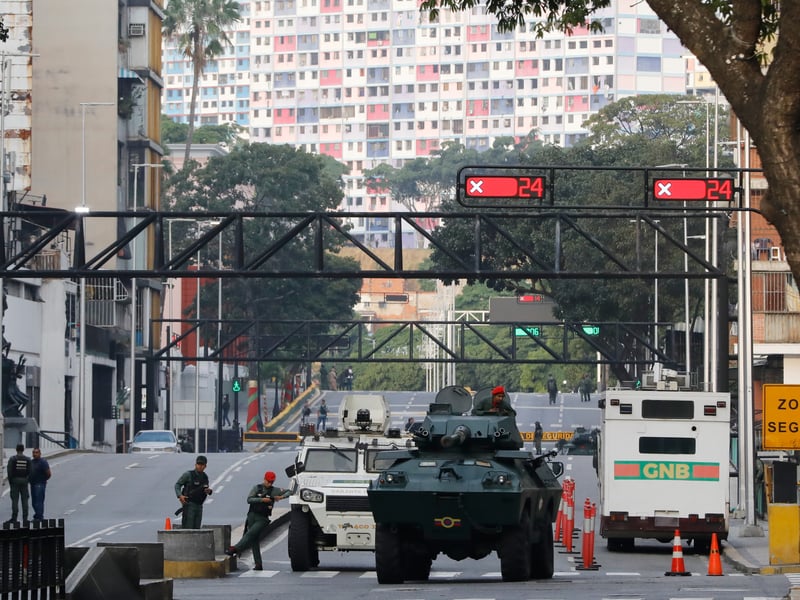
U.S. forces struck military and government facilities in Caracas around 2 a.m. Saturday, capturing Venezuelan President Nicolás Maduro and his wife before flying them via Guantanamo Bay to New York, where they face drug trafficking charges. Trump said the U.S. would “run” Venezuela indefinitely.
Asked at a European Commission — the EU’s executive arm — briefing Monday whether the operation was legal, spokesperson Anitta Hipper said it was “too early” to assess, even as she repeatedly insisted the U.N. Charter “must be upheld.”
When reporters pressed officials to at least characterize what happened, spokesperson Paula Pinho wouldn’t say: “We haven’t really discussed how we are calling it. I don’t think that that’s the most relevant.”
The commission instead framed Maduro’s removal as “an opportunity for a democratic transition led by the Venezuelan people.” Throughout the briefing, officials invoked Maduro’s lack of legitimacy as justification for not condemning the operation — effectively using the EU’s longstanding refusal to recognize his presidency as cover for avoiding a direct confrontation with Washington.
Twenty-six of 27 EU member states issued a statement Sunday calling for “calm and restraint” while emphasizing that “the principles of international law and the U.N. Charter must be upheld.” Hungary, a close Trump ally, was the lone holdout.
The statement describes the U.S. action as an “intervention” but avoids condemnation, noting only that fighting drug trafficking must respect “territorial integrity and sovereignty.”
Individual EU leaders took varied approaches. Spain’s Pedro Sánchez said Saturday the operation “violates international law,” joining Brazil, Chile, Colombia, Mexico and Uruguay in a joint statement condemning it. Germany’s Friedrich Merz said the legal assessment was “complex and requires careful consideration.”
France sent mixed signals. President Emmanuel Macron said Saturday that Venezuelans “can only rejoice” at being “rid of Nicolás Maduro’s dictatorship,” but his foreign minister Jean-Noël Barrot said the same day the operation “contravenes the principle of non-use of force that underpins international law.” Macron clarified Monday in a cabinet meeting that France “neither supported nor approved” the method.
Italy’s Giorgia Meloni said Saturday that “external military action is not the path to end totalitarian regimes” but called the operation “legitimate defensive intervention against hybrid attacks” related to drug trafficking.
Commission President Ursula von der Leyen said the EU “stands with the people of Venezuela” while insisting “any resolution must be grounded in international law.” Brussels recognizes opposition leader Edmundo González and Nobel laureate María Corina Machado as Venezuela’s legitimate leaders, not Vice President Delcy Rodríguez, who was sworn in as interim president following Maduro’s capture.
U.K.’s cautious response
The U.K. government has so far declined to say whether it believes the U.S. military action in Venezuela was legal, insisting that it is for Washington to set out the legal basis for its actions.
Prime Minister Keir Starmer confirmed Saturday that Britain had no role in the strikes or the capture of Maduro, but stopped short of condemning the operation, saying he was waiting for all the facts to emerge before commenting further.
Speaking to reporters Sunday, the prime minister added that the situation remains “complicated,” stressing that the priority is stability and a peaceful transition to democracy.
Starmer reiterated that he regarded Maduro as an illegitimate president: “We shed no tears about the end of his regime.”
The prime minister’s caution has exposed divisions within his own party.
Several Labour figures have criticized the U.S. military’s action, most prominently Emily Thornberry, the chair of the Commons Foreign Affairs Committee.
Thornberry told a radio program Sunday that the strikes were “not a legal action” and said she “cannot think of anything that could be a proper justification.”
Speaking on the program, she urged the U.K. government and its allies to defend international law.
“We condemn Putin for doing it. We need to make clear that Donald Trump shouldn’t be doing it either,” she said.
“People just can’t do whatever they want,” she added. “I mean, we really can’t have a kind of international anarchy.”
‘We need Greenland’
Brussels’ reluctance to condemn the U.S. comes as Trump over the weekend drew an explicit connection between the Venezuela operation and Greenland, an autonomous territory within EU member Denmark.
Asked Sunday about the Venezuela operation’s implications for Greenland, Trump said: “We do need Greenland, absolutely. We need it for defense.” Hours later aboard Air Force One, he told reporters: “We need Greenland from the standpoint of national security, and Denmark is not going to be able to do it.”
The remarks came after Katie Miller, wife of White House Deputy Chief of Staff Stephen Miller, posted an image on X of Greenland covered with the U.S. flag captioned “SOON” — just hours after U.S. forces captured Maduro on Saturday.
In a statement late Sunday, Danish Prime Minister Mette Frederiksen said it “makes absolutely no sense to talk about the U.S. needing to take over Greenland. The United States has no right to annex any of the three countries in the Danish Realm.”
She noted Denmark and the U.S. already have a defense agreement giving Washington extensive Greenland access, and the Danish kingdom falls under NATO security guarantees. “I would therefore strongly urge the United States to stop threatening a historically close ally and another country and people who have made it very clear that they are not for sale.”
At Monday’s briefing, commission officials insisted there was no comparison between the two situations. “Greenland is an ally to the U.S. and is also covered by the NATO alliance, and that is a big, big difference,” Hipper said.
But when pressed on Trump’s Air Force One statement that “the EU needs us to have” Greenland, officials were evasive. “Each country may be very interesting from many points of view,” Pinho said, declining to contradict Trump’s assertion.
Trump said Sunday he would address Greenland “in about two months” and to “talk about Greenland in 20 days.”
The U.N. Security Council met Monday afternoon in a contentious session that produced no formal action. U.N. officials warned the operation set a “dangerous precedent,” while Venezuela’s ambassador Samuel Moncada called the strikes an “illegitimate armed attack” that violated the U.N. Charter and Geneva Convention — which governs states’ conduct during armed conflict.
He said tolerating the “kidnapping of a head of state” would signal “the law is optional” and argued the U.S. is after Venezuela’s natural resources, not fighting drugs.
Yuval Molina is the EU correspondent for Courthouse News, based in Brussels.
Courthouse News reporter James Francis Whitehead is based in England.
Subscribe to our free newsletters
Our weekly newsletter Closing Arguments offers the latest about ongoing trials, major litigation and rulings in courthouses around the U.S. and the world, while the monthly Under the Lights dishes the legal dirt from Hollywood, sports, Big Tech and the arts.