
 Search Articles


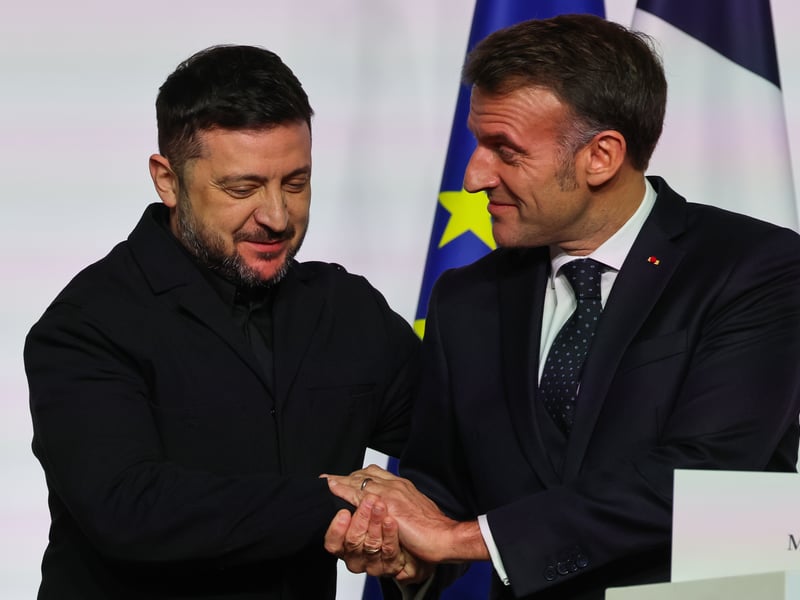
PARIS (CN) — A Tuesday meeting of 27 heads of state gathered in Paris to discuss Europe’s role in assuring a durable, lasting peace in Ukraine culminated with French President Emmanuel Macron and U.K. Prime Minister Keir Starmer pledging to send troops to Ukraine in the event of a peace deal.
“One year ago we couldn’t even [conceive of this] and now we have this step,” Ukrainian President Volodymyr Zelenskyy said during a press conference immediately after the signing, adding that there’s still work to be done. “It [will be] enough when the war in Ukraine will end.”
Macron, Starmer and German Chancellor Friedrich Merz co-chaired the meeting at the Élysée Palace. U.S. Special Envoy Steve Witkoff and Jared Kushner attended after Secretary of State Marco Rubio cancelled, likely due to the military operation in Venezuela.
The Coalition of the Willing also released a statement announcing new measures to boost support for Ukraine.
These include the participation in a new “U.S.-led ceasefire monitoring and verification mechanism,” which will help to identify potential breaches and attribute responsibility. The coalition also announced long-term military and defense support for Ukraine, binding commitments of support in the case of future Russian attacks and a new coordination cell in Paris.
“This declaration of the Coalition of the Willing, for the first time, represents an operational convergence,” Macron said during the press conference. “We want this peace to be just, durable and solid.”
Zelenskyy added that Ukraine is working on bilateral and trilateral documents that should be signed soon in various formats. He also thanked Trump and the U.S. multiple times for their support. But there was a clear shift in tone, with the word “compromise” repeatedly arising in relation to a peace deal with Russia.
“We will obviously make compromises, and we will likely not achieve the ideal peace [that we had imagined],” Merz said. “We will go about this with perseverance, and a clear view of what is best for Europe.”
After jovially greeting the crowd of reporters, and praising Macron — “thank God for you!” he said with a chuckle — Witkoff turned to the conditions of a potential peace plan.
“We heard Zelenskyy and other people here talking about land options and that will be the most critical issue,” he said. “Hopefully we will arrive at a compromise related to this.”
But what started as an Ukraine-focused summit expanded to address President Donald Trump’s threats to Greenland and broader questions about the continent’s sovereignty. This was the elephant in the room; reporters almost exclusively asked questions about Europe’s trust in the U.S. following Trump’s statements, and leaders repeatedly skirted around them.
When Starmer was asked to comment about the U.S. potentially invading a fellow member of NATO, he said that he had already made his position clear in a statement released yesterday.
“I’ve been equally clear that the relationship between the U.K. and the U.S. is one of our strongest relationships,” he added before prasing the work of the Coalition of the Willing.
When Macron was asked how the French could still have confidence in Americans after Trump’s actions in Venezuela, he responded that Witkoff and Kushner’s presence in Paris on Tuesday marked a new step in relations, and that Europe has been working on boosting its sovereignty for years anyway.
As leaders arrived earlier throughout the day, Macron, Starmer, Merz and the prime ministers of Italy, Poland, Spain and Denmark released a joint statement on Greenland.
“NATO has made clear that the Arctic region is a priority and European Allies are stepping up,” they said. The statement called on the U.S. to respect sovereignty and territorial integrity.
“Greenland belongs to its people,” leaders said in the statement, adding that only Denmark and Greenland can decide the territory’s future.
The five Nordic foreign ministers issued a separate statement citing Denmark’s 1951 defense agreement with the U.S. and offering to increase Arctic investments “in close consultation with the United States.”
The summit shifted focus after Trump removed Venezuelan leader Nicolás Maduro on Saturday, then threatened to take Greenland and other territories.
“We need Greenland from the standpoint of national security,” Trump told reporters Sunday. “Right now, Greenland is covered with Russian and Chinese ships all over the place.”
European leaders are walking a diplomatic tightrope: they need Washington’s backing to end the war in Ukraine, but Trump is threatening Greenland using the same sovereignty principles they’re defending in Kyiv.
Macron wants Trump to commit in writing to provide intelligence, ceasefire monitoring and other support as a backstop for European peacekeeping forces. Without U.S. involvement, officials say, any security guarantees won’t deter Russia.
European leaders see keeping Trump engaged on Ukraine as paramount — treating disputes over Greenland, Venezuela and recent sanctions on EU officials as distractions they cannot afford to let derail the fragile cooperation.
The meeting comes weeks after EU leaders’ all-night December summit yielded a 90 billion-euro loan for Ukraine through joint EU borrowing, after Trump administration pressure forced them to abandon plans to use frozen Russian assets.
Courthouse News reporter Lily Radziemski is based in Paris.
Yuval Molina is the EU correspondent for Courthouse News, based in Brussels.
 Follow @lilyradz
Subscribe to our free newsletters
Our weekly newsletter Closing Arguments offers the latest about ongoing trials, major litigation and rulings in courthouses around the U.S. and the world, while the monthly Under the Lights dishes the legal dirt from Hollywood, sports, Big Tech and the arts.