
 Search Articles


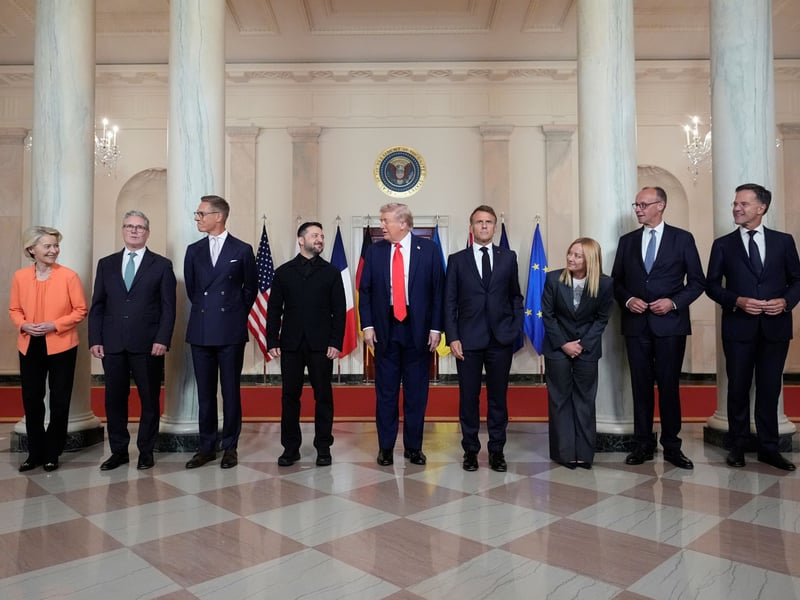
BRUSSELS (CN) — European leaders held back-to-back summits Tuesday to coordinate their response to U.S. President Donald Trump’s commitment to provide Ukraine with security guarantees during high-stakes Washington meetings with Ukrainian President Volodymyr Zelenskyy.
The talks reflected European determination to build on what leaders described as a diplomatic shift. After initial concerns about Trump’s approach following his Alaska summit with Russian President Vladimir Putin Friday, EU officials expressed cautious optimism about the United States’ renewed engagement in Ukraine’s future security arrangements.
More than 30 allies joined a virtual “Coalition of the Willing” meeting Tuesday morning, followed by an extraordinary EU summit in the early afternoon. Both sessions focused on Trump’s Monday pledge to provide Ukraine with security guarantees — a commitment European leaders hailed as transformative despite Trump’s well-documented history of reversing course.
Trump on Tuesday said U.S. troops would not be sent to Ukraine to defend against Russia, after seeming to leave open the possibility the day before. He also said in a morning TV interview that Ukraine’s hopes of joining NATO and regaining Crimea are “impossible.”
The theatrical nature of Monday’s diplomacy was unmistakable. European leaders had rushed to Washington fearing Trump might browbeat Ukraine into territorial concessions, forming what officials described as a protective wall around Zelenskyy. Instead, they watched choreographed displays of unity that masked limited concrete achievements.
Despite the careful staging, substantive gaps remained apparent. Security guarantee details remain undefined, ceasefire prospects appear distant and uncertainty persists about whether any Putin-Zelenskyy summit will materialize.
The next two weeks will be “absolutely critical” to turn Trump’s vague promises into binding guarantees, French President Emmanuel Macron told French broadcaster LCI Tuesday from Washington. Zelenskyy said security arrangements would be “formalized on paper within the next week to 10 days,” while German Chancellor Friedrich Merz reported Trump and Putin agreed to meet “within the next two weeks.”
The overlapping deadlines reflect Europe’s awareness that Trump’s commitments may not last. Leaders are racing to secure agreements before the president shifts course — a recurring theme of transatlantic relations since his return to office.
Relief meets diplomatic reality
Merz said his “skeptical” expectations had been “more than met,” while Dutch Prime Minister Dick Schoof described himself as “cautiously optimistic.” NATO Secretary-General Mark Rutte called Trump’s willingness to even discuss security guarantees “a breakthrough.”
Behind the diplomatic theater, European leaders are preparing to act. Macron revealed Tuesday that “the British, French, Germans, Turks and others are ready to carry out operations, not at the front line, not provocatively, but reassurance operations in the air, at sea and on land.”
Trump may make the promises, but Europeans expect to provide the deterrent force.
As Trump promotes bilateral Putin-Zelenskyy talks followed by a trilateral summit, Macron is pushing Geneva as the venue. Italian Foreign Minister Antonio Tajani endorsed the idea, and Swiss Foreign Minister Ignazio Cassis said Putin would be shielded from arrest despite an ICC warrant.
Lost in European relief is Ukraine’s increasingly absurd diplomatic position: Kyiv must negotiate peace with Putin, whom it cannot trust, while depending on Trump, whom it also cannot trust. Ukrainian officials privately acknowledge this paradox while publicly maintaining optimism.
Zelenskyy’s careful preparation for Monday’s meeting reflected lessons learned from his disastrous February encounter with Trump, when the Ukrainian leader faced public criticism before leaving the White House abruptly. This time, he arrived with symbolic gifts and formal attire, recognizing that managing Trump’s mercurial personality has become as crucial as battlefield strategy.
Despite the public optimism, European leaders harbor deep skepticism about Russian intentions. Macron warned against “taking the Kremlin at its word,” describing Russia as “a destabilizing force” and “a predator, an ogre at our door.”
The French president emphasized the need to ensure Ukraine has “sufficient deterrence power not to be attacked again” — a recognition that any peace deal must be backed by credible military force.
European officials also faced pushback from Trump on their preferred sequencing. While EU leaders stressed the importance of establishing a ceasefire before substantive negotiations, Trump dismissed the idea, telling reporters he didn’t believe a preliminary truce was necessary.
Moscow dampens European optimism
While European leaders rushed to build on Monday’s diplomatic momentum, Moscow quickly moved to temper expectations. Russian Foreign Minister Sergey Lavrov said Tuesday that any summit would need to be prepared “step by step, gradually, starting from the expert level and then going through all the necessary stages” — a marked contrast to the European urgency for immediate progress.
“Any contacts involving top officials must be prepared with the utmost care,” said Lavrov.
The response follows a familiar Russian pattern of agreeing in principle while stalling in practice. In May, Putin suggested a meeting with Zelenskyy for peace talks, only to send a second-tier delegation instead. This time, despite Trump’s enthusiasm after their phone call, Kremlin aide Yuri Ushakov offered only cautious language about “raising the level of direct Russian-Ukrainian negotiations.”
Even optimistic European leaders acknowledged the uncertainty. Merz, despite reporting that Trump and Putin had agreed to meet, admitted doubt: “We don’t know whether the Russian president will have the courage to attend such a summit.”
Moscow’s message remained clear: Russia is willing to talk about talks, but not to commit to summits.
Behind the diplomatic celebrations, EU leaders are deploying their own substantial leverage tools: providing military support for Ukraine immediately, opening EU accession talks this September with 2030 as the target date, urgently proceeding with a 19th package of sanctions, and using frozen Russian assets to fund Ukraine’s recovery.
The discussions come as Europe has taken the lead in military support for Ukraine, according to the Kiel Institute’s Ukraine Support Tracker. The German research institute found that Europe has allocated at least 35.1 billion euros ($38.26 billion) in military aid through defense procurement contracts — 4.4 billion euros ($4.8 billion) more than the United States.
Recent European contributions include Germany’s 5-billion-euro ($5.45 billion) military aid package, Norway’s 1.5 billion euros ($1.64 billion) and Belgium’s 1.2 billion euros ($1.31 billion). Meanwhile, for the first time since the Trump administration began, America approved major arms exports to Ukraine in May — but as sales that Kyiv must finance itself, not as military aid, the Kiel Institute reported.
The potentially transactional nature of Trump’s security commitments emerged Tuesday with reports that Ukraine has proposed purchasing $100 billion worth of American weapons financed by Europe in exchange for U.S. security guarantees, according to the Financial Times. The reported proposal also includes a $50 billion deal for Washington and Kyiv to jointly produce drones with Ukrainian companies.
That pledge comes on top of Kyiv’s earlier rare earths trade deal with Washington — a bid to lock the U.S. into Ukraine’s long-term economic and strategic orbit by dangling access to critical minerals.
If those details are accurate, the arms package would reveal the economic calculations behind Trump’s diplomatic “breakthrough.”
While European leaders celebrate America’s renewed engagement, they could ultimately finance both Ukraine’s weapons purchases and their own military commitments to secure the country — effectively paying twice for the same security outcome.
The “Coalition of the Willing” brings together more than 30 countries outside formal NATO structures to coordinate Ukraine support. The European Council represents the EU’s top decision-making body, where all 27 member nation leaders hash out major policy. Both forums are increasingly where Europe works around U.S. volatility to manage Ukraine’s future.
The diplomatic performances will likely continue as European leaders navigate the gap between public optimism and private concerns about U.S. reliability. Tuesday’s summits revealed a continent adapting to a new reality: celebrating incremental progress while building the infrastructure to secure Ukraine’s future — with or without reliable American support.
Courthouse News correspondent Yuval Molina Obedman is based in Brussels, Belgium.
Subscribe to our free newsletters
Our weekly newsletter Closing Arguments offers the latest about ongoing trials, major litigation and rulings in courthouses around the U.S. and the world, while the monthly Under the Lights dishes the legal dirt from Hollywood, sports, Big Tech and the arts.