
 Search Articles


BRUSSELS (CN) — A growing rebellion across European institutions is threatening to torpedo President Donald Trump’s trade deal with the EU, as lawmakers and even senior EU government officials openly challenge what critics call a “capitulation” that has failed to deliver promised stability.
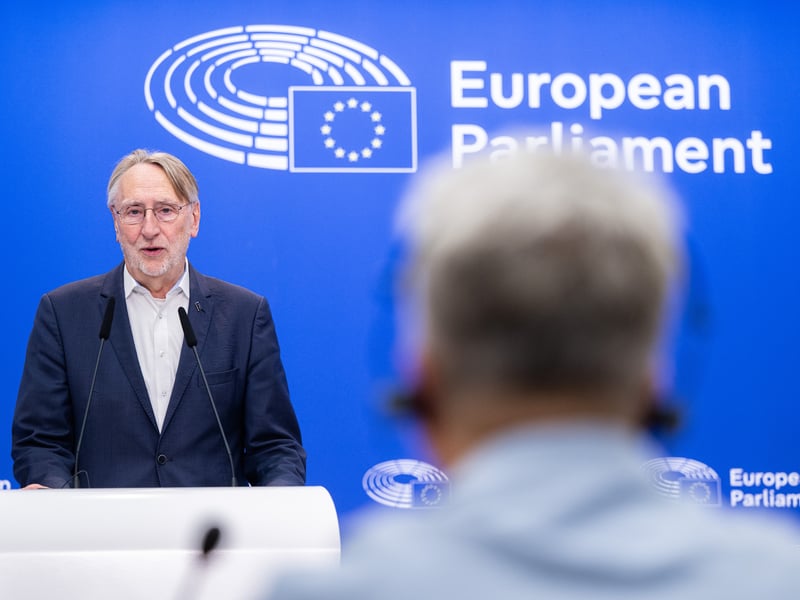
“There is no security and predictability” from the July agreement, said Bernd Lange, chair of the European Parliament’s trade committee, as the revolt intensified Wednesday. Following an extraordinary committee meeting, Lange announced plans to table amendments that could fundamentally alter the deal, highlighting mounting anger among lawmakers who must approve the legislation for it to take effect.
“In the face of those who brandish tariffs as a weapon of blackmail, the EU can no longer submit,” French liberal lawmaker Marie-Pierre Vedrenne wrote on X, capturing the bitter mood among parliamentarians across the political spectrum.
But resistance is no longer confined to Parliament — cracks are appearing within the commission, the EU’s executive arm. Executive Vice President Teresa Ribera, the EU’s second-most powerful official, openly challenged the institutional response on Friday, pushing Europe to be “courageous” and “avoid the temptation of being subordinated to others’ interests.”
On Aug. 26, just weeks after European officials thought they had secured trade peace, Trump posted explicit threats on Truth Social, warning countries with “Digital Taxes, Digital Services Legislation and Digital Markets Regulations” would face “substantial additional Tariffs” and restrictions on “Highly Protected Technology and Chips.”
His message: “America, and American Technology Companies, are neither the ‘piggy bank’ nor the ‘doormat’ of the World any longer.”
“The EU should reassess the trade deal if Trump follows through on his digital regulation threats,” said Ribera, who is also the EU’s top competition official. “We cannot be subject to the will of a third country.”
But those threats are already reshaping European policy. According to reports, Trade Commissioner Maroš Šefčovič — the EU’s chief trade negotiator — intervened Monday to block a planned antitrust penalty against Google over its search advertising practices, overruling Ribera despite years of investigation.
Since 2021, Brussels has investigated Google’s ad monopoly, demanding divestiture by 2023.
The Google intervention has triggered fierce backlash from lawmakers who see it as proof of their worst fears. Some lawmakers, like Vedrenne, are calling for activation of the EU’s anti-coercion instrument — the bloc’s so-called “trade bazooka” that allows retaliation against countries using economic pressure to force policy changes — against Trump’s threats.
Member of the European Parliament (MEP) Leila Chaibi, a fellow French leftist, denounced a “shameful betrayal on Washington’s orders by the European Commission, which cancels the announcement of a fine against Google” just “one month after swearing that the agreement with Trump would not affect the digital sector.”
Even center-right politicians have joined the criticism, with German MEP Andreas Schwab, a European People’s Party politician who helped draft the Digital Markets Act, arguing that “a decision in a specific competition case should not be politicized.”
The divide reflects Europe’s broader struggle with how to respond to Trump’s “America First” agenda. The pattern extends beyond trade into digital regulation, where the EU has effectively frozen enforcement of its flagship tech laws against American companies. Despite ongoing investigations into X, Meta, Apple and Google under the Digital Services Act, no major decisions have been concluded since Trump’s threats intensified.
The contradiction in the commission’s position became apparent when Šefčovič insisted Wednesday that “technological sovereignty was never debatable” and legislative autonomy “was always the paramount importance” — even as critics pointed to his intervention in the Google case as evidence of exactly the opposite.
Former EU digital chief Thierry Breton, no longer constrained by official diplomatic language, has emerged as one of the fiercest critics of European “capitulation.” In a blistering editorial across European media, he argued that Europe accepted unnecessarily harsh terms compared to other major trading partners who negotiated more aggressively with Trump.
Breton framed the stakes in existential terms, arguing that surrendering regulatory control over digital space would be “a historic abdication of the public sphere, of political will, of the democratic promise.” His rallying cry — “enough is enough, es reicht, ça suffit, adesso basta” — captured the multilingual frustration building across European capitals.
French Prime Minister François Bayrou called it “a dark day when an alliance of free peoples resigns itself to submission.” Spanish Prime Minister Pedro Sánchez said he would support the deal “without any enthusiasm,” while Swedish Trade Minister Benjamin Dousa described it as “maybe the least bad alternative.”
On the other side stand pragmatists who view the 15% baseline tariff as an unpalatable but necessary compromise to avoid economic catastrophe. German Chancellor Friedrich Merz welcomed the agreement as avoiding a trade conflict that would have devastated his country’s automotive sector.
Trump’s tariff authority questioned
The institutional rebellion comes as the legal foundation for Trump’s trade threats faces unprecedented challenge. Friday’s U.S. appeals court ruling that most of Trump’s tariffs are illegal has undermined his negotiating leverage, though the decision remains under Supreme Court review.
The 7-4 ruling specifically targeted Trump’s “reciprocal tariffs” — including the 15% baseline rate that applies to European goods under the July trade deal — as well as separate “trafficking tariffs” on China, Canada and Mexico. The court found that Trump exceeded his authority under the International Emergency Economic Powers Act when he declared trade deficits and drug trafficking to be national emergencies justifying sweeping import taxes.
Crucially, the decision does not affect tariffs imposed under other legal authorities, such as the steel and aluminum duties that have been expanded to cover hundreds of additional European products. This means that while the court ruling undermines the legal basis for the EU trade deal’s central 15% tariff rate, other punitive measures against European exporters remain intact.
Meanwhile, Brussels has begun implementing its side of the bargain, introducing legislation to eliminate tariffs on U.S. industrial goods — but Washington has yet to reciprocate with promised automatic tariff cuts on European cars from Aug. 1. The delay reinforces critics’ arguments that accommodating Trump doesn’t produce the stability European leaders promised.
The political stakes extend beyond trade. The deal has become a proxy battle over Europe’s strategic autonomy and its willingness to challenge American dominance. Critics argue that accepting Trump’s terms — including commitments to buy $750 billion in American energy and invest $600 billion in the U.S. — makes Europe a junior partner in the relationship.
European business groups remain split. Airlines and aerospace companies, which secured zero tariffs under the deal, have praised the agreement. But manufacturers facing new steel and aluminum penalties are furious, with some warning they may have to close factories.
The rebellion also reflects deeper European frustrations with Trump’s volatile leadership style. Many lawmakers expected the agreement to provide stability, only to see Trump issue new threats within days of signing it. The Google case illustrates how those threats are already constraining European sovereignty in areas beyond trade, as officials second-guess enforcement actions to avoid provoking Washington.
Under the July agreement, the EU accepted a 15% baseline tariff on European goods entering the United States — higher than the 10% rate initially proposed but lower than the 30% Trump had threatened. The deal also commits the EU to eliminating tariffs on most U.S. industrial products while providing quotas for American agricultural goods.
The EU-U.S. economic relationship represents $1.7 trillion in annual trade, making it one of the world’s largest trading partnerships. The Parliament’s decision will determine whether the agreement moves forward or whether mounting political opposition derails the pact that took months of difficult negotiations to achieve.
Courthouse News correspondent Yuval Molina Obedman is based in Brussels.
Subscribe to our free newsletters
Our weekly newsletter Closing Arguments offers the latest about ongoing trials, major litigation and rulings in courthouses around the U.S. and the world, while the monthly Under the Lights dishes the legal dirt from Hollywood, sports, Big Tech and the arts.