
 Search Articles


BRUSSELS (CN) — European leaders scrambled Monday to respond to a weekend assault from Washington that won praise from Moscow, exposing divisions over how to counter an increasingly hostile U.S. administration.
The crisis unfolded over four chaotic days. Late Thursday, the Trump administration released a National Security Strategy attacking Europe over “civilizational erasure.” Friday brought a $140 million EU fine against Elon Musk’s X platform, escalating the fight. By Sunday, the Kremlin was welcoming the U.S. approach as “consistent with our vision.”
The varied responses underscored a troubling dynamic: A U.S. strategy document that explicitly endorses Europe’s far-right parties while echoing Kremlin talking points has left European leaders uncertain whether to confront Washington, accommodate it or simply hope the storm passes.
European Commission — the EU’s executive arm — President Ursula von der Leyen stayed silent through the weekend before finally speaking Monday evening, but she took a defensive stance rather than directly confronting the attacks. “Russia’s brutal war sought to divide us, but it has achieved the opposite,” she said in remarks following a virtual meeting of the “Coalition of the Willing,” a group of European leaders coordinating support for Ukraine. “Our ties are stronger than ever.”
The dilemma was sharpest on Russia, where Trump claimed Moscow is cooperating on peace, while von der Leyen insists the Kremlin “repeatedly deceives and stalls for time … mocking diplomacy and increasing strikes while pretending to seek peace.”
The EU’s foreign policy chief, Kaja Kallas, had offered a notably weaker response on Saturday, refusing to criticize the U.S. attacks and saying only that Europeans “should be more self-confident.”
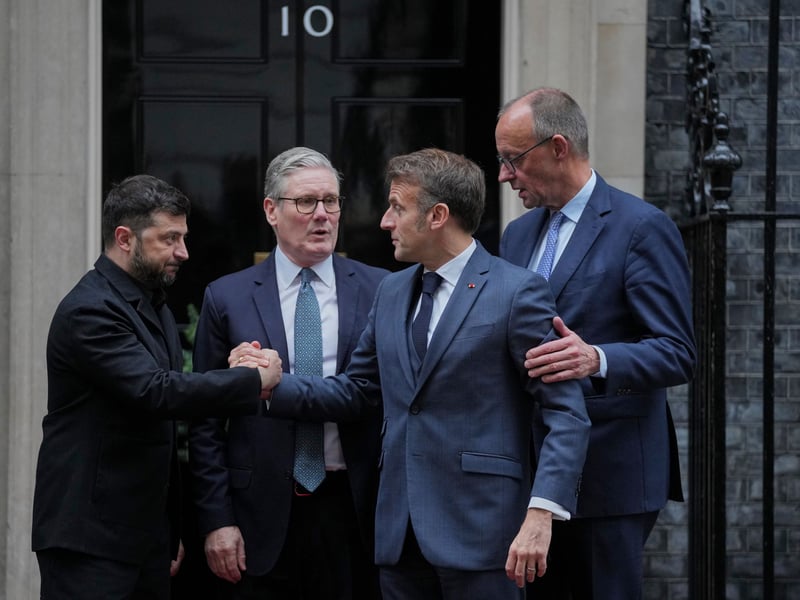
Before going behind closed doors, Ukrainian President Volodymyr Zelenskyy met with British Prime Minister Keir Starmer, German Chancellor Friedrich Merz and French President Emmanuel Macron in London. “We have a lot of cards in our hands,” Macron told British reporters, while Merz offered a more cautious approach, saying he was “skeptical” about “some of the details coming in the documents from the U.S. side.”
The meetings came as Zelenskyy made clear significant gaps remain in peace negotiations. “We don’t have a unified view on Donbas” between the U.S., Russia and Ukraine, referring to the occupied eastern region. More critically, Ukraine still lacks the security guarantees it’s demanding. “There is one question I — and all Ukrainians — want to get an answer to: if Russia again starts the war, what will our partners do?”
Zelenskyy described Monday’s talks in London as “small progress towards peace,” announcing a Ukraine-Europe plan for a peace deal will be shared with Washington by Tuesday. He then traveled to Brussels for separate evening meetings with EU and NATO leadership, including von der Leyen, NATO Secretary General Mark Rutte and European Council President António Costa.
The tensions coincide with ongoing disputes within the EU over a controversial mechanism to use interest earnings from frozen Russian central bank reserves to back billions in loans for Ukraine, adding to the pressure on European leaders to demonstrate unity on support for Kyiv.
Washington’s offensive
The Trump administration’s National Security Strategy, released Thursday, marked a sharp departure from previous U.S. approaches to Europe. The 33-page document blamed the European Union and immigration for pushing the continent toward cultural collapse. It accused Brussels of undermining democracy, criticized migration policies for “transforming the continent and creating strife,” and warned of “censorship of free speech,” “cratering birthrates” and “loss of national identities.”
The document went further, openly cheering on Europe’s far-right movements. “America encourages its political allies in Europe to promote this revival of spirit, and the growing influence of patriotic European parties indeed gives cause for great optimism,” it stated. The strategy pledged to “cultivate resistance” within Europe and help the continent “correct its current trajectory.”
“Allies do not threaten to interfere in the democratic life or the domestic political choices of these allies,” Costa — who chairs meetings of EU national leaders — told a Paris conference on Monday. “The United States cannot replace European citizens in deciding which are the right parties and the wrong parties,” warning that critical comments from U.S. officials are no longer “isolated outbursts but now constitute the doctrine of the United States.”
Louise van Schaik, head of EU and Global Affairs at the Clingendael Institute in The Hague, told Courthouse News the EU “shows leadership when it continues to stand behind its policies” on tech regulation and trade rather than picking public fights with Washington. Von der Leyen’s silence on the NSS “is also part of this smart diplomatic behavior,” she argued. “This disables the U.S. [by] playing a divide and rule strategy.”
The Kremlin welcomed the document, embracing language that effectively blamed Europe’s problems on its own lack of self-confidence rather than Russian aggression. The new U.S. approach was “largely consistent with our vision” and could help advance “joint work on finding a peaceful settlement in Ukraine,” spokesperson Dmitry Peskov told Russian media Sunday. He praised Trump as “strong” enough to reshape American foreign policy, noting the document doesn’t call Russia an adversary as previous versions did.
The strategy slammed Europe for having “unrealistic expectations” about the Ukraine war and suggested they’re getting in the way of peace talks. It also signaled Trump wants to stop NATO expansion, aiming to end “the perception, and preventing the reality, of NATO as a perpetually expanding alliance.”
Trump turned up the heat on Ukraine Sunday night, telling reporters he was “a little bit disappointed that President Zelenskyy hasn’t yet read the proposal” for a U.S.-backed peace plan. Russia was “fine with it,” but Zelenskyy was holding things up, Trump claimed, adding that “his people love it. But he isn’t ready.”
The comments came after three days of talks in Florida between U.S. and Ukrainian officials that ended Saturday without a breakthrough. Trump envoy Steve Witkoff and the president’s son-in-law, Jared Kushner, had brought a revised peace proposal to Moscow the week before, then continued negotiations with Ukrainian representatives in Miami.
His son piled on at a conference in Qatar the same day. “I think he may” walk away from Ukraine, Donald Trump Jr. told the Doha Forum when asked if the president could abandon the country without a peace deal.
The X platform blowup
The crisis deepened Friday when Brussels dropped another bombshell: a €120 million ($140 million) fine against Musk’s X for breaking Europe’s new social media rules. Coming just hours after Washington’s security strategy, the penalty — the first under the Digital Services Act — further polarized an already explosive transatlantic debate.
Brussels said X broke the rules by running a “deceptive” blue checkmark system that lets anyone buy verification without proving their identity, keeping a lousy advertising database that makes it hard to spot scams and fake political ads, and blocking researchers from accessing public data.
U.S. Ambassador to the EU Andrew Puzder called the fine “regulatory overreach targeting American innovation” on Saturday. Secretary of State Marco Rubio went further, calling it “an attack on all American tech platforms and the American people by foreign governments.”
Musk fired back by shutting down the European Commission’s advertising account on X, then spent the weekend on a posting spree comparing the EU to Nazi Germany and demanding the bloc be “abolished.”
On Monday, commission spokesperson Paula Pinho dismissed Musk’s attacks as “completely crazy statements” protected by free speech, insisting “the fine reflects non-compliance with law. It is not about ideology.”
While TikTok and Meta have made compliance commitments, “X and Elon Musk seem to be entirely uninterested in complying with European laws,” Jan Penfrat, senior policy advisor at European Digital Rights, told Courthouse News. X risks losing access to a market of roughly 106 million monthly users if it continues refusing to comply with EU rules.
“Every month that compliance is delayed is a month in which the companies can pose a risk to our online public debate and to democracy,” warned Penfrat.
The weekend’s events have crystallized a dilemma European leaders have tried to avoid: whether to treat Trump’s administration as a wayward ally requiring patience or as a hostile actor demanding confrontation. European officials say consultations continue, but the disputes over frozen assets and the gaps in Ukraine peace talks suggest consensus remains elusive.
Courthouse News correspondent Yuval Molina is based in Brussels, Belgium.
Subscribe to our free newsletters
Our weekly newsletter Closing Arguments offers the latest about ongoing trials, major litigation and rulings in courthouses around the U.S. and the world, while the monthly Under the Lights dishes the legal dirt from Hollywood, sports, Big Tech and the arts.