
 Search Articles


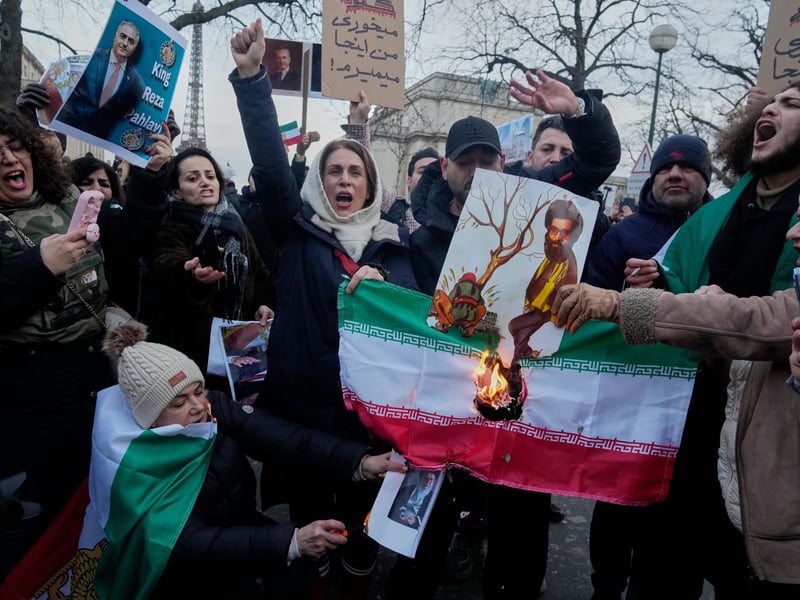
BRUSSELS (CN) — The European Union on Thursday designated Iran’s Islamic Revolutionary Guard Corps as a terrorist organization, joining the United States in blacklisting the powerful military force alongside al-Qaida and Hamas, following the violent suppression of protests that erupted in late December over soaring inflation.
The EU moved after France dropped years of opposition, prompted by a crackdown on protesters that rights groups say has killed more than 6,000 people — with thousands more deaths still under review. It aligns Europe with Washington on one of the thorniest issues in Western policy toward Tehran.
The decision came as tensions between Washington and Tehran near a breaking point. President Donald Trump has deployed an aircraft carrier to the Persian Gulf and threatened military strikes. Iranian Foreign Minister Abbas Araghchi warned Wednesday that his country’s forces have their “fingers on the trigger.”
“Europe is busy fanning the flames,” Araghchi wrote on X Thursday after the announcement. He warned Europe would suffer from surging energy prices if regional conflict escalates, describing the designation as a “PR stunt.”
Tehran has also threatened “destructive consequences” over the designation, and Iran’s parliament has drafted legislation to label all EU militaries as terrorist organizations in retaliation.
French Foreign Minister Jean-Noel Barrot announced Paris’ support Wednesday, citing the “unbearable repression of the peaceful uprising of the Iranian people.”
His announcement came hours before EU foreign ministers met Thursday in Brussels, following similar shifts by Italy and Spain, the other major holdouts. Germany led the push for the designation.
EU foreign policy chief Kaja Kallas said the holdouts shifted once the scale of the crackdown became undeniable. “There was an internet ban and everything was not clear what has happened,” she said after the meeting. “And when the atrocities were clear, then it was clear that there has to be a very strong response from the European side.”
“Those who operate through terror must be treated as terrorists,” Kallas told reporters after the meeting.
Some ministers had been more cautious before the vote. Belgian Foreign Minister Maxime Prévot said he hoped for a result “by the end of the day” but acknowledged it might come later. German Foreign Minister Jörg Wadephul warned that “so far we don’t see that Tehran has understood what the situation is.”
The decision required unanimous approval from all 27 member states.
The EU also imposed asset freezes and travel bans on 15 individuals and six entities for what it called “serious human rights violations” following the violent suppression of protests. Those sanctioned include Interior Minister Eskandar Momeni, Prosecutor General Mohammad Movahedi-Azad, presiding judge Iman Afshari and multiple Revolutionary Guard commanders. The EU also targeted entities involved in internet censorship and surveillance, including the Iranian Audio-Visual Media Regulatory Authority and the Seraj Cyberspace Organization.
“The EU expresses its solidarity with the Iranian people as they voice their legitimate aspiration for freedom and dignity,” a Council statement said.
The protests triggered what rights groups describe as one of the bloodiest crackdowns in Iran since the 1979 Islamic Revolution. The U.S.-based Human Rights Activists News Agency confirmed at least 6,373 deaths, including 5,993 protesters, with an additional 17,091 cases still under review — suggesting the final toll could be far higher. Iran’s government puts the death toll at 3,117, saying most were civilians and security forces killed by what it calls “terrorists.”
The Revolutionary Guard was established after the 1979 revolution and answers directly to Supreme Leader Ayatollah Ali Khamenei. It controls Iran’s ballistic missile and nuclear programs and commands between 125,000 and 190,000 troops, according to the U.S. National Counterterrorism Center.
Kallas said she had weighed concerns that the designation could hamper diplomatic relations. “These risks have been calculated,” she said, adding that diplomatic interactions with Iran’s foreign minister would not be affected. “The estimate is that diplomatic channels will remain open, even after the listing of the Revolutionary Guard.”
“The losses suffered by the civilian population during the protests demand a clear response,” Italian Foreign Minister Antonio Tajani said Monday in announcing Italy’s support for the measure.
The designation triggers asset freezes on guard members and entities, bans Europeans from providing funds or support to the organization and imposes travel restrictions. It also makes it a criminal offense to belong to the guard, support the group, attend its meetings or display its logo in EU territory.
The United States designated the group as a terrorist organization in 2019 during Trump’s first term. Canada followed in 2024 and Australia in November 2025.
The EU also imposed measures Thursday on four individuals and six entities linked to Iran’s support for Russia’s war against Ukraine, targeting the country’s drone and missile programs. Those sanctioned include Khojir Missile Development and Production, a leading entity in Iran’s ballistic missile program, and Sahara Thunder, described as a front company for Iran’s Ministry of Defense. A total of 24 individuals and 26 entities are now sanctioned under this regime.
The EU first introduced sanctions against Iran for human rights violations in 2011, renewing them annually. Since October 2022, the bloc has drastically increased sanctions in response to the deteriorating rights situation, including the September 2022 death in police custody of 22-year-old Mahsa Amini, which sparked earlier waves of protest.
The EU’s restrictive measures on Iran for human rights violations now apply to 247 individuals and 50 entities.
Still, the practical economic impact of Thursday’s designation may be limited. Iran is already under sweeping U.N. sanctions reimposed in September 2025 after Britain, France and Germany triggered the “snapback” mechanism in the 2015 nuclear deal, restoring restrictions that had been lifted under the agreement.
The designation also effectively signals the end of European efforts to revive the 2015 Iran nuclear deal, from which Trump withdrew during his first presidency. Trump has in recent weeks said U.S. naval forces in the region were prepared to act, raising concerns in Europe about escalating tensions and sending oil prices above $70 per barrelon fears of supply disruptions.
Tensions between Washington and Tehran escalated sharply in June 2025 when the U.S. and Israel launched a 12-day military campaign against Iran, striking nuclear facilities and military sites. The attacks killed top Revolutionary Guard commanders including leader Hossein Salami and dealt severe damage to Iran’s nuclear program.
Courthouse News correspondent Yuval Molina is based in Brussels, Belgium.
Subscribe to our free newsletters
Our weekly newsletter Closing Arguments offers the latest about ongoing trials, major litigation and rulings in courthouses around the U.S. and the world, while the monthly Under the Lights dishes the legal dirt from Hollywood, sports, Big Tech and the arts.