
 Search Articles


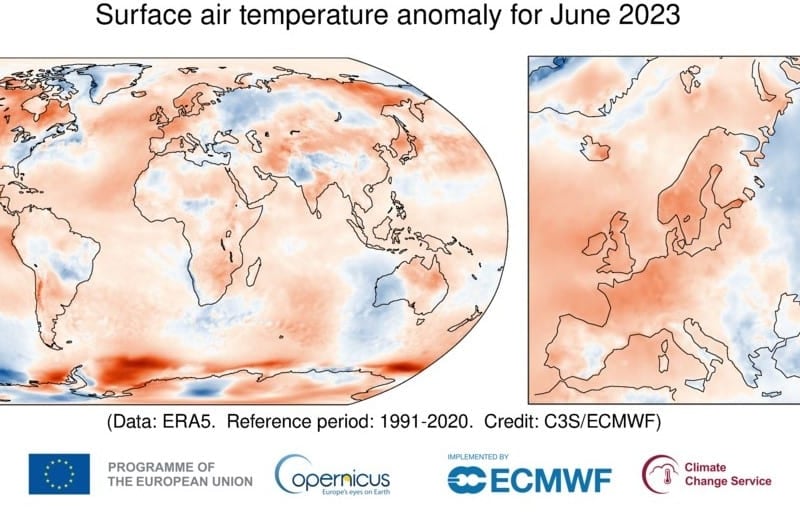
(CN) — The world experienced its hottest June ever recorded, a troubling sign as an El Niño weather pattern kicks in and supercharges the planet’s already warming atmosphere, according to the European Union’s climate change agency.
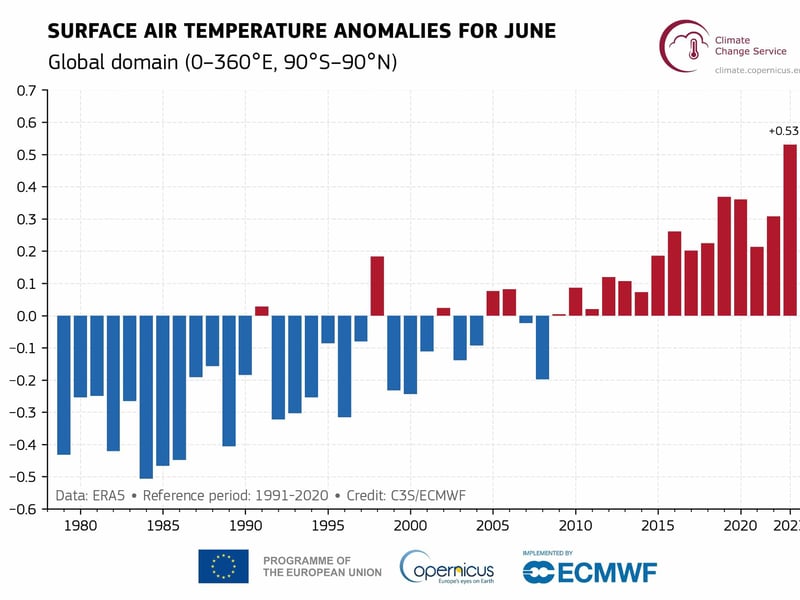
The planet’s surface air last month was measured at just over 0.5 degrees Celsius or 0.9 degrees Fahrenheit above the average temperature for June going back to 1991, a 30-year baseline that Copernicus Climate Change Service uses for its calculations.
June’s average global temperature far exceeded the previous record set in 2019, Thursday’s report said. Copernicus scientists warn this year, and several more to come, are on track to become the hottest ever measured due to the emergence of El Niño.
Copernicus is an EU science agency that monitors the climate and the effects of human-caused global warming. It bases its measurements on a fleet of satellites and billions of readings at weather stations around the planet.
Globally, June also saw the warmest sea surface temperatures than any previous June on record, continuing a trend that started in May when Copernicus measured the warmest sea surface temperatures ever for that month.
Seas in the North Atlantic were exceptionally warm, with marine heatwaves affecting Ireland, the United Kingdom and the Baltic Sea, it said.
In the meantime, an El Niño weather pattern is emerging for the first time in seven years in the tropical eastern Pacific Ocean, and it has strengthened. It is a naturally occurring phenomenon, and in the past it has led to record heat while also causing drought in some parts of the world and heavy rains in others. Scientists are concerned this El Niño cycle may make the next few years among the hottest and most extreme ever on record.
“These exceptional conditions in the north Atlantic highlight the complexity of the Earth system, and remind us of the importance of monitoring the global climate in near real time,” said Copernicus Director Carlo Buontempo.
Copernicus said heat records for June were broken in north-western Europe and parts of Canada, the United States, Mexico, Asia and eastern Australia were significantly warmer than normal.
It got so hot in the first two weeks of June that some schools in parts of the United States — the Northeast, Mid-Atlantic and Great Lakes areas — decided to close or send students home early. A heat wave around the same time broke temperature records in Puerto Rico with the heat index, a measure of how temperatures feel to the human body, reaching 125 degrees Fahrenheit on parts of the island.
At the end of June, a so-called “heat dome” descended on Texas, Louisiana and Mississippi and caused the deaths of at least a dozen people. Blistering temperatures also hit northern Mexico, where temperatures surpassed 121 degrees Fahrenheit.
A recent report from the public policy research group Center for American Progress estimates extreme heat will amount to $1 billion in healthcare-related costs in the United States this summer and cause nearly 235,000 emergency department visits.
Hot and dry conditions this June have played a major factor in massive wildfires in Canada that have blanketed many American cities in smoke.
Elsewhere, the heat was unbearable too. Since mid-June, northern parts of China have been baking with temperatures reaching over 104 degrees Fahrenheit.
Copernicus also measured the lowest extent of sea ice in the Antarctic for June since satellite observations began. It said the expanse of sea ice was 17% below average, breaking the previous June record by a substantial margin.
The release of huge volumes of carbon emissions since the start of the industrial age has caused the planet to warm; scientists estimate that temperatures are nearly 2.2 degrees Fahrenheit higher on average than in the mid-1800s. Global warming is increasingly linked to extreme weather, drought and ecological disruption.
Courthouse News reporter Cain Burdeau is based in the European Union.
 Follow @cainburdeau
Subscribe to our free newsletters
Our weekly newsletter Closing Arguments offers the latest about ongoing trials, major litigation and rulings in courthouses around the U.S. and the world, while the monthly Under the Lights dishes the legal dirt from Hollywood, sports, Big Tech and the arts.