
 Search Articles


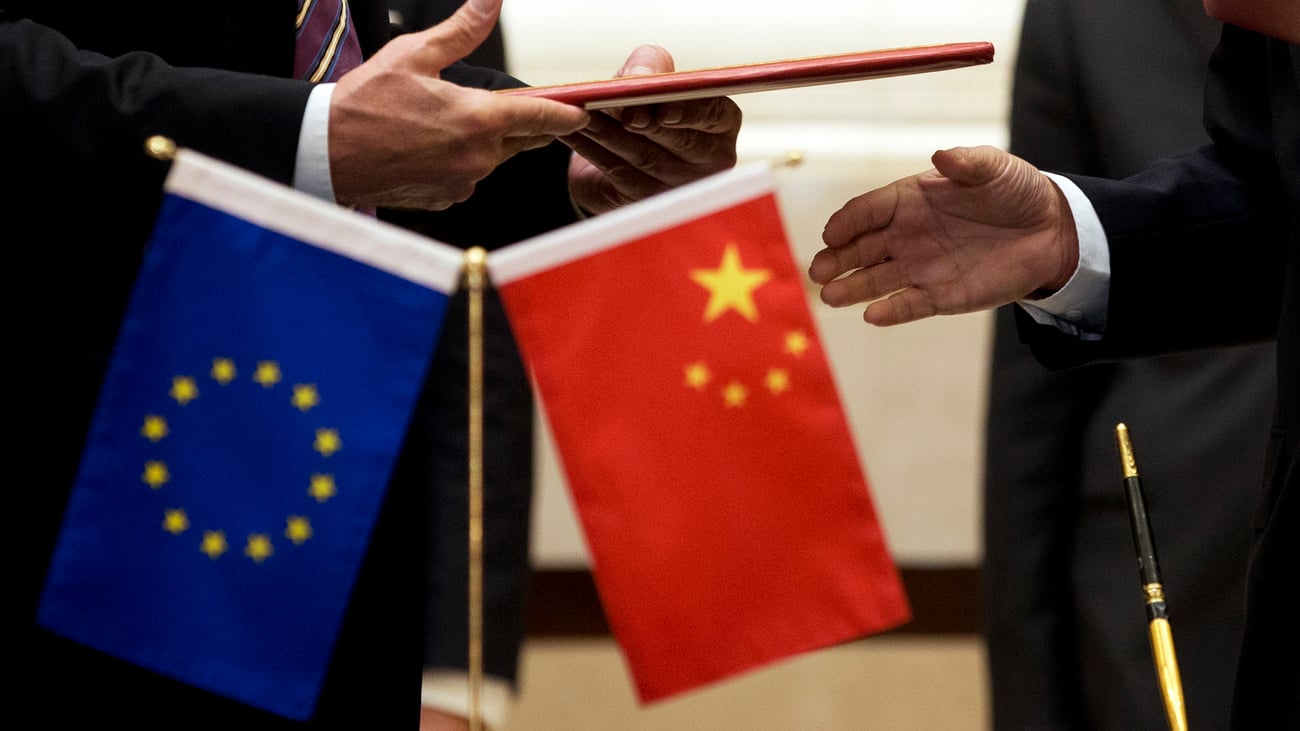
BRUSSELS (CN) — Europe got its first full-year bill Friday for the 2025 U.S.-China trade war: A 360 billion-euro ($392 billion) deficit with Beijing, up 18% from the year before, as Chinese goods that can no longer reach the American market flooded in instead.
The EU imported 559.4 billion euros worth of Chinese goods in 2025 while exporting 199.6 billion euros, leaving a deficit of 359.8 billion euros, according to the EU’s statistics agency, Eurostat. Imports rose 6.4% from the year before, while exports dropped 6.5% — both moving in the wrong direction at once.
The single biggest import category last year was electrical machinery, audio-visual equipment and related parts — 164.9 billion euros, nearly 30% of everything the EU bought from China. The category covers batteries, components and consumer electronics at the heart of EU trade and industrial policy debates with Beijing.
Europe’s dependence runs deeper still: The bloc sources 98% of its rare earth magnets from China, materials essential for electric vehicle motors, wind turbines and weapons systems.
The vehicle import figure — 29.9 billion euros — is also drawing attention in Brussels. The European Commission last year imposed tariffs on Chinese-made electric vehicles after concluding Beijing’s subsidies gave its manufacturers an unfair advantage. China disputed the findings and the two sides have been in negotiations since.
But the dip in Chinese EV exports to Europe has been “replaced by a fourfold surge in plug-in hybrid and hybrid electric vehicle exports from China not covered by the duties,” said Victor de Decker, a researcher at the Egmont Royal Institute in Brussels.
Deeper than tariffs
The surge reflects a broader shift triggered by the U.S.-China tariff war. After Washington imposed tariffs of up to 145% on Chinese goods in April 2025, Beijing redirected exports that could no longer reach the American market toward Europe, where many Chinese goods still face tariffs of just 2% to 3% under WTO rules.
A one-year truce struck in October brought rates down to around 10% on each side, but average U.S. tariffs on Chinese goodsstill stand at roughly 34% — more than 10 times the rate Europe applies — keeping the diversion pressure firmly in place. U.S. President Donald Trump is due in Beijing in May for a summit with Chinese President Xi Jinping aimed at deepening the existing trade truce.
But the imbalance has been building for over a decade. Since 2015, EU imports from China have nearly doubled, rising 89%, while exports grew by just over a third, at 37.1%.
At the root of it is China’s domestic demand problem. Alicia García-Herrero, a senior fellow at the Bruegel think tank in Brussels, traces the imbalance to a cost divergence that predates the tariff war. European producer prices spiked during the 2022 energy crisis while China entered a deflationary phase, she argues — a gap that currency markets have done nothing to close.
“This divergence in costs has given Chinese exporters a decisive price advantage in many sectors, including machinery, chemicals, electric vehicles and green technologies,” she wrote.
De Decker puts it more directly: When supply goes up and domestic demand doesn’t follow, exports become the only outlet — increasingly in high-tech sectors like machinery and electric vehicles where European firms once dominated.
Miguel Otero-Iglesias, a senior researcher at the Elcano Royal Institute in Madrid, told Courthouse News: “The irony is that Europe and the U.S. have internal problems that make them less competitive, while China’s internal problems make it more competitive abroad.”
But not everyone reads the figures as bad news for Europe. Rolf Langhammer, a researcher at the Kiel Institute in Germany, told Courthouse News the deficit reflects declining European export competitiveness more than a flood of unwanted Chinese goods. “Trade suppresses inflation and leads to real income gains for EU consumers,” he said. “I do not see the EU losing from trade conflicts between the U.S. and China.”
A contested response
The European Parliament’s research arm warned last week that competitive pressures on European industry are set to “persist or intensify” as China’s weak domestic demand keeps its factories producing more than its consumers can absorb.
Brussels has responded with a wave of defensive measures. The European Commission has proposed cutting steel import quotas by nearly half and doubling out-of-quota tariffs to 50%, partly to avoid a repeat of the squeeze that followed Trump’s reimposition of steel tariffs last year, which shut European producers out of the U.S. market just as Chinese imports surged.
Brussels went to a WTO ministerial in Cameroon last month demanding the right to treat China differently from other trading partners — a challenge to the body’s core nondiscrimination rules — but left without the agreement. “But tariffs only gain you time,” Otero-Iglesias said.
In March, the EU’s own security think tank warned that Europe’s window to use its market access as leverage over Beijing is closing — and that “the cost of inaction is likely to be even higher” than any Chinese retaliation.
“The European Union is tackling these disputes one by one — sectoral tariffs here, countervailing duties there — but the underlying problem is a systemic imbalance of payments that is not getting resolved anytime soon,” de Decker said.
“If China does not open up and rebalance, the trend of more protectionism in Europe is likely,” Otero-Iglesias said.
The EU is also racing to diversify. Brussels recently concluded a trade deal with Australia — the latest in a run of agreements that has brought in India, Indonesia and the Mercosur bloc — in a push to open new markets and reduce dependence on both China and the United States.
But de Decker cautioned the strategy will take time to bear fruit. “The agreements are not going to produce any systemic change in supply chain diversification before 2028,” he said.
Courthouse News correspondent Yuval Molina is based in Brussels.
Subscribe to our free newsletters
Our weekly newsletter Closing Arguments offers the latest about ongoing trials, major litigation and rulings in courthouses around the U.S. and the world, while the monthly Under the Lights dishes the legal dirt from Hollywood, sports, Big Tech and the arts.
Additional Reads


 German court bans Gaza protest at Buchenwald memorial April 10, 2026