
 Search Articles


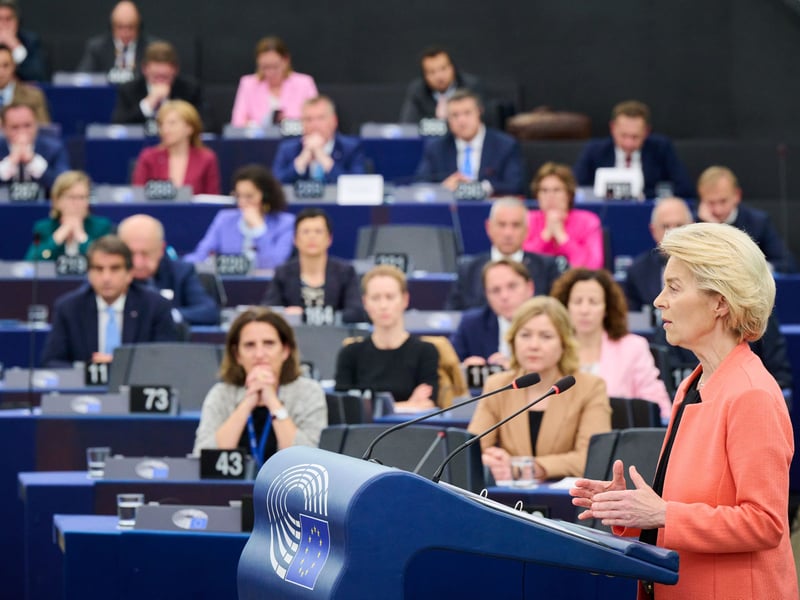
BRUSSELS (CNS) — European Commission President Ursula von der Leyen defended herself before the European Parliament Monday as she faces a largely symbolic no-confidence vote that could force the resignation of the entire EU executive, in the unlikely event it succeeds.
But the vote also gives von der Leyen’s critics — and even some of her backers — a rare chance to call for a public accounting.
Thursday’s vote focuses on “Pfizergate” — a 35 billion euro ($38.5 billion) deal with Pfizer for up to 1.8 billion Covid vaccine doses that von der Leyen, head of the EU executive branch, negotiated through text messages with the company’s CEO. The European Court of Auditors called this “the biggest Covid-19 vaccine contract signed by the commission.”
This marks the first time since 2014 that a commission president has faced such a challenge. Von der Leyen is in the midst of negotiating a crucial trade agreement with the United States. A highly unlikely successful vote would create a leadership vacuum as the EU faces potential U.S. tariffs and ongoing war in Ukraine.
But the Pfizergate scandal has become emblematic of broader concerns about von der Leyen’s leadership style, particularly her tendency to conduct important negotiations outside normal institutional channels. Even some within her own European People’s Party privately express concern about her approach, though they remain publicly supportive.
Though the motion is virtually certain to fail in the EU Parliament, it crystallizes the fundamental tensions reshaping European politics: rising far-right nationalism, crumbling centrist coalitions, and public frustration with Brussels’ lack of accountability. Mainstream parties find themselves caught between addressing real governance problems and refusing to hand victories to anti-EU forces — leaving legitimate questions unanswered to avoid strengthening the EU’s harshest critics.
The challenge is led by Romanian far-right lawmaker Gheorghe Piperea. He collected 79 signatures from lawmakers — just above the 72-member threshold needed. The signatures came primarily from far-right and nationalist groups from Germany, Poland, and Romania.
The vote is not secret, forcing each of the 720 parliamentarians to publicly declare their position. The motion requires a two-thirds majority — virtually impossible given current parliamentary numbers. It serves as a public airing of grievances at a critical moment, with the real impact likely being political embarrassment rather than institutional change.
Political theater
During Monday’s debate, Piperea sought to frame the far-right initiative in constitutional rather than partisan terms.
“The democratic concentration of decisions in the hands of the president of the European Commission happens against the principle of separation and balance,” he said.
Von der Leyen appeared with her entire team of commissioners — who, like the U.S. presidential cabinet, each oversee specific policy areas — including top diplomat Kaja Kallas, seated prominently.
“It is taken right from the oldest playbook of extremists,” von der Leyen said, dismissing the challenge as conspiracy-mongering. She defended her contacts over the vaccines: “It is no secret that I was in contact with top representatives of the companies producing the vaccines.”
European People’s Party leader Manfred Weber launched a scathing attack on the motion’s supporters, linking them to Russian interests.
“Putin will like what his friends are doing here,” he said, calling specific parties “puppets of Putin.”
Weber argued the motion threatens European interests at a critical time, warning that “in a few days Donald Trump’s tariff pause will end. Millions of jobs are at risk.”
“Where are the MAGA friends in this house?” he asked.
Liberal and center-left lawmakers also oppose the motion despite frustrations with von der Leyen.
“We need a strong Europe with a stable commission — this motion only seeks to undermine both,” a spokesperson from Renew Europe — the liberal political group that includes French President Emmanuel Macron’s party — told Courthouse News
The liberal group’s opposition reflects the difficult position facing pro-European parties. While many are genuinely concerned about transparency and von der Leyen’s leadership style, they refuse to hand a political victory to far-right forces they view as fundamentally opposed to European integration. This dynamic has allowed von der Leyen to survive previous controversies by essentially making herself “too big to fail” within the current political structure.
Social Democratic leader Iratxe García attacked both the far right and von der Leyen’s conservative allies.
“We will not give a single vote to those who want to destroy the European Union,” she said. She criticized the European People’s Party’s strategy of working with far-right groups and warned von der Leyen: “If you betray it once again, social democracy will lead the resistance.”
García’s comments reflect a broader breakdown in European Parliament alliances, as the EPP increasingly seeks support from far-right parties rather than its traditional centrist coalition partners.
Recent examples include the EPP joining with nationalists to block environmental NGO funding transparency measures, dilute climate policies including controversial carbon credit schemes, and push for reduced environmental regulations.
In June, Von der Leyen announced withdrawal of the Green Claims Directive one day after the EPP and far-right groups jointly demanded it, raising questions about her independence from these political pressures.
‘Pfizergate’
She has led the commission since 2019, overseeing the bloc’s response to Covid-19 and Russia’s war in Ukraine.
Her presidency has been marked by both significant achievements and persistent controversies. Supporters credit her with leading Europe through multiple crises, from the pandemic to the war in Ukraine, while securing unprecedented EU borrowing for the post-Covid recovery fund. Critics, however, point to a pattern of opacity and increasingly authoritarian decision-making that they argue undermines democratic accountability.
The controversy began in March 2021 when von der Leyen bypassed normal EU procedures to negotiate directly with Pfizer CEO Albert Bourla via text. The New York Times revealed the messages’ existence in April 2021.
Von der Leyen has a history of transparency issues. As Germany’s defense minister, she faced investigation over improperly awarded consulting contracts. While formally cleared, investigators found she “hardly signed any decision documents herself” and had erased messages when probed.
The EU paid substantially more for the vaccines von der Leyen negotiated — 19.50 euros ($21.45) per dose versus 15.50 euros ($17.05) in previous contracts, according to leaked EU documents reported by European media — costing taxpayers billions. The text messages could contain vital information about how this price escalation happened and whether proper competitive procedures were followed.
The scandal also involves concerns about the sheer volume of doses purchased. The 1.8 billion dose contract was signed when EU vaccination rates were already climbing, raising questions about whether such quantities were necessary. Critics point out that significant amounts of the vaccine supply now sit unusedin warehouses across Europe, representing billions in potentially wasted public funds.
Years of transparency battles
The current crisis stems from years of stonewalling over the text messages. When journalists requested them in summer 2021, the commission claimed they were “short-lived” documents not preserved.
The European Ombudsman — an independent watchdog that investigates EU institutional misconduct — found in January 2022 that the commission’s refusal constituted “maladministration.” The European Court of Auditors published a damning report in September 2022 finding von der Leyen had conducted Pfizer negotiations improperly.
In May 2025, the EU’s General Court delivered a scathing ruling against the commission in a case brought by The New York Times. The court found von der Leyen’s administration violated EU transparency rules and failed to explain the missing messages.
The ruling established that text messages can constitute official documents subject to public access laws. The court noted the commission admitted “text messages have been exchanged” but couldn’t explain what happened to them. Legal experts called the decision a watershed moment for EU transparency, potentially forcing institutions to archive all communications related to official business, regardless of the medium.
The court’s decision completely invalidated the commission’s 2022 refusal to provide the text messages, forcing the EU executive to either release the documents or provide legally sound justifications for withholding them. The commission could still appeal to the European Court of Justice, but legal observers say the ruling’s comprehensive nature makes a successful appeal unlikely.
The European Public Prosecutor’s Office has investigated the vaccine deals since October 2022, examining potential “interference in public functions, destruction of SMS, corruption and conflict of interest.”
The office told Courthouse News the case remains ongoing and it cannot release details “in order not to endanger its outcome.”
The case involves disputes between European and Belgian authorities over jurisdiction, leaving the criminal investigation split between different legal systems.
Trade pressure mounts
The political drama unfolds as von der Leyen faces pressure over stalled U.S. trade talks. The U.S. has threatened tariffs up to 50% on European exports, with the highest rates applying to countries failing to reach agreements by August.
The EU is exploring a deal maintaining 10% tariffs on exports to the U.S. in exchange for relief from sensitive sectors. Trade Commissioner Maroš Šefčovič returned from Washington on Friday to present a draft agreement in principle to member states. While the White House announced Sunday that the deadline had been extended to August, a European Commission spokesperson said Monday that European negotiators expect to announce a deal by the original July 9 deadline.
Subscribe to our free newsletters
Our weekly newsletter Closing Arguments offers the latest about ongoing trials, major litigation and rulings in courthouses around the U.S. and the world, while the monthly Under the Lights dishes the legal dirt from Hollywood, sports, Big Tech and the arts.