
 Search Articles


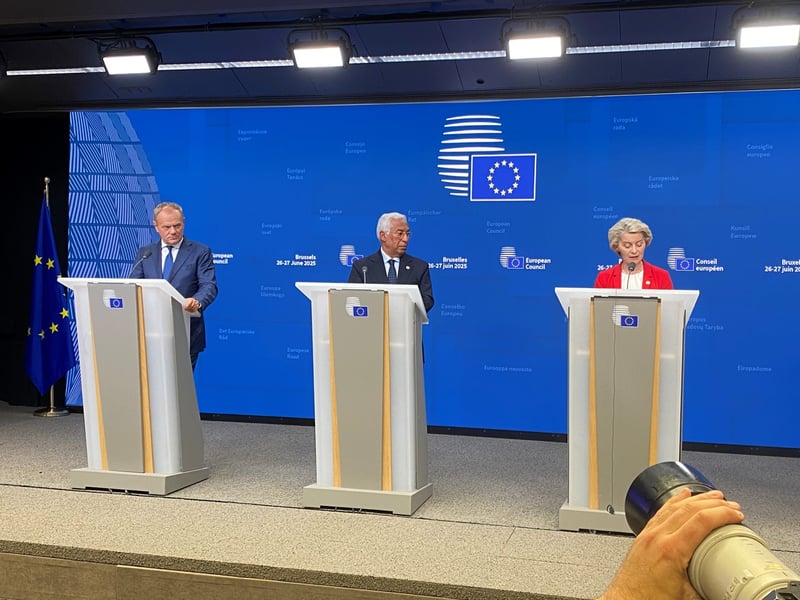
BRUSSELS (CN) — European Union leaders didn’t wrap up marathon talks until past 11 p.m. at a Thursday summit, where they broke key budget rules to fund massive military spending and backed Ukraine despite Hungarian opposition, while demanding an immediate Gaza ceasefire.
The EU suspended its deficit rules to let countries bust debt limits for weapons purchases — a major shift for a bloc that has long demanded fiscal discipline.
“Europe must become more sovereign, more responsible for its own defense,” the 27 EU heads of state meeting in Brussels declared, calling Russia’s invasion of Ukraine “an existential challenge for the European Union.”
But the budget breaks don’t apply to countries already overspending, including France, Italy and Belgium — limiting help for some of the bloc’s biggest potential military spenders.
Leaders welcomed the 150 billion-euro ($175 billion) Security Action for Europe program, the EU’s largest-ever defense financing scheme, approved in May. They committed to “substantially increase expenditure on Europe’s defense and security” to hit NATO’s new target of 5% of GDP by 2035.
For the first time, EU leaders explicitly called for defending “the EU’s eastern border, considering the threats posed by Russia and Belarus.”
European Council President António Costa stressed coordination over duplication. “We don’t need to replicate the same capabilities in each member state. We don’t need to multiply by 27 all our investments in defense. We need efficiency and fair burden sharing,” he said.
Ukraine secures big win
In a major victory for Ukraine, 26 of 27 EU leaders backed a comprehensive support statement after President Volodymyr Zelenskyy addressed them via video. Only Hungary’s Viktor Orban held out.
During his call, Zelenskyy pushed for tougher economic pressure on Moscow. “For Russia’s appetite for war to shrink, its oil revenues must shrink,” he told leaders.
“We urge you to support further steps to lower the price cap on Russian oil. A $45 cap could help move toward peace. But for real, lasting peace, a cap of $30 per barrel is needed,” he added.
He also called for Ukraine’s inclusion in the EU’s defense program: “The EU’s SAFE program, we believe Ukraine should be a full part of it.”
The statement warns Russia that the EU “stands ready to increase pressure as necessary,” including through “a new robust package of sanctions.”
But leaders made no mention of the proposed 18th sanctions package that would have included Nord Stream pipeline bans, lowering the oil price cap and blacklisting 77 Russian oil tankers. The omission suggests the package remains stalled after last week’s failed G7 summit.
The EU committed 30.6 billion euros to Ukraine in 2025, including 7 billion from profits on frozen Russian assets. Leaders promised “robust and credible security guarantees” and agreed to help train Ukrainian forces.
The statement also endorsed opening formal negotiations on Ukraine’s EU membership, with the Commission saying basic democratic requirements are “ready to be opened.”
Leaders also welcomed progress on establishing a war crimes tribunal within the Council of Europe — a 46-member human rights organization that kicked out Russia in 2022.
Trade deal splits Europe
The strong Ukraine statement capped a summit marked by sharp divisions, particularly over how to handle U.S. President Donald Trump’s trade threats.
German Chancellor Friedrich Merz pushed for immediate trade talks with Washington, calling the European Commission’s approach “far too complicated.” His push for a quick deal ahead of Trump’s July 9 deadline split him from France, which wants to avoid rushed negotiations.
“You can’t agree a sophisticated trade agreement there,” Merz told reporters. He said German industries — noting the chemical, the pharmaceutical, mechanical engineering, steel, aluminum, the automotive industries — face “such high tariffs that it is really putting companies at risk.”
Merz argued “it’s better to act quickly and simply than slowly and in a highly complicated way,” claiming “we have all agreed on that; there is no disagreement at all.”
France disagreed. French President Emmanuel Macron reportedly didn’t want to rush into a lopsided deal just to hit Trump’s deadlines. But after the summit, he said he would accept a U.K.-style deal with 10% tariffs.
“It would be best to have the lowest tariff possible, zero% is the best. But if it 10%, it’ll be 10%,” he said. But Macron added a condition: “If the American choice falls on 10%, there will be a compensation on goods sold by the United States. The levy will result in the same levy on U.S. goods.”
The trade tensions intensified Thursday when the U.S. submitted a new proposal during the summit.
“Today we received the latest U.S. document for further negotiations. We are assessing it as we speak right now,” European Commission President Ursula von der Leyen revealed afterward.
“We are ready for a deal. At the same time, we are preparing for the possibility that no satisfactory agreement is reached. This is why we consulted on a rebalancing list. And we will defend the European interests as needed. In short, all options remain on the table,” she said.
Merz also pushed for quick completion of the long-stalled EU-Mercosur trade deal with South America. “We want to see that we come to a conclusion as quickly as possible,” he said after the summit, arguing it would show other countries the EU can finalize trade deals.
Orban’s rebellion
Hungarian Prime Minister Viktor Orban arrived telling reporters: “What I suggest to all my colleagues, rebellion, rebellion, rebellion. Rebellion is the only way.”
Later he posted on social media that Ukraine’s EU membership would “drag the entire Union into war.”
Hungary continued pushing back through a domestic poll claiming 95% opposition to Ukraine joining the EU. The consultation’s legitimacy remains unclear and has no binding effect on EU decisions.
Progressive parties have criticized von der Leyen for shifting from environmental leadership toward defense priorities. The rightward political shift has accelerated what EU officials call “simplification” — rolling back environmental regulations under the guise of reducing bureaucracy. Recent moves include suspending anti-greenwashing rules.
The summit’s competitiveness conclusions reinforced this trend, with leaders calling for a “simplicity by design” approach and urging co-legislators to “avoid over-regulation and the introduction of administrative burdens.” They also called for work to “reinforce the international role of the euro, including as a reserve currency.”
Climate targets also sparked controversy, with unconfirmed reports suggesting France-backed efforts to separate the EU’s 2035 and 2040 climate goals. Belgium’s Prime Minister Bart De Wever confirmed tensions, saying “it was a very heated debate,” though he added the discussion focused mainly on how to achieve climate goals.
“Almost nobody wants to give up on the target, the discussion is more about how to get there,” De Wever said.
Israel review shelved
Leaders avoided concrete action on a damning review of Israel’s conduct, instead saying they “take note” of findings that Israel violated human rights commitments under the EU-Israel Association Agreement. The review, requested by 17 member states led by the Netherlands, examined whether Israel complies with requirements for ties based on “respect for human rights and democratic principles.”
The agreement governs 42.6 billion euros ($49.8 billion) in annual trade, making the EU Israel’s largest trading partner. Spain pushed for immediate suspension, but faces opposition from Germany, Czech Republic and Hungary. They delayed decisions until July.
Options include removing trade preferences and cutting Israel from EU research programs, though full suspension needs unanimous agreement. Belgium and eight other countries separately want to halt trade with Israeli settlements.
Leaders also discussed Moldova’s EU membership ahead of next week’s bilateral summit. They extended the EU’s Libya border mission for two years with a 52 million-euro budget to combat human trafficking.
Migration coordination continued with Italy, Denmark and the Netherlands hosting 14 member states including Germany — the first time a German leader joined these talks.
Subscribe to our free newsletters
Our weekly newsletter Closing Arguments offers the latest about ongoing trials, major litigation and rulings in courthouses around the U.S. and the world, while the monthly Under the Lights dishes the legal dirt from Hollywood, sports, Big Tech and the arts.