
 Search Articles


BRUSSELS (CN) — It took the better part of a decade, a diplomatic crisis over submarines and a collapsed negotiation — but the European Union and Australia finally have a deal.
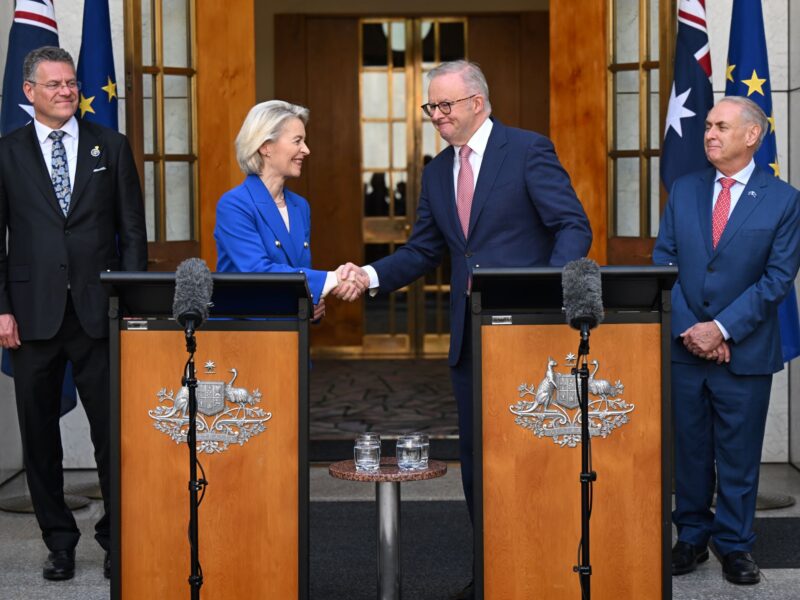
European Commission President Ursula von der Leyen and Australian Prime Minister Anthony Albanese concluded a free trade agreement Tuesday in Canberra — nearly eight years in the making, and the latest in a run of deals that has also netted India, Indonesia and Mercosur in recent months.
The deal is the latest sign of how U.S. tariff volatility and European overreliance on Chinese supply chains are redrawing the bloc’s trade map. At its heart, it is three things at once: a trade agreement, a bid to secure critical minerals and a defense relationship — each dependent on the others.
“The world we live in is brutal, harsh and unforgiving,” von der Leyen told a joint sitting of the Australian Parliament Tuesday — the first woman leader to do so. “What we knew as certainties are in question.”
But the road to Tuesday was bumpy. In 2021, Australia ditched a multibillion-euro submarine contract with France — without warning — to join a security pact with the U.S. and U.K. Paris was furious, briefly recalled its ambassadors from Washington and Canberra, and the fallout chilled EU-Australia relations for months.
Talks collapsed again two years later, when Canberra walked away over beef quotas. Both sides eventually returned to the table, driven in part by a shared unease about the direction of U.S. trade policy under President Donald Trump.
The beef impasse was papered over with phased quotas and safeguard clauses — while industry on both sides pushed hardfor gains on cars, chemicals, financial services and digital trade.
The European Commission, which negotiates deals on behalf of the 27-nation bloc, projects EU exports to Australia growing by up to 33% over the next decade, with businesses saving around 1 billion euros ($1.16 billion) a year in tariffs — assuming smooth implementation and sustained demand.
The EU already runs a 28 billion-euro goods surplus with Australia. Nearly half of what it exports there is machinery and transport equipment, while 54% of what it imports back is minerals and energy. The EU is Australia’s third largest trading partner after China and Japan, accounting for 8.6% of its trade.
“It is not only a drop in tariffs for finished products — above all it gives legal security and establishes rules that allow companies to invest with confidence,” Oscar Guinea, trade economist and director of the European Centre for International Political Economy, a Brussels-based think tank, told Courthouse News.
One notable exception: steel. Both sides agreed to carve it out entirely, a reflection of the EU’s broader push to shield its struggling steel industry from a global glut that Brussels attributes largely to Chinese overproduction.
The food fight
The fight over food names was the last thing standing between the two sides and a deal.
The EU treats geographic indicators as intellectual property — if your cheese isn’t made in Comté, you can’t call it Comté. Australia, like the U.S., has long seen that system as protectionism dressed up as heritage. The standoff was “almost a clash of religions,” a senior commission official said Tuesday, noting Australia had for decades been “probably the closest proxy to the U.S. positions” on the issue.
In the end, 165 European food names and 231 spirit designations will be protected in Australia. Feta and Gruyère producers who’ve used the terms for at least five years can keep doing so under strict labeling rules. Prosecco gets a 10-year runway before Australian exports must drop the name. Parmigiano Reggiano will be fully protected — “parmesan,” a generic term in Australia, will not.
Australian farmers are unimpressed. The EU market has been effectively closed to their beef and sheep meat for decades, protected by tariffs of up to 160%. The National Farmers’ Federation said the deal “appears to offer no material change” from the terms Canberra walked away from in 2023.
“They will now pay the price for this subpar EU deal for decades to come,” NFF President Hamish McIntyre said, pointing to the EU-Mercosur agreement — which came with nearly $80 billion in European farm subsidies — as “a clear signal protectionism is alive and well.”
Albanese pushed back, touting the removal of EU wine tariffs — worth $37 million annually to Australian producers. Trade Minister Don Farrell called it a “hard-fought deal” that opens a market “effectively closed for decades.”
Australia is the world’s second-largest beef exporter, but its quota under the deal — 33,700 tons, phased in over 10 years — amounts to roughly 0.5% of EU domestic consumption.
European farmers are no happier. Copa-Cogeca, the main EU farming association, warned against the cumulative impact of successive trade agreements, calling agriculture “once again the bargaining chip” of EU trade strategy.
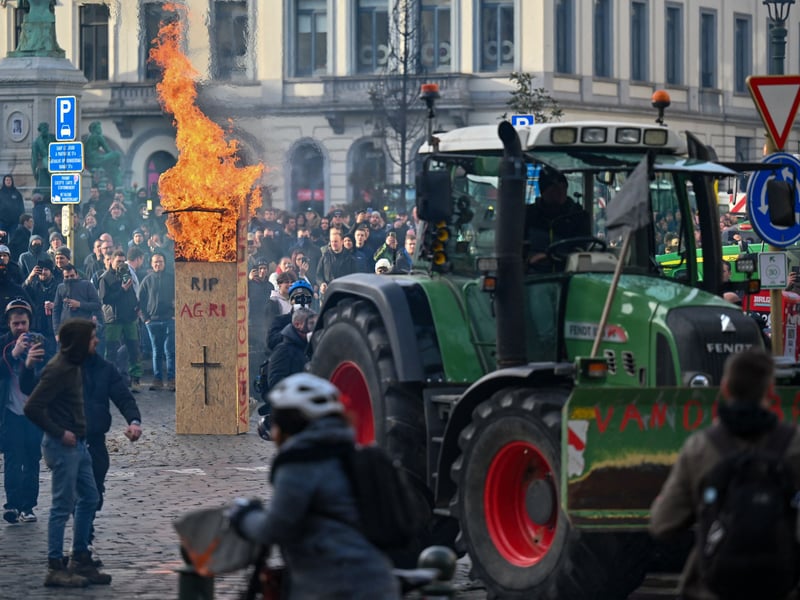
It is the second time in months Brussels has pushed through agricultural market openings over farmers’ objections — the Mercosur deal, signed in January amid highway blockades across France, Ireland and Belgium, takes effect provisionally on May 1 despite a European Parliament legal challenge.
A minerals problem
The chapter covering aluminum, lithium and manganese bans export restrictions and opens investment opportunities. “Australia is blessed with huge natural wealth and they have possessions almost all critical minerals we need,” EU trade chief Maros Šefčovič said in Canberra on Monday.
Guinea cautions against framing the deal as a simple minerals-for-market-access swap. Tariffs on Australian raw materials are already near zero — Europe has no incentive to tax products it doesn’t produce. “It is not about lowering the tariffs,” he said. “It is about establishing the conditions of stable investment.”
But the hard problem remains unsolved. Most of Australia’s lithium goes to China, which has the refining capacity to process it that Europe does not.
Australian car exports to Europe get duty-free access from day one; European carmakers get a raised luxury tax threshold for EVs, exempting roughly 75% of their exports to Australia.
The trade deal comes paired with a defense partnership that opens a path toward Australia joining SAFE, the EU’s 150 billion-euro defense procurement instrument. Brussels did the same with India in January, and the pattern is now deliberate: trade and defense, coupled.
“Europe and Australia are oceans apart, but our security and prosperity are tightly linked,” EU’s foreign policy chief Kaja Kallas said Tuesday.
Guinea noted the defense pairing matters because arms trade operates under far stricter rules than commercial goods. “When countries buy weapons or defense equipment from each other, it is under quite restrictive conditions,” he said. “Having a regulatory framework makes it much easier to advance toward greater integration.”
Ratification is simpler than most EU deals. No trek through 27 national parliaments — just sign-off from the EU’s co-legislative powers, the Council and Parliament — with provisional application of the trade portions expected before the full process is done. In Australia, Albanese’s 94-seat lower house majority gives him the numbers, though the Senate may need crossbench support.
Courthouse News correspondent Yuval Molina is based in Brussels, Belgium.
Subscribe to our free newsletters
Our weekly newsletter Closing Arguments offers the latest about ongoing trials, major litigation and rulings in courthouses around the U.S. and the world, while the monthly Under the Lights dishes the legal dirt from Hollywood, sports, Big Tech and the arts.