
 Search Articles


BRUSSELS (CN) — The European Union proposed on Wednesday to suspend trade benefits covering 37% of Israeli exports and impose sanctions on Israeli ministers, marking Brussels’ strongest action yet against the nation in response to the Gaza war.
The European Commission’s proposal would end special trade deals that help Israeli goods enter the bloc — Israel’s biggest trading partner — with lower tariffs. But the measures require approval from a qualified majority of the EU’s 27 member countries, where Israel retains significant support, led by Germany.
The proposals come as Israel launched a major ground offensive into Gaza City on Monday, yet another escalation in the campaign against Hamas that has killed more than 64,000 Palestinians, according to Gaza health authorities.
The initiative stems from European Commission President Ursula von der Leyen’s Sept. 10 State of the Union pledge to suspend trade benefits with Israel over human rights violations. The announcement follows a day after a U.N. investigative panel’s conclusion that Israel is committing genocide in Gaza, though EU officials cite distinct legal grounds under their bilateral Association Agreement.
“We regret having to take this step,” said EU trade chief Maroš Šefčovič, who presented the trade measures Wednesday. “However, we believe it is both appropriate and proportionate, given the ongoing humanitarian crisis in Gaza.”
But the trade restrictions face major obstacles. They need support from at least 15 countries, representing 65% of the bloc’s population — and Israel still has allies. Spain and Belgium are pushing hard for tough measures, while Germany is joined by Hungary, Italy, the Czech Republic, Austria and Bulgaria in urging restraint.
For Israel, this matters enormously. The EU is Israel’s largest trading partner, accounting for 32% of Israeli global trade and buying nearly 29% of everything the country exports. Israel may rank only as the EU’s 31st largest trading partner, representing less than 1% of total EU imports, but the relationship involves serious money.
Under the proposal, Israeli machinery and transport equipment — worth 7 billion euros ($7.7 billion) last year, or 44% of Israel’s 15.9-billion-euro EU exports — would face much higher tariffs. Chemical exports (2.9 billion euros) and manufactured goods (1.9 billion euros) would take hard hits too.
In 2024, trade between the EU and Israel totaled 42.6 billion euros in goods. The EU sold Israel 26.7 billion euros worth of goods and bought 15.9 billion euros. They also trade 25.6 billion euros in services annually.
More than 60% of Israeli goods already qualify for standard international tariffs to enter Europe. And in a notable exception, weapons and military equipment would remain unaffected since they enter duty free under existing international trade rules.
If the proposals are approved, Israel would receive 30 days’ notice before the measures take effect. That gives time for diplomatic responses and lets businesses prepare for the changes.
The suspension targets key parts of the2000 EU-Israel Association Agreement: trade in goods, services, public procurement and intellectual property rules. But capital flows and customs cooperation would keep running normally.
Commission officials have been looking into whether Israel is breaking the human rights requirements in their trade deal since June. They told EU foreign ministers on June 23 that Israel was violating its human rights commitments.
Brussels specifically references Gaza’s deteriorating humanitarian conditions following Israeli military operations, Israel’s blockade of humanitarian aid between March and May 2025, escalating military activities and Israeli settlement expansion in the West Bank. The U.N. declared famine conditions in northern Gaza on Aug. 22.
A complete suspension would require unanimous member state agreement, making this partial approach more politically viable. The Association Agreement operates within the EU’s Euro-Mediterranean Partnership framework from 1995 — the same mechanism used to impose sanctions on Syria over human rights violations.
The EU already maintains trade distinctions with Israel through a 2004 “Technical Arrangement” with Israeli customs authorities. This denies preferential treatment to goods from Israeli settlements in territories occupied since 1967, per EU senior officials.
Beyond trade measures, Brussels proposes travel bans and asset freezes targeting Israeli National Security Minister Itamar Ben-Gvir and Finance Minister Bezalel Smotrich. These supplement earlier sanctions from April and July 2024, targeting now nine violent settlers and extremist groups, plus five organizations. The package includes sanctions against 10 Hamas leaders across Gaza, the West Bank and foreign countries.
Using executive authority that does not require member state approval, the commission has suspended 6 million euros annually in partnership programs. These include “twinning” arrangements between EU and Israeli government agencies covering technology collaboration, big data projects and energy efficiency initiatives, plus regional development support under the Abraham Accords — the 2020 U.S.-brokered normalization agreements between Israel and several Arab countries.
An additional 14 million euros in allocated funds from 2020 to 2024 are on hold under EU aid programs. Of this amount, 4.3 million euros had already been contracted while 9.4 million euros remain uncontracted.
“This is a decision the commission can make independently on the basis of exceptional events, like in this case,” said Dubravka Šuica, the EU’s top official charged with democracy issues. “And can be revoked if conditions on the ground change.”
Meanwhile, the EU is significantly expanding support for Palestinians, with 1.6 billion euros allocated over the next two years for the Palestinian Authority’s reform process under what officials call an increasingly precarious financial situation.
“Gaza’s horrific daily events must cease,” von der Leyen said Wednesday in a press statement. “An immediate ceasefire, unrestricted humanitarian access and hostage releases by Hamas are essential.”
Israel reacted furiously to the proposals, with Foreign Minister Gideon Sa’ar accusing von der Leyen of empowering terrorist groups. “It is profoundly disturbing that you, by advancing such a proposal are in practice empowering a terrorist organization responsible for and continuing to perpetrate heinous crimes,” he wrote in a letter addressed to the commission.
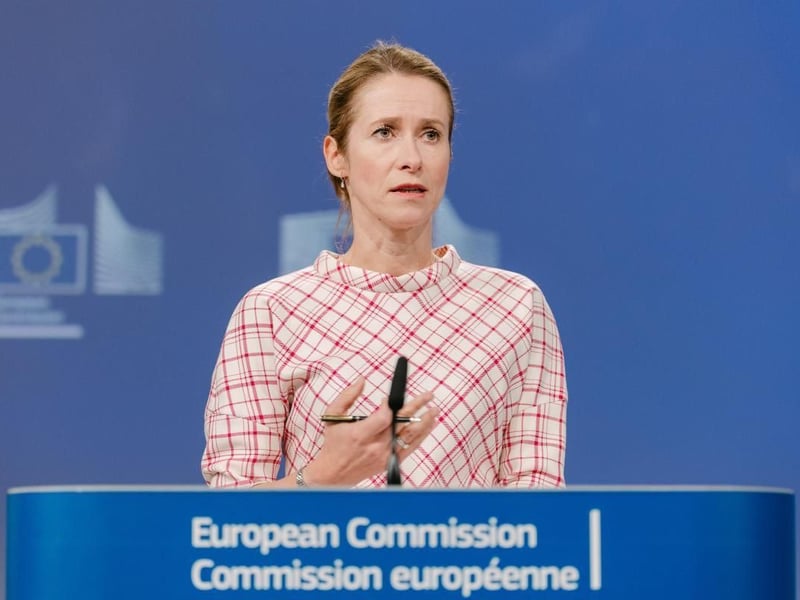
EU officials defended their approach as humanitarian rather than punitive. “I want to be very clear. The aim is not to punish Israel. The aim is to improve the humanitarian situation in Gaza,” EU chief of diplomacy Kaja Kallas said Wednesday during the announcement.
The timing coincides with preparations for next week’s U.N. General Assembly in New York, where Israeli Prime Minister Benjamin Netanyahu and other world leaders will convene. Belgium and France plan to formally recognize Palestinian statehood during the proceedings, alongside the United Kingdom and Canada, with the U.N. investigative panel’s conclusions likely serving as a foundation for international criticism of Israeli policies.
Courthouse News correspondent Yuval Molina is based in Brussels, Belgium.
Subscribe to our free newsletters
Our weekly newsletter Closing Arguments offers the latest about ongoing trials, major litigation and rulings in courthouses around the U.S. and the world, while the monthly Under the Lights dishes the legal dirt from Hollywood, sports, Big Tech and the arts.