
 Search Articles


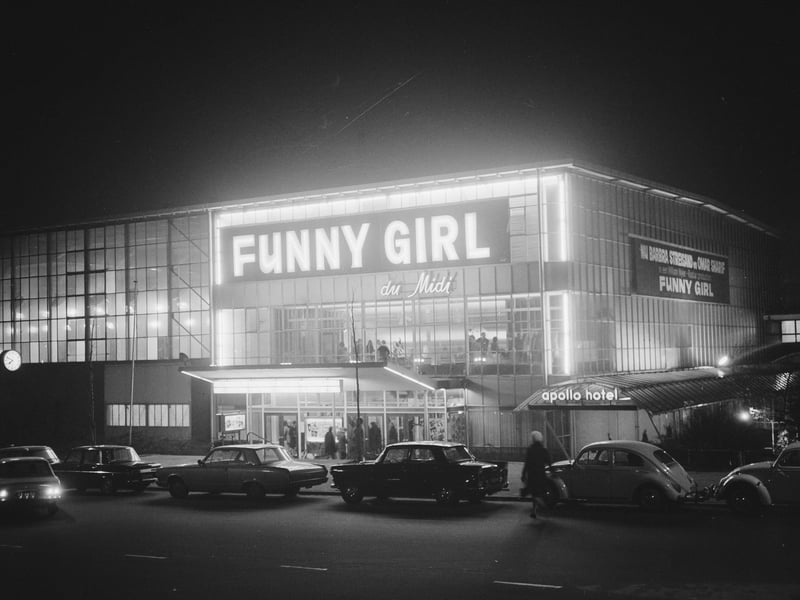
MANHATTAN (CN) — The widow of the late lyricist Bob Merrill asked a federal appeals court on Thursday morning to terminate a 61-year-old copyright agreement between her husband and a Broadway musical producer that entitled him to a larger portion of royalties derived from the hit play “Funny Girl.”
Merrill wrote and copyrighted the lyrics to “Funny Girl,” the 1960’s Broadway golden age musical that made a young Barbra Streisand a star in 1964, and later earned her an Academy Award when she reprised the role of Fanny Brice for her film debut in the 1968 movie adaptation.
The family of the show’s late producer, Eliot Hyman, asked the Second Circuit Court of Appeals to affirm a federal judge’s finding that Merrill’s widow had no right under the 1976 Copyright Act to terminate the royalties contract, in which Hyman gave Merrill $82,500 in 1963 in exchange for “an undivided two-thirds” interest in all future compensation derived from “Funny Girl.”
Represented on appeal by Santa Monica attorney Robert Besser, Suzanne Merrill argued that her late husband actually sold “grand rights” — a financial right she asserts is “untethered to copyright ownership” — to Hyman, and that she, his widow, can walk back this sale under the 1976 Copyright Act.
Besser asserted that such “grand rights” are separate and distinct from the so-called “small performance rights” and all of the other exclusive rights to the lyrics bestowed upon a copyright owner.
“There would be no copyright if he hadn’t written the lyrics,” Besser exclaimed. “These three people knew exactly what they had done. They confirmed it three years later, they lived with it for years until the rights were terminated properly, we say, under section 304 of the Copyright Act.”
The Merrills’ reading of the 1963 contract faced scrutiny from the Second Circuit panel.
“Why shouldn’t one read that the way it most sounds, as if they wanted to get more money early and so they made a deal with respect to the royalties?” Clinton-appointed Senior U.S. Circuit Judge Guido Calabresi challenged early during oral arguments on Thursday morning.
U.S. Circuit Judge Paul Engelmayer, an Obama appointee, queried, “Doesn’t the word ‘two-thirds’ naturally itself suggest that it’s two-thirds of a calculation, which is to say, something like a royalty stream — as opposed to two-thirds of a more intangible intellectual property, right?”
U.S. Circuit Judge Alison Nathan, a Biden appointee, asked Besser, “In a practical sense, what does it mean to own two-thirds?”
The Second Circuit panel did not immediately rule on the appeal.
The Hyman family was represented on Thursday by Bridgeport, Connecticut, attorney Marc Herman, who argued the 1976 Copyright Act doesn’t give Merrill the right to terminate her late-husband’s royalties deal with the show’s producers.
“Plain and unambiguous language in the Royalties Agreement shows that Merrill sold Hyman a financial right; and, with no genuine issues of material fact, summary judgment in Defendant’s favor was warranted,” Herman wrote in an appeal brief.
The producer’s estate claims plain language in the contract illustrates that Merrill sold Hyman only a financial right, not copyright interests.
“The reason we know that is that the quartet of terminology in 1963 agreement — ‘royalties,’ ‘percentage compensation,’ ‘rights,” and the catch-all term ‘other compensation’ can not reasonably be read any other way,” Herman told the panel on Thursday. “’Other compensation’ tells the reader clearly that what the drafters had in mind here was that we are referring to a stream of income and nothing else.”
The lower court sided with the Hyman family in October 2022, awarding summary judgment in their claims for declaratory relief, breach of contract and permanent injunctive relief, finding the 1963 contract solely focused on future royalties and not copyrights.
“I agree with the Hymans. Although Merrill may terminate her late husband’s licensing deals, she has no right to cancel his royalty deals,” U.S. District Judge Jeffrey Alker Meyer wrote.
The original Broadway production of “Funny Girl” opened at the Winter Garden Theatre on March 26, 1964. It ran for 1,348 performances and was nominated for the 1964 Tony Awards for the Best Musical and Score.
A revival of “Funny Girl” ran at the August Wilson Theatre from April 2022 through September 2023, first starring Beanie Feldstein, and later Lea Michele, who replaced Feldstein after the show’s first five months.
 Follow @jruss_jruss
Subscribe to our free newsletters
Our weekly newsletter Closing Arguments offers the latest about ongoing trials, major litigation and rulings in courthouses around the U.S. and the world, while the monthly Under the Lights dishes the legal dirt from Hollywood, sports, Big Tech and the arts.