
 Search Articles


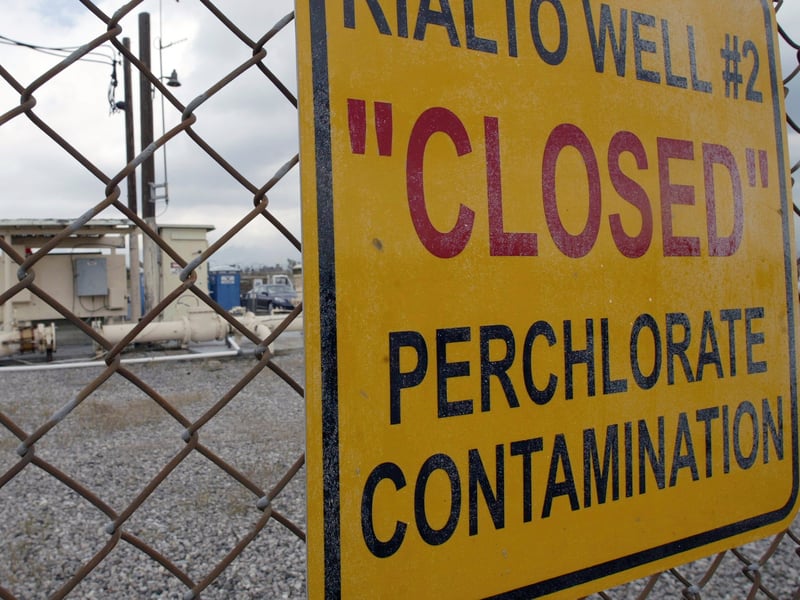
WASHINGTON (CN) — The Environmental Protection Agency announced on Monday it would set a new limit on the toxic chemical perchlorate in drinking water, while casting doubt on its necessity, to comply with a 2023 D.C. Circuit decision.
A three-judge panel unanimously ordered the environmental agency to begin regulating the chemical — which is used to manufacture fireworks, explosives and rocket fuel — after finding the agency ignored clear health risks in 2020 when it withdrew an Obama-era decision to regulate it.
“The EPA’s proposed regulation could require over 66,000 systems in the United States to test and monitor for the presence of perchlorate,” the agency said. “The EPA anticipated that very few regulated water systems — approximately one-tenth of 1% — are likely to find perchlorate in drinking water above the proposed enforceable limits or the [maximum contaminant level goal].”
Monday’s announcement opens the public comment period for the proposal, before a May 21, 2027, deadline to sign a final rule.
In the proposal, the EPA said it would set the limit at 20 micrograms per liter and would also take comments on an enforceable maximum contaminant level at 20, 40 or 80 micrograms per liter. In the agency’s view, most communities are not expected to have perchlorate levels above any of the three proposed contaminant levels.
Further, all “community water systems” and “non-transient non-community water systems” will be required to monitor for perchlorate, but they can monitor less frequently if initial testing shows low perchlorate levels.
“Because the EPA has determined that the vast majority of water systems are not likely to have perchlorate levels at the level of public health concern, the proposal includes provisions that would attempt to reduce the burden on both systems and states compared to the standard monitoring requirements for other regulated inorganic contaminants,” the EPA said.
Perchlorate poses significant risks to children and pregnant women, as exposure can impact an individual’s metabolism and hinder growth, particularly brain development. The chemical can also cause hypothyroidism, negatively affect reproduction and development and impact the cardiovascular system.
In an attached “Questions & Answers” fact sheet, the agency explained that the only reason it was proposing the new rule was to comply with the D.C. Circuit’s decision in *NRDC v. Reagan,*and a resulting consent decree that set a deadline of Jan. 2, 2026 — last Friday — for the proposal.
In 2020, the EPA determined that perchlorate was not prevalent enough to cause concern. The agency said regulation “does not present a meaningful opportunity for health risk reduction,” and therefore it did not have the authority to regulate the chemical.
The agency originally decided to regulate perchlorate in 2011 under President Barack Obama after estimates showed the chemical could be present in the drinking water for approximately 16 million people, but failed to propose a standard by the deadline in 2016.
In May 2023, the D.C. Circuit panel determined the EPA’s actions violated the 1974 Safe Water Drinking Act, which empowered the agency to set minimum health standards for states and public water system operators to follow.
Former Senior U.S. Circuit Judge David Sentelle, a retired Ronald Reagan appointee, said the Safe Water Drinking Act only gives the EPA the authority to create regulations, not to strike them down.
“To read into the statute another course of action — one that allows EPA to withdraw its regulatory determination entirely and decide that it ‘shall not’ regulate — would be to contravene the statute’s clear language,” Sentelle wrote.
Sentelle added that the Safe Water Drinking Act has an “antibacksliding” provision that requires that any revision must “maintain … or provide for greater health protections.”
Former Senior U.S. Circuit Judge David Tatel, a retired Bill Clinton appointee, and U.S. Circuit Judge Florence Pan, a Joe Biden appointee, ruled with Sentelle.
Pan agreed with Sentelle and Tatel, but went even further in a concurring opinion, opining that the agency’s decision not to regulate perchlorate was “arbitrary, capricious, and otherwise not in accordance with law.”
She pointed to the danger perchlorate poses to children’s mental development as reason enough to consider the chemical a public health risk.
“A decrease in average IQ of even one point is undoubtedly an ‘adverse effect on the health of persons,’” Pan wrote.
The EPA scheduled a Feb. 19 virtual hearing for members of the public to comment on the proposal.
 Follow @Ryan_Knappy
Subscribe to our free newsletters
Our weekly newsletter Closing Arguments offers the latest about ongoing trials, major litigation and rulings in courthouses around the U.S. and the world, while the monthly Under the Lights dishes the legal dirt from Hollywood, sports, Big Tech and the arts.