
 Search Articles


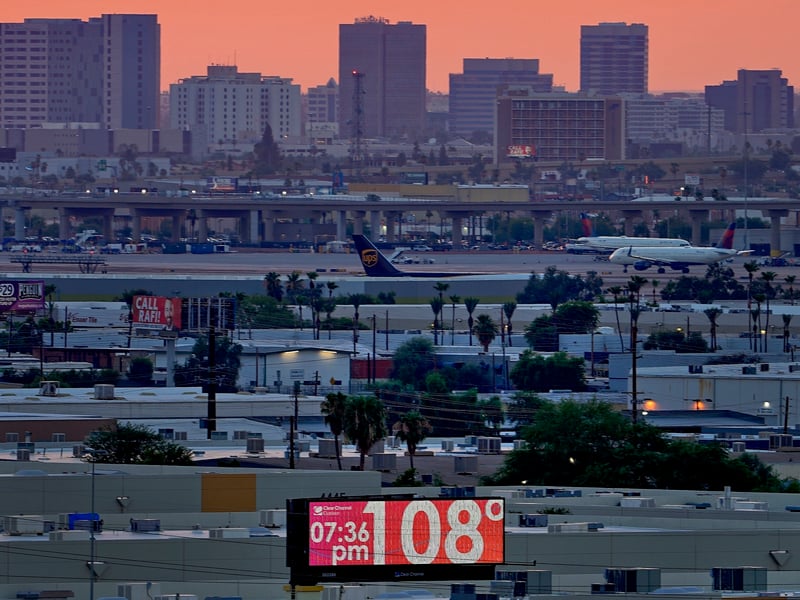
PHOENIX (CN) — As air quality in the Phoenix metro worsens, the U.S. Environmental Protection Agency floated a novel suggestion this week: Exempt the area from Clean Air Act requirements because much of the valley’s air pollution is out of its control.
The agency proposed the solution Wednesday, one day before a federal judge approved a consent decree requiring the city to act on ozone pollution in the Phoenix-Mesa metro area by Feb. 3, 2026. Excluding wildfires and winds blown from overseas, the EPA says the area has already met the standards.
Members of the public now have until Dec. 19 to comment on the proposal.
“It’s outrageous that the Trump EPA wants to use international emissions as an excuse to do nothing instead of reducing the dangerous smog Phoenix residents are forced to breathe every day,” Benjamin Rankin, an associate attorney at the Center for Biological Diversity, said in a press release. “People in the Phoenix metro area can push back and demand that the Trump administration act aggressively and urgently to reduce unhealthy pollution rather than pander to the polluters causing it.”
The Clean Air Act requires the EPA to set “national ambient air quality standards” for pollutants such as ozone, commonly known as smog. The EPA set air standards for ozone in 2015 and found Phoenix-Mesa to be out of attainment, but missed its deadline to determine reattainment status in 2024, prompting environmental groups to sue this year.
In its annual “State of the Air” report, the American Lung Association ranked the Phoenix-Mesa area as fourth worst out of more than 225 metros for high ozone days. From 2021 to 2023, the metro averaged 54 high ozone days per year. The acceptable standard is three.
The metro also ranks 28th for 24-hour particle pollution and 20th for annual particle pollution.
The Valley of the Sun is particularly susceptible to high ozone days thanks to its extreme heat and high levels of industrial and vehicle emissions. But the pollution floating over the country’s hottest cities is often worsened by California wildfire smoke and, in larger quantities, air blown from overseas.
Though it’s difficult to accurately track, some estimate that as much as 80% of the metro’s pollution comes from overseas. Excluding high fire days and foreign pollutants, the EPA claims in its proposal the metro likely would have attained Clean Air Act compliance as earlier as 2020, and shouldn’t be held responsible for what is out of its control.
Origin aside, environmentalists say the agency has a responsibility to do more to protect vulnerable Americans.
People exposed to excess ozone are at risk of reduced lung function and increased respiratory problems like asthma. The EPA itself estimates that around 4 million people in the Phoenix area are chronically exposed to ozone pollution.
Ozone also causes widespread environmental harms by stunting tree growth, damaging leaves and increasing plants’ susceptibility to disease, insect damage and harsh weather.
“It’s high time that the Trump administration took action to protect people from disease-causing ozone pollution, especially children and the elderly, who are most vulnerable,” Shakoora Azimi-Gaylon, senior director of toxic exposures and pollution prevention at the Center for Environmental Health, said in the press release. “It’d be a shame if the EPA only stops sitting on its hands just to let Phoenix off the hook for its ozone problem. We must continue to fight for clean air for the millions of people living in Phoenix.”
The Maricopa Association of Governments, representing 27 cities and towns in Phoenix’s home county, presented a list of potential solutions to the Legislature in 2023, anticipating a failure to attain compliance. Suggestions included decreasing allowed nitrogen oxide emissions and implementing idling reduction technologies in heavy-duty vehicles like trucks and school buses, incentives to buy partial-zero and zero emission light-duty vehicles, and replacing gas-fired heaters, boilers and cooking appliances with electric appliances.
But Republicans on the committee turned their nose at what they called “draconian” restrictions, and never acted on the proposal.
More recently, the city of Phoenix committed to planting nearly 30,000 new trees over the next five years to reduce heat and improve air quality.
An EPA study found Clean Air Act programs to reduce fine particle and ozone pollution prevented more than 230,000 deaths, 200,000 heart attacks, and 2.4 million asthma attacks in 2020 alone. For each dollar spent, Americans have received more than $30 of health benefits in return.
 Follow @JournalistJoeAZ
Subscribe to our free newsletters
Our weekly newsletter Closing Arguments offers the latest about ongoing trials, major litigation and rulings in courthouses around the U.S. and the world, while the monthly Under the Lights dishes the legal dirt from Hollywood, sports, Big Tech and the arts.