
 Search Articles


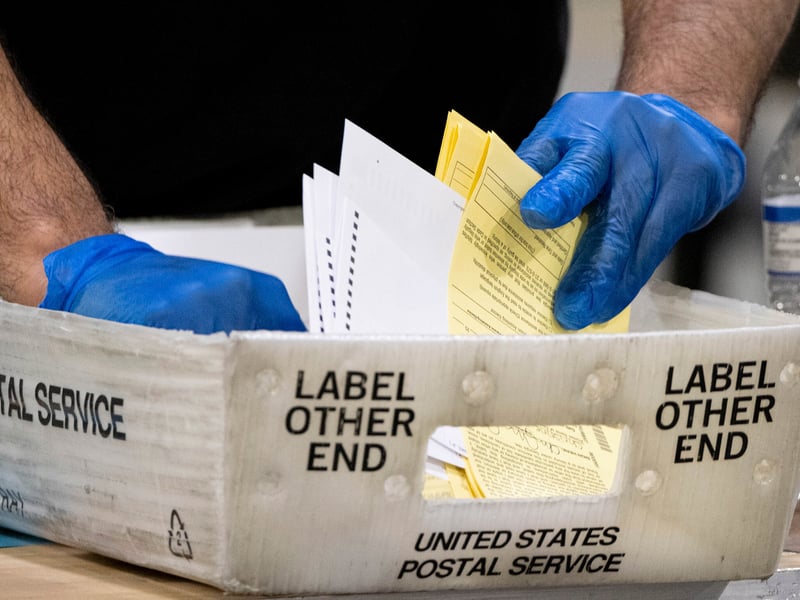
ATLANTA (CN) — Fulton County argued to a federal judge Friday that the Justice Department acted in “callous disregard” when it obtained a search warrant to take possession of all of its original ballots from the 2020 election.
The county, which is the most populous in Georgia, urged the judge to order the return of the 656 boxes of election materials seized by the FBI on Jan. 28.
It argued the Justice Department failed to determine the credibility of the 11 anonymous witnesses cited in the affidavit used to obtain the search warrant and that it omitted contradicting information without identifying any criminal suspect.
“The affidavit has no allegations that anything was done intentionally,” attorney Abbe Lowell told the court.
Lowell, of D.C.-firm Lowell & Associates, noted that its been five years since the election took place and questioned the government’s motive as to why they would not have sought the materials sooner.
He added that there have already been multiple inquiries into the election that found no wrongdoing by the county and said there are deficiencies in every election.
“That is the nature of the beast,” Lowell said.
U.S. District Judge J.P. Boulee acknowledged that the affidavit could have left out contradicting information, but declined to rule from the bench on whether or not that means it was carried out unlawfully.
“The magistrate judge thought that was good enough and made the decision to sign the warrant,” Boulee, a Donald Trump appointee, said.
“How far does the affidavit have to go?” he questioned.
Testifying for the county, Bryan Macias, an expert on election administration and security, said nothing in the affidavit proves any intentional misconduct on behalf of the county as accused.
As an election security consultant, Macias said he was brought in to assist Fulton County with the influx of absentee ballots received during the 2020 election due to the Covid-19 pandemic.
Macias said the accusations in the affidavit do not reflect the reality of how the election was conducted and typical election administration conduct. Because the margin in Georgia was so tight for the presidential race, Macias said, the results were confirmed by a hand count of the ballots and then an additional voting machine recount.
“The affidavit does not have a substantial basis of reality,” Macias said.
When asked about concerns over possible duplicate ballot images, Macias said that means a ballot was “pictured” twice, not counted twice. These images of ballots do not effect the outcome of an election as only the “cast vote record” from voting machines is used for tabulation, Macias said.
He added that a duplicated ballot is not one that is scanned twice, but one that is recreated or remade, such as for military voters who receive a digital ballot that cannot be scanned by a tabulator, similar to if an absentee ballot is torn or damaged.
A ballot scanned more than once means there was a jam in the tabulator machine that required it to be deleted and rescanned, Macias said.
“There are quality control methods in place to prevent any duplicate scanning of ballots,” he added.
In the affidavit, FBI Special Agent Hugh Raymond Evans wrote that Fulton County reported a recount totaling 511,343 ballots, which was 17,434 ballots fewer than original counted. The following day, Fulton County then reported a total of 527,925 ballots counted.
Macias testified that the lower recount number comes from an internal report for the county to understand where it was at the time of their counting, not a complete total.
The county questioned Macias if whether he thought there was any evidence of intentional misconduct, to which he replied, “no.”
Boulee previously denied a request to reconsider his decision to quash the subpoena for Evans. The judge sided with the government’s position of not wanting to disclose facts about their ongoing investigation.
The county also argued the Trump administration bypassed two pending civil lawsuits seeking access to the 2020 records. One is from the Justice Department and the other was brought by the State Election Board, which has long scrutinized Fulton’s 2020 performance.
In its view, the Justice Department attempted to circumvent the slow moving process and costs estimated by the county to put together the records, by issuing the criminal investigation as a way to take the records themselves.
“If that’s what did happen, I think that would advance petitioner’s argument significantly,” Boulee said.
But the Justice Department argued that this is a completely separate investigation and that those other cases are irrelevant.
They also asserted that the county has no particularized need for the original ballots, an argument Boulee appeared sympathetic to.
Fulton argued they need the ballots returned to ensure voters’ confidence in elections and to end the constant brigades of election fraud from Trump and his allies.
“That is not enough to climb this hill of callous disregard,” DOJ attorney Tysen Duva argued on behalf of the federal government.
Duva also said the statute of limitations doesn’t matter in this case because there are no limits on search warrants.
As part of a separate petition, the NAACP also requested Friday that the court order reasonable limitations on the government’s use of the seized materials, prohibiting use for purposes other than the government’s criminal investigation of the matters described in warrant.
 Follow @Megwiththenews
Subscribe to our free newsletters
Our weekly newsletter Closing Arguments offers the latest about ongoing trials, major litigation and rulings in courthouses around the U.S. and the world, while the monthly Under the Lights dishes the legal dirt from Hollywood, sports, Big Tech and the arts.