
 Search Articles


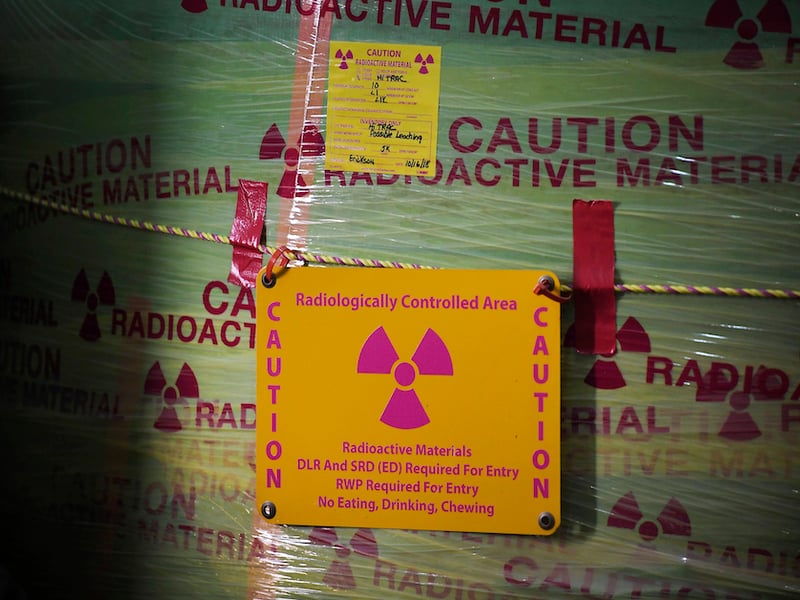
(CN) — The St. Louis Airport Authority, energy utility Commonwealth Edison and mining services company Cotter Corporation took two St. Louis area sisters before the Eighth Circuit on Wednesday, fighting the pair over their claims that radioactive pollution in a creek near their home caused them to develop cancer.
While the sisters seek redress for their longstanding injuries, the trio of public and private institutions argue their state law claims could undermine federal regulatory power on nuclear safety issues.
“The line that [state law] cannot cross … is it cannot supply the standard of care. Because that directly intrudes on the federal government’s exclusive province to regulate nuclear safety,” the trio’s attorney Jennifer Steeve, of the Chicago law firm Riley Safer, told the Eighth Circuit judges.
Nikki Steiner Mazzocchio and Angela Steiner Kraus have been fighting Cotter, Commonwealth Edison and the airport over the pollution in federal court since early 2022 arguing they and their legal predecessors are liable for radioactive material that was poorly handled and stored around St. Louis between the 1940s and early 1970s. Federal authorities have known since at least the mid-1990s that radioactive waste contaminates sites across northern St. Louis County, including the Coldwater Creek which flows through the St. Louis suburb of Hazelwood.
Public cleanup efforts of sites involved in the Manhattan Project and early atomic energy programs, including St. Louis, began under the federal government’s Formerly Utilized Sites Remedial Action Program in 1974. But enough waste remains in the area that last week the the Army Corps of Engineers announced on Facebook it would soon be posting “do not dig” signs on local properties where low-level radioactive materials are still present.
Full cleanup of the area isn’t expected to finish until 2038.
Mazzochio and Kraus — who lived near and used Coldwater Creek from 1984 to 2014 and 1997 to 2003 respectively — hold the airport authority, Cotter and Commonwealth Edison responsible for the multiple myeloma they’ve developed in the meantime. They brought six claims against the trio for trespass, nuisance, negligence and strict liability in Missouri state court in January 2022, and added a civil conspiracy claim to a February 2023 amended complaint after their case was removed to federal court.
The trio of public and private interests, in their defense, say the sisters’ state law level claims are preempted by the federal Price-Anderson Act of 1957. The act helps shield private players in the nuclear energy industry from liability claims and deems certain lawsuits arising from nuclear waste injuries to be covered by federal law. Cotter argued for dismissal in March 2023, claiming the sisters haven’t shown how it or the other defendants violated the federal standard of care under the Price-Anderson Act. Cotter cites the separate 2012 federal court case over Missouri radioactivity, McClurg v. Mallinckrodt , to establish annual exposure to 500 millirems of radiation as the Price-Anderson threshold.
“As this court has held, federal regulations at the time of Cotter’s conduct defined the levels of radiation that would protect members of the public in an unrestricted area from excessive exposure and thus establish Cotter’s standard of care,” Cotter wrote in March 2023. “But plaintiffs fail to allege any facts showing that Cotter ever breached these levels of radiation permitted by federal regulations.”
U.S. District Judge Matthew Schelp thought otherwise last September when he denied the trio’s dismissal motions. The Donald Trump appointee wrote that applying such a specific standard of care to the sisters’ claims would be, at that stage of the litigation, premature.
“Maybe some federal safety regulation other than the regulations dealing with numeric dose limits could form the basis of a public liability action. And maybe [radiation dosage] regulations used as the exclusive standard of care makes sense in certain types of ’nuclear incident’ actions,” Schelp wrote. “But defendants’ one-size-fits-all approach is unpersuasive, especially given the facts of the case here.”
Cotter and the other defendants appealed Schelp’s ruling, hoping the Eighth Circuit would order the lower court to dismiss the case.
Steeve reiterated the Price-Anderson Act line of argumentation before a three-judge appellate panel on Wednesday. She posited that allowing Schelp’s ruling to stand would undermine the U.S. Nuclear Regulatory Commission, and potentially hand laymen jurors authority over complex nuclear safety and mitigation issues.
“Denying preemption of state nuclear safety standards of care as a matter of law is based on an interpretation that violates fundamental rules of statutory construction … and the ruling threatens to upend the balance Congress gave the NRC the exclusive power to achieve,” Steeve said.
She added that states do still have some regulatory power over nuclear energy, but must cede safety issues like the kind the sisters raise to federal control.
The sisters’ own attorney Victor Cobb, of the New Orleans-based Cooper Law Firm, countered that the trio were misinterpreting the Price-Anderson Act and contradicting Congress’ intent with the law. Even if the federal government is the supreme authority on nuclear safety regulation, he said, it does not wholly discount state law when nuclear waste exposure victims are seeking justice. Cobb cited the Supreme Court’s 1984 ruling in the case Silkwood v. Kerr-McGee Corp. to support his argument.
In that decision, the high court ruled that “federal preemption of state regulation of the safety aspects of nuclear energy does not extend to the state-authorized award of punitive damages for conduct related to radiation hazards.”
The appellate judges had questions and criticism for both attorneys, but pressed Cobb especially on the fact that prior appellate court rulings, including from the Eighth Circuit, had found other state nuclear damage cases pre-empted by federal law.
In the 1971 case Northern States Power Co. v. Minnesota . for example, the Eighth Circuit ruled “the states possess no authority to regulate radiation hazards” unless the federal government agrees with a state to cede control over certain regulations. Missouri currently has no such agreement with the federal government.
Asked how he reconciles his textual argument with those words from the court, the attorney once again pointed at Silkwood.
“The state cannot, if they do not have an agreement [with the Nuclear Regulatory Commission], create their own regulations. But state common law, tort law, which does have an indirect affect, can still apply,” Cobb said.
The appellate panel consisting of U.S. Circuit Judges Duane Benton, Morris Arnold and Jonathan Kobes — a George W. Bush, George H.W. Bush and Donald Trump appointee respectively — took the case under advisement but did not say when they would issue a ruling.
 Follow @djbyrnes1
Subscribe to our free newsletters
Our weekly newsletter Closing Arguments offers the latest about ongoing trials, major litigation and rulings in courthouses around the U.S. and the world, while the monthly Under the Lights dishes the legal dirt from Hollywood, sports, Big Tech and the arts.