
 Search Articles


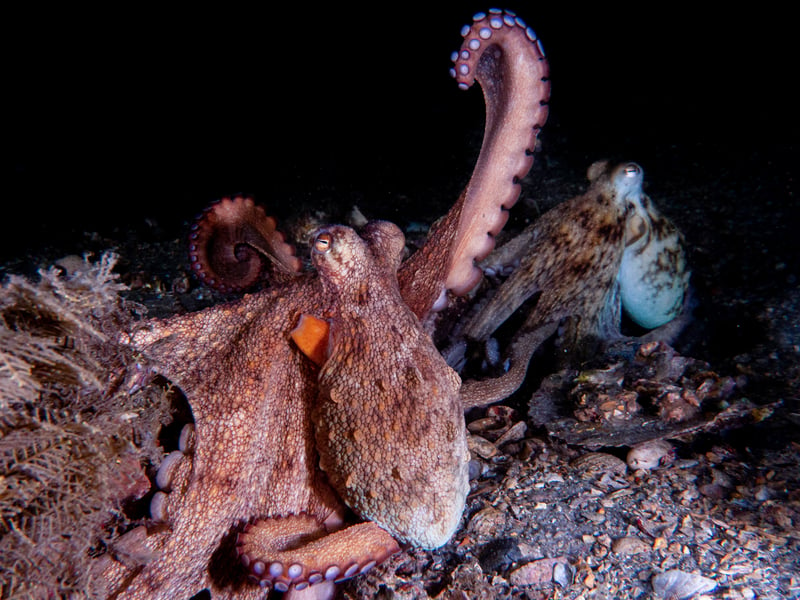
(CN) — Octopuses are known for their advanced intelligence, including tool use, and the ability to mimic their surroundings. Now, based on new research, sophisticated motor capability of all the cephalopod’s arms can be added to the list of unique behaviors dictating octopus life.
A new study by scientists at Florida Atlantic University’s Charles E. Schmidt College of Science and the Woods Hole, Massachusetts-based Marine Biological Laboratory — published Thursday in the Nature journal Scientific Reports — deepens understanding about an octopus’s arm movements in relation to its behavior in natural sea habitats.
Previously, studies looking into motor function and arm movements observed specimens in lab settings only. The new findings show wild octopuses use their limbs in many ways with clear patterns to coordinate movements and specialize certain areas of arms for specific maneuvers.
“Octopuses are unique in that they have eight flexible appendages that can bend, shorten, elongate and twist (arm deformations) in all directions due to the octopus’s extensive nervous system in each arm and the complex arrangement of their arm musculature and lack of bones,” said Chelsea Bennice, lead author and a research fellow at FAU’s Marine Laboratory, in a written statement.
“The combination of these deformations creates different arm behaviors that can occur on the same arm and different arms simultaneously to achieve complex whole animal behaviors," she said.
The researchers analyzed 25 video recordings of three wild octopuses in six different water habitats located in the Caribbean and Spain. They noted 15 different behaviors, such as fetching objects, exploring rock sides, and walking on the seafloor, culminating in nearly 4,000 arm movements.
One of the surprising observations was that all eight of an octopus’s arms are capable of all the behaviors noticed, indicating dynamic dexterity.
“Adaptability is the key feature,” said Roger Hanlon, a study co-author and an ethologist and marine biologist at the Marine Biological Laboratory, in a written statement.
“Because they are such tactile creatures, they have evolved suckers and arms that not only give them many forms of locomotion, but sensory capabilities that allow them to find hidden foods when they forage in any eco-habitat,” he said.
Octopuses live in a range of oceanic environments, including shallow coasts, seagrass beds, 5,000-year-old coral reefs and deep waters.
And although an octopus can move any arm for a certain reason, sometimes it has a preference.
“Importantly, all arms are capable of all functions, but the front arms are simply used more often than the rear arms,” said Kendra Buresch, a study co-author and a biologist at the Marine Biological Laboratory, in a written statement.
She explained the usage between the front four versus the rear four arms is a 64% to 36% split.
Additionally, octopuses’ remarkable flexibility identified in the research may lead to possible implications for humans in the future.
“Our comprehensive hierarchical analysis lends additional insight into the combinations of small arm movements and arm behaviors that can be useful for the field of soft robotics,” said Bennice. “Octopuses are ultimate multitaskers.”
Subscribe to our free newsletters
Our weekly newsletter Closing Arguments offers the latest about ongoing trials, major litigation and rulings in courthouses around the U.S. and the world, while the monthly Under the Lights dishes the legal dirt from Hollywood, sports, Big Tech and the arts.