
 Search Articles


(CN) — Abortion rights advocates saw measures in seven states to protect and expand reproductive health access succeed, while voters in Florida, Nebraska and South Dakota defeated similar constitutional amendments that would leave abortion bans in place.
Perhaps most notably, Missouri approved a measure guaranteeing the right to an abortion until a fetus is viable — which typically occurs around 21 weeks. Missouri, a mostly red state, was the first to pass a ban on abortion after the U.S. Supreme Court overturned Roe v. Wade with its 2022 Dobbs ruling.
The successes in Missouri and elsewhere came in the same election that Republican Donald Trump won the presidency, and despite his inconsistent stance on abortion and reproductive rights.
“There’s a lot of voters who think they can disaggregate their views on abortion bans from their support for Trump,” Mary Ruth Ziegler, a law professor at the University of California, Davis, and a leading historian on the U.S. abortion debate, said. “Democrats didn’t do a good enough job explaining why that may be counterproductive.”
Abortion rights amendments also passed in Arizona, Colorado, Maryland, Montana, Nevada and New York.
Since 2022, advocates have amped up their efforts to safeguard reproductive health access nationwide. Prior to this year, every state that has put protections on the ballot has succeeded including California, Michigan, Vermont, Kansas, Kentucky, Montana and Ohio.
Recent polling indicates most Americans generally support abortion rights. According to an Associated Press/NORC poll conducted in June, roughly 61% of adults think their state should allow a person to get an abortion for any reason.
“The fact that abortion remains popular is a good sign,” said David S. Cohen, a law professor at Drexel University. But he added the presidential election results may jeopardize these wins.
“The American people also overwhelmingly voted for someone who supported anti-abortion policies,” Cohen said. “The future of abortion is precarious in this country.”
Despite what may happen during a second Trump presidency, experts say these states may be the most important to consider regarding where abortion rights currently stand.
Colorado
With 61.5% of the vote, Coloradans enshrined the right to abortion in the state constitution and repealed the state’s nearly four-decade-old ban on taxpayer money being used to pay for abortions.
Abortion is already allowed at all stages of pregnancy in Colorado, a reliably blue state. But the measure’s passage means lawmakers can’t undermine abortion rights in the future.
Perhaps more notably, the measure allows government funds to be used to pay for abortions. It repeals a 40-year-old constitutional amendment that banned taxpayer funding of abortions except in cases where the life of a mother is in danger or when a pregnancy is a result of rape or incest.
“This is important because the whole point of Medicaid is that it allows people to get medical care without having to sacrifice other things in their life,” Cohen said. “Like housing or clothing or supplies for kids and so for people who are currently on Medicaid who want an abortion, they have to make the decision that Medicaid was intended to prevent.”
Florida
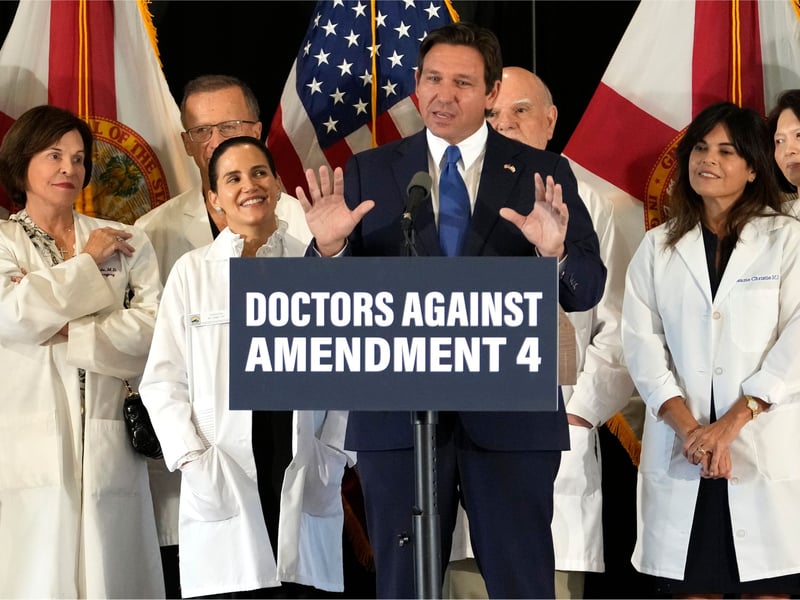
Despite a majority of Floridians in support, the ballot initiative in the Sunshine State ultimately failed because the state requires a 60% voter threshold to pass.
Amendment 4, which would have protected the right to abortion until fetal viability or when necessary to protect the pregnant person’s health, ultimately failed despite securing 57.2% of the vote.
“We haven’t seen any ballot measure pass with that much of the vote anywhere outside of pretty blue states like California or Vermont,” Ziegler said.
Because the measure failed, Florida’s ban on abortion after six weeks will stay in effect, with some exceptions for rape, incest and when the person’s life is at risk.
Prior to the six-week ban being enacted in May, Florida previously allowed abortion until 15 weeks, which made it a haven for individuals seeking an abortion from surrounding states that had stricter bans.
The outcome may be attributed in part to Florida Governor Ron DeSantis, who has emphatically rallied against the measure and steered state GOP funds to fight it. He also urged local TV stations to remove ads about the abortion-related ballot measure and launched his own campaign against the measure.
“He tried to inflate the amount this cost. He tried to make it difficult to get on the ballot in the first place. He said the signatures weren’t right,” Cohen said. “He pulled out all the stops.”
Nebraska
Nebraska was the only state to have dueling abortion measures on the ballot, and voters ultimately opted to support a measure that enshrines the state’s current ban on abortions after the 12th week of pregnancy in the state constitution.
In turn, voters rejected a competing measure that sought to expand the right to abortion until fetal viability.
The anti-abortion measure didn’t change much in Nebraska, which already had a 12-week ban on abortion with exceptions for cases of rape and incest and to protect the life of the pregnant person. But the measure that passed makes the ban more difficult to reverse since doing so would require amending the state constitution.
Ziegler said the anti-abortion movement’s success in Nebraska may inform their strategy moving forward but added that may be of “limited utility” because anti-abortion measures haven’t historically been all that successful.
“We’ve seen anti-abortion ballot measures fail in other states like Kentucky and Montana, so having the anti-abortion movement go on the offensive can be useful,” Ziegler said.
 Follow @NikaSchoonover
Subscribe to our free newsletters
Our weekly newsletter Closing Arguments offers the latest about ongoing trials, major litigation and rulings in courthouses around the U.S. and the world, while the monthly Under the Lights dishes the legal dirt from Hollywood, sports, Big Tech and the arts.