Search Articles


(CN) — A new study has revealed a surprising factor contributing to the very first stars and galaxies billions of years ago: a special glow of ultraviolet light that bathed the early universe.
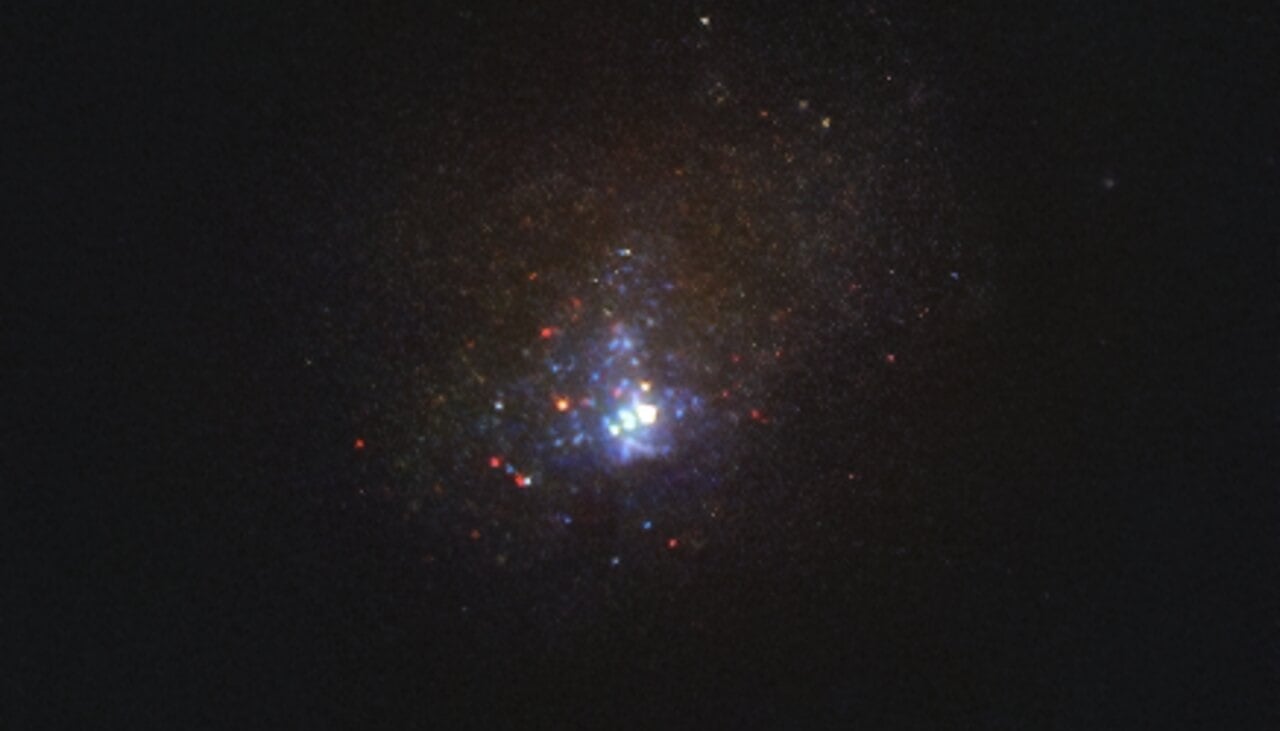
The tiniest galaxies in the universe are like ancient fossils. These “ultra-faint” dwarf galaxies contain just a few hundred to a few thousand stars and quietly orbit our Milky Way. They are the smallest galaxies we know and act as powerful time capsules, helping scientists understand the role of dark matter in the universe.
The research, published Thursday in the journal Monthly Notices of the Royal Astronomical Society, was led by astronomers Shaun T. Brown and Azadeh Fattahi. They ran 65 extremely detailed “zoom-in” simulations of dwarf galaxy formation, tracking gas, stars and exploding stars down to the mass of just a few individual stars — about four times the mass of our sun.
The key ingredient was something called the Lyman-Werner background, a glow of ultraviolet light from the universe’s very first stars and galaxies that breaks apart molecules of hydrogen gas. Those hydrogen molecules act like a natural refrigerator, helping gas cool down so it can collapse and form new stars. Without them, tiny clumps of dark matter have a much harder time making galaxies.
“A useful analogy … is to plants and crops and how the way they grow is sensitive to the weather conditions,” said Brown, who led the study while working at OKC and Durham University. “In the same way that the yield of a crop in summer can indirectly tell you a lot about what the weather in spring must have been like, the properties of faint dwarf galaxies today can tell us a lot about the conditions, or weather, of the universe at a much earlier time.”
The team tested two realistic versions of this early ultraviolet glow, recreating the luminosity of the universe as it was some 13 billion years ago. In the version with almost no early ultraviolet light, stars could form in very small dark-matter clumps, as small as 10 million times the mass of our sun. This produced a smooth pattern where most small clumps ended up hosting at least a few stars.
In the version with stronger early ultraviolet light, many of the smallest clumps were “sterilized.” The light prevented hydrogen molecules from forming, so the gas stayed too warm to collapse efficiently. As a result, the smallest galaxies only appeared in larger dark matter clumps, about 100 million solar masses or more. Today, dark matter clumps of similar size can either host a galaxy with 1,000 to 100,000 stars, or remain completely dark and empty.
Both versions showed something striking: The faintest galaxies all have roughly the same minimum size, about 1,000 stars. They formed in one quick burst very early on. A few massive stars then exploded as supernovas, blasting away the remaining gas and permanently shutting down further star formation.
“We found that these small ultra-faint galaxies are very sensitive to these changes, while more massive galaxies, like our Milky Way, don’t really care,” Brown explained. “For the smallest galaxies, early conditions can decide whether they become visible galaxies — or remain starless dark matter halos.”
The results help explain why astronomers see gaps in the numbers of small galaxies and why ultra-faint dwarfs are so sensitive to conditions right after the Big Bang. They also show that accurate simulations of tiny galaxies must include cold gas physics and the blast of individual exploding stars.
The findings have big implications for understanding the Milky Way’s many small satellite galaxies and for future observations with telescopes like the Vera C. Rubin Observatory in Chile. Future work will explore different types of first-generation stars to paint an even clearer picture.
“These are the smallest galaxies that ever formed,” Fattahi said. “Their properties today still carry the imprint of the very first stars and the radiation they produced.”
 Follow @gabetynes
Subscribe to our free newsletters
Our weekly newsletter Closing Arguments offers the latest about ongoing trials, major litigation and rulings in courthouses around the U.S. and the world, while the monthly Under the Lights dishes the legal dirt from Hollywood, sports, Big Tech and the arts.