
 Search Articles


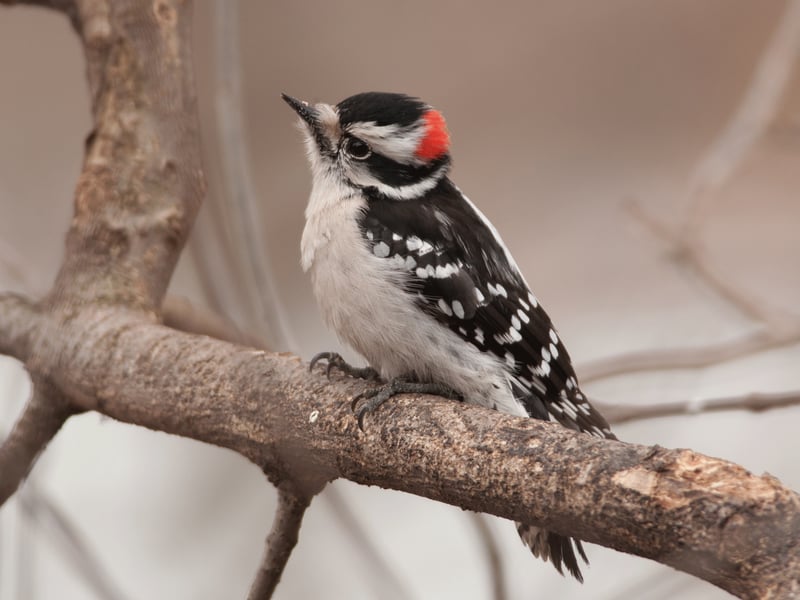
(CN) — Woodpeckers have a reputation for making a racket on a quiet morning with their unremitting clobbers, so it may be no surprise new evidence reveals the extreme power behind their drilling.
In a study published in the Journal of Experimental Biology on Thursday, five scientists at Brown University and a bird song expert from the University of Münster in Germany found downy woodpeckers brace their head, neck, abdomen and tail muscles to hold their bodies in a certain way, enabling the hammer-like pounding necessary to get at the meal inside trees.
“What is really exciting about this study is that it tells us how they do what they do,” Nicholas Antonson, a postdoctoral research associate in the department of ecology, evolution and organismal biology at Brown and a co-author of the study, said in an email.
“Woodpeckers take their name seriously and the pecking behaviors they use to navigate the world are quite extreme and difficult to perform compared to other birds,” he said.
The scientists used electromyography (EMG), which measures the electrical activity of muscles and nerves, along with measuring air-sac pressure during breathing, to compile the data. An EMG device was temporarily inserted into eight birds’ beaks. The woodpeckers were caught using mists nets near the lab.
“This behavior closely mirrors the way songbirds take mini-breaths during bouts of singing,” explained Antonson and his co-authors in the study.
“Overall, these results provide further support for the notion that drilling and tapping in woodpeckers — as extreme forms of pecking behavior — engage the entire body in tight muscular and respiratory coordination.”
Additionally, the researchers noted the downy woodpeckers, the smallest species of woodpecker in North America, synchronize their breathing and make a loud grunt from the exertion of striking wood, which stabilizes some of the muscles they use to drill.
“We found that their muscles contract in a precisely coordinated fashion to produce these behaviors and, when timed with breathing through their strikes, they forge one of nature’s most iconic hammers,” said Antonson.
The scientists recorded birds breathing at extremely fast rates during their tapping — breathing in and out at rates of 13 breaths per second and inhaling in as little as 40 milliseconds between each strike.
“That is faster than a person can blink,” said Antonson.
He explained woodpeckers’ adaptions in their musculature and respiratory system allow them to maintain power through repeated impacts, without having to slow down or adjust.
“One of the most surprising findings for us was that in addition to the neck, the hip muscles seem to be doing a lot of work to power these strikes,” he said. “This differs from what most people’s assumptions would be from watching woodpeckers in their backyard.”
The findings, Antonson said, lead to more questions about similarities and differences in the drilling behavior of other woodpecker species.
“Figuring out how other woodpeckers do this and how they might differ are some exciting next steps.”
Subscribe to our free newsletters
Our weekly newsletter Closing Arguments offers the latest about ongoing trials, major litigation and rulings in courthouses around the U.S. and the world, while the monthly Under the Lights dishes the legal dirt from Hollywood, sports, Big Tech and the arts.