
 Search Articles


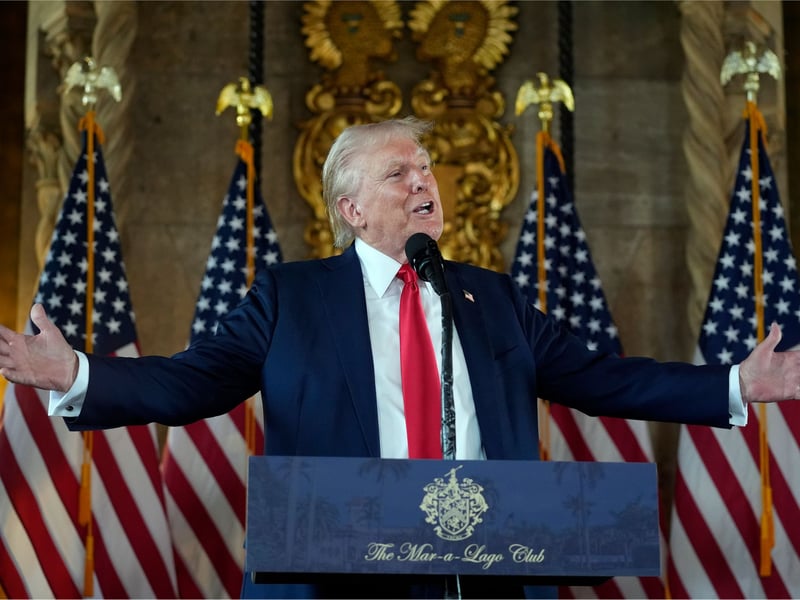
WASHINGTON (CN) — A federal grand jury brought a second indictment against former President Donald Trump on Tuesday, as part of his long-paused election subversion case, maintaining the same four charges special counsel Jack Smith levied in 2023.
The move comes in the wake of the U.S. Supreme Court’s July ruling to grant Trump immunity for all core official acts taken while president and presumptive immunity for those within the “outer perimeter” of his presidential authority.
Smith once again hit the former president with four charges: conspiracy to defraud the United States, conspiracy against rights, conspiracy to obstruct an official proceeding and obstruction of an official proceeding.
While much of the conduct covered in the new indictment remains the same, the superseding indictment is nine pages shorter than the original 45-page indictment as Smith removed a series of accusations related to Trump’s communication with the Justice Department to support his claims of election fraud that the conservative majority in the immunity case determined clearly fell within a president’s core official acts.
In addition to removing those claims, Smith also removed any reference to an individual referred to in the indictment as “Co-Conspirator No. 4,” who had been publicly identified as former Justice Department official Jeffrey Clark.
Clark’s removal still leaves five uncharged conspirators — including members of Trump’s legal team, Rudy Giuliani, John Eastman and Sidney Powell, as well as Kenneth Cheseboro. The identity of the final co-conspirator has yet to be clearly identified.
In the new indictment, Smith highlights Trump’s communications to supporters between November 2020 and Jan. 6, 2021 on his then-Twitter account, in an apparent effort to draw a line between Trump’s official and personal uses of the account to further his conspiracies.
“Throughout the conspiracies, although the defendant sometimes used his Twitter account to communicate with the public, as President, about official actions and policies, he also regularly used it for personal purposes,” Smith wrote.
Smith noted that Trump used his Twitter “to spread knowingly false claims of election fraud, exhort his supporters to travel t0 Washington, D.C. on Jan. 6, pressure the vice president to misuse his ceremonial role in the certification proceeding, and leverage the events at the Capitol on Jan. 6 to unlawfully retain power.”
Similarly, Smith makes several points that Trump was acting in his capacity as a political candidate, not president while detailing his efforts to influence state officials in swing states like Arizona, Georgia and Pennsylvania to effectively hand him their states’ votes.
The rehashed slew of charges come weeks after the case was finally returned to U.S. District Judge Tanya Chutkan, a Barack Obama appointee, who has yet to hold an initial hearing to determine next steps.
Smith had requested an extension on Aug. 9 to prepare for such a hearing, which Chutkan first scheduled for Aug. 16, which was then granted and pushed to Aug. 30, this coming Friday. That initial hearing was rescheduled for Sept. 5.
In its 6-3 ruling in July, the Supreme Court created three buckets in which a president’s actions can fall into: core official acts, such as pardons; official acts in the outer perimeter of their duties; and unofficial acts.
While core official acts receive absolute immunity and unofficial acts receive none, the majority determined that acts within the outer perimeter received the presumption of immunity, an bar that prosecutors could theoretically clear but the justices left undefined.
Chief Justice John Roberts, a George W. Bush appointee, left it to Chutkan to determine which bucket Trump’s conduct falls into, only ruling that Trump’s communications with the Justice Department should be considered official and therefore immune.
He suggested that Trump’s communications with former Vice President Mike Pence should similarly receive immunity, but did not go so far as to outright rule as such.
In the wake of the ruling, legal experts suggested that Chutkan could hold a “mini-trial” as she weighs what was official vs. unofficial, which would likely be the only way Trump’s efforts to overturn the 2020 election results could be scrutinized before the upcoming 2024 election.
But according to recent reporting by Bloomberg News and the New York Times, Smith and his team have decided not to seek such a major evidentiary hearing before voters go to the polls.
The fate of the case depends on whether voters decide to send Trump or Vice President Kamala Harris to the White House next January. If Trump is elected, he could order his newly selected attorney general to dismiss the case outright, sinking any effort to hold him to account.
If Harris were to be elected, however, Trump would still have to face the four criminal charges, although he could still try to bring his case back to the Supreme Court once again.
 Follow @Ryan_Knappy
Subscribe to our free newsletters
Our weekly newsletter Closing Arguments offers the latest about ongoing trials, major litigation and rulings in courthouses around the U.S. and the world, while the monthly Under the Lights dishes the legal dirt from Hollywood, sports, Big Tech and the arts.