
 Search Articles


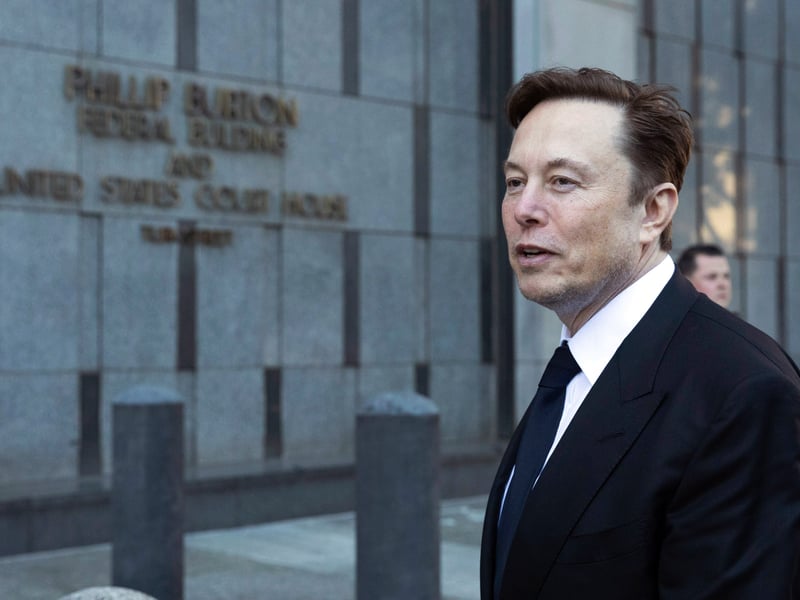
SAN FRANCISCO (CN) — Federal courts do not have jurisdiction over a fraud and breach of contract suit filed by former CNN host Don Lemon against Elon Musk, a federal judge said in a ruling determining that Musk and X Corp. were citizens of California when the action was filed.
Lemon’s suit — claiming that he and Musk had a deal for an interview show on X, including a guaranteed $1.5 million annual salary along with other bonuses and incentives — will remain in San Francisco Superior Court where he first filed it in August.
Lemon claims he spent hundreds of thousands of dollars to set up a company and studio to record the interviews but was never paid after Musk became angry at a question during a March 8 interview.
In that interview, when Lemon asked the billionaire X owner about hate speech on the platform, Musk replied, “I don’t have to answer that question.”
Lemon said that Musk’s behavior deceived him, and that Musk was hoping to profit from the name recognition of a well-known American broadcaster without honoring his side of the agreement.
Shortly after the lawsuit was filed in San Francisco Superior Court, Musk had the action removed to federal court in September. In her order filed late Friday, U.S. Senior District Judge Maxine Chesney, a Bill Clinton appointee, granted Lemon’s motion to remand the case back to Superior Court, writing that X was not yet a citizen of Bastrop, Texas when the action was filed.
“In sum, while X Corp.’s relocation may eventually be far enough along to establish a nerve center in Bastrop, Texas, Musk fails to meet his burden to show such nerve center was established as of September 16, 2024,” Chesney wrote in her 10-page order.
In both his notice of removal and opposition to Lemon’s motion to remand, Musk attempted to establish Bastrop, Texas, as X Corp.’s principal place of business — relying on a lease executed in April on property in the small city outside of Austin and on corporate forms and legal filings listing Bastrop as X Corp.’s corporate address. He also attempted to use his residency and that of X’s CEO, Linda Yaccarino, along with statements about the location and structure of X Corp.’s decision-making and the closing X’s San Francisco office in September.
“First, Musk’s showing as to the lease essentially stops where it starts. Musk has not alleged, let alone submitted evidence showing, what operations or decision-making, if any, have taken place at the leased site, nor has he provided any details about the lease or the property to which it applies; indeed, there is no evidence that the property even has an office building on it,” Chesney wrote.
Chesney added that registration statements filed in Iowa and Oregon from September signed by Musk personally listed Musk’s address as being in San Francisco.
“When viewed in the context of all the evidence, the forms and filings on which Musk relies are more consistent with a showing of preparation in advance of a headquarters transition rather than the transition itself,” Chesney wrote.
Finally, Chesney noted that primary decision-making and operations may have continued in the Bay Area and California even after X closed its San Francisco office in September, citing X’s September registration statements filed with the Secretary of State of California as well as Yaccarino’s email announcing the closure of X’s San Francisco office, which stated that X would “work to transition to its new primary locations in the Bay Area,” including offices in San Jose and Palo Alto.
Lawyers for Lemon and Musk did not return requests for comment before publication, and X media relations did not return a request for comment.
Subscribe to our free newsletters
Our weekly newsletter Closing Arguments offers the latest about ongoing trials, major litigation and rulings in courthouses around the U.S. and the world, while the monthly Under the Lights dishes the legal dirt from Hollywood, sports, Big Tech and the arts.