
 Search Articles


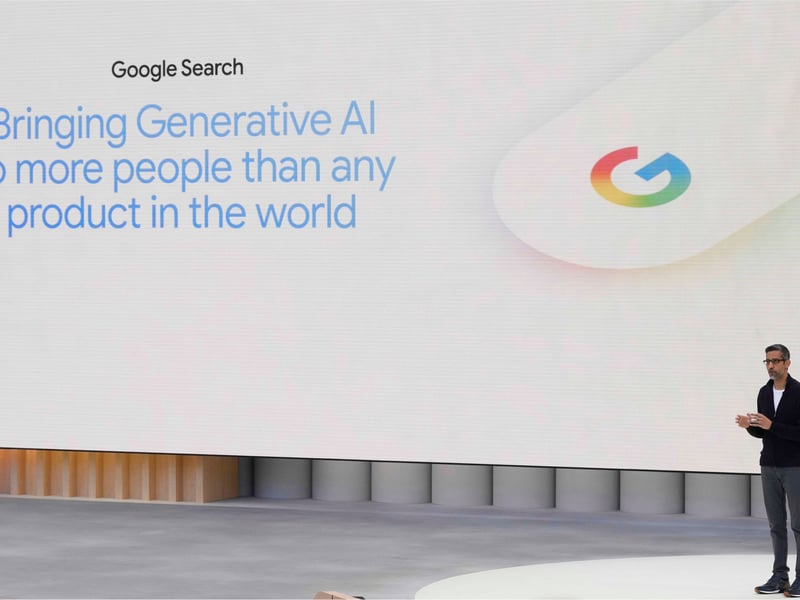
WASHINGTON (CN) — With closing arguments in the remedy portion of the antitrust trial over Google’s internet search monopoly set for Friday, the government and the tech giant each filed 200-plus-page briefs on Thursday addressing key questions about how generative artificial intelligence products fit into the court’s ultimate remedy.
U.S. District Judge Amit Mehta, after hearing two weeks of witness testimony earlier this month, is tasked with determining the appropriate solution to end Google’s dominance over internet search and search advertising, with a decision expected in August.
The Justice Department has urged the Barack Obama appointee to order the divestiture of Google’s Chrome browser and potentially Android, barring multimillion-dollar deals for default search engine status and the syndication of Google’s search data to help rivals improve their engines.
Throughout the remedy phase, however, the government has left what to do with Google’s new AI products, specifically its Gemini app, up to Mehta.
The Justice Department has expressed concern that the new technology could allow Google to circumvent any ultimate remedy Mehta imposes and maintain its search monopoly but concluded that the technology was developing too quickly to propose a remedy.
In Thursday’s 261-page brief, the feds argued that “GenAI” apps need to be treated like search access points, a term meant for devices or software where users can search the internet, such as browsers, a Google widget and Siri, among others.
Google’s Gemini app — and other AI products like ChatGPT, Perplexity and Microsoft CoPilot — and its “Circle to Search” feature on Android devices should fall under that definition and thus Mehta’s remedies.
“If remedies do not apply to GenAI apps, Google may be able to exclude GenAI-based general search rivals like it has historically excluded traditional general search rivals,” the Justice Department wrote. “GenAI apps are a nascent threat to Google because they are developing general search capabilities that might compete with traditional general search firms.”
As a result, GenAI competitors should also receive Google’s data and ads syndication so they can compete with Gemini, the Justice Department said.
Google has urged Mehta to craft a narrow remedy that would allow the tech giant to continue paying for default status by opening the agreements to bids from rival search engines. The agreements would only last a year and apply to single devices, so in a given year, the default search engines on iPhones may be different than iPads, Android devices or iMacs.
The Justice Department noted that trial testimony revealed Google has continued signing the exclusive revenue sharing agreements that Mehta ruled problematic when he found Google held an illegal search monopoly, only now for the Gemini app rather than Google Search.
Google CEO Sundar Pichai testified that the company has begun updating its search distribution agreements to align with its proposed remedies.
According to documents presented at trial, the most recent agreements maximize the money carriers get from Google by making it the default on all search access points and sending the maximum possible traffic to Google that way.
Specifically, Google signed a new, six-month revenue sharing agreement with Samsung two days before the remedy trial began, which would bring the agreement in line with Google’s proposals.
In its 259-page brief, Google warned that adopting the government’s expanded search access point definition to include GenAI products would “stifle innovation and preempt competition.”
“Plaintiffs’ proposed ban on paid distribution of ‘Search Access Points’ would have, for example, prohibited Google from competing against OpenAI for the paid distribution of their respective GenAI products within Apple Intelligence,” Google said.
The tech giant argued that GenAI can be used for much more than search, with uses in healthcare, education, manufacturing, finance, retail and commerce.
For its role in search, Google said, GenAI and AI have improved search engines — adding that the company has incorporated AI in search since 2015 — by improving responses for queries seeking certain documents and for misspelled queries, among others. Rivals like Microsoft’s Bing also improved after incorporating ChatGPT, thus improving competition.
ChatGPT’s meteoric rise as the primary GenAI product is further proof that Mehta need not intervene and expand his search-market remedies to apply to GenAI products.
According to Google, ChatGPT had 160 million daily active users as of March 28, nearly double the estimated number six months prior. The product’s monthly active user count has grown faster than “any other stand-alone consumer internet product that Google has ever tracked, including TikTok, Pinterest, Twitter, Facebook, Instagram and Snapchat.”
“The record evidence is unequivocal: the generative AI space is very competitive,” Google said. “Plaintiffs have not offered any evidence that Google has market power or otherwise has a leading position in the GenAI space with respect to model or product quality, let alone that there is a material advantage to Google with respect to foundation models.”
 Follow @Ryan_Knappy
Subscribe to our free newsletters
Our weekly newsletter Closing Arguments offers the latest about ongoing trials, major litigation and rulings in courthouses around the U.S. and the world, while the monthly Under the Lights dishes the legal dirt from Hollywood, sports, Big Tech and the arts.