
 Search Articles


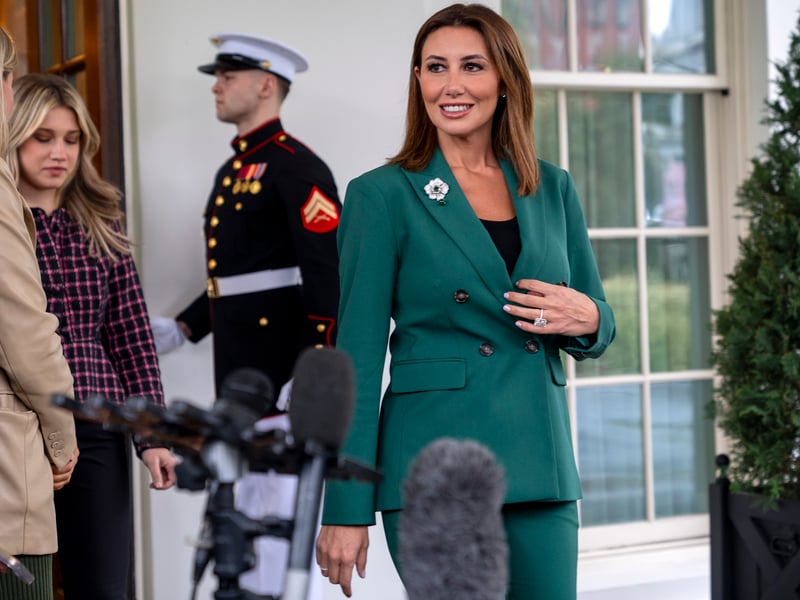
(CN) — A Trump administration lawyer on Monday defended the unusual appointment of Alina Habba as the U.S. attorney in the District of New Jersey, telling a federal appellate court that the maneuver was “consistent with longstanding practice.”
Justice Department attorney Henry Whitaker made the claim during lengthy oral arguments in the Third Circuit, where the government is trying to overturn a lower court’s finding that Habba’s appointment was unlawful.
“I didn’t think you’d say that,” U.S. Circuit Judge D. Brooks Smith said in response to Whitaker’s consistency argument, before going on to recount the unique legal maneuver the Justice Department used to keep Habba in power.
After Habba was voted out of her top prosecutor role by the district’s judges, the Trump administration withdrew Habba’s nomination for U.S. attorney, fired the replacement approved by the judges, then appointed Habba as the first assistant U.S. attorney for New Jersey. With the U.S. attorney job technically vacant at the time, Habba was automatically appointed back to the post from which she was just booted.
“Can you come up with an example of any time that such a concatenation of events has occurred with respect to the appointment of a United States attorney?” Smith, a George W. Bush appointee, posed.
“Well, I guess I cannot,” Whitaker replied.
U.S. Circuit Judge D. Michael Fisher, another George W. Bush appointee, scrutinized one specific step of the maneuver: Habba’s appointment to the first assistant U.S. attorney, which by default propelled her back into the leading role.
Fisher said that, historically, the first assistant’s job was filled by an “experienced person” who — unlike Habba — has worked in the district before.
“Congress had a very specific intent,” he said. “They wanted an experienced person to be that acting officer.”
Whitaker disagreed, claiming that the first assistant is a “political appointee.”
Prior to taking the reins of New Jersey’s federal court, Habba was a personal attorney for President Donald Trump, representing him in several losing efforts like his civil fraud case and his pair of defamation trials against writer E. Jean Carroll.
A lower court in August found that Habba’s unorthodox appointment to New Jersey’s U.S. attorney role violated federal law.
“Faced with the question of whether Ms. Habba is lawfully performing the functions and duties of the office of the United States Attorney for the District of New Jersey, I conclude that she is not,” U.S. District Judge Matthew Brann, a Barack Obama appointee in the Middle District of Pennsylvania, wrote in an order from Aug. 21.
By that point, Habba’s scrutinized appointment had thrusted New Jersey’s federal court into chaos, as criminal defendants argued that prosecutors had no rightful boss and sought ends to their cases. Brann ruled that Habba could not have involvement in any district cases but declined to dismiss any on that basis.
Lawyer James Pearce said Monday that, if the Third Circuit were to overturn Brann’s ruling, it would “in essence permit the Attorney General to set up a shadow government of delegated U.S. attorneys throughout the country.”
“That just can’t be right,” said Pearce, who represents the Association of Criminal Defense Lawyers of New Jersey, an amicus in the case.
Abbe Lowell, who represents two of the criminal defendants whose cases in New Jersey were affected, agreed. He chastised the government for constructing a hybrid role for Habba that gives her all the powers of a U.S. attorney while circumventing the proper procedure to give her that title.
“The government cites a chimera of seven different statutes that they alternate depending on what they are trying to accomplish to call her the interim U.S. attorney, an acting U.S. attorney, the first assistant U.S. attorney or a special attorney,” Lowell said.
“The only thing she doesn’t have is that certificate on the wall that says ‘United States Attorney for the District of New Jersey,’” he added.
The Third Circuit panel didn’t immediately issue a ruling on Monday. U.S. Circuit Judge L. Felipe Restrepo, an Obama appointee, was at the bench alongside Smith and Fisher.
Habba’s brief tenure as New Jersey’s top prosecutor has been marred by controversy. In addition to her questionable appointment, she faced criticism for saying in an interview that she wanted to use her role to help “turn New Jersey red.” U.S. attorneys typically shy away from making such overtly political statements.
Since then, Habba led the prosecution of Newark Mayor Ras Baraka, who was arrested in May on charges of trespassing at a federal immigration holding facility. That effort was rebuked by a magistrate judge, and Baraka is now suing for malicious prosecution.
 Follow @Uebey
 Follow @uebey.bsky.social
Subscribe to our free newsletters
Our weekly newsletter Closing Arguments offers the latest about ongoing trials, major litigation and rulings in courthouses around the U.S. and the world, while the monthly Under the Lights dishes the legal dirt from Hollywood, sports, Big Tech and the arts.