
 Search Articles


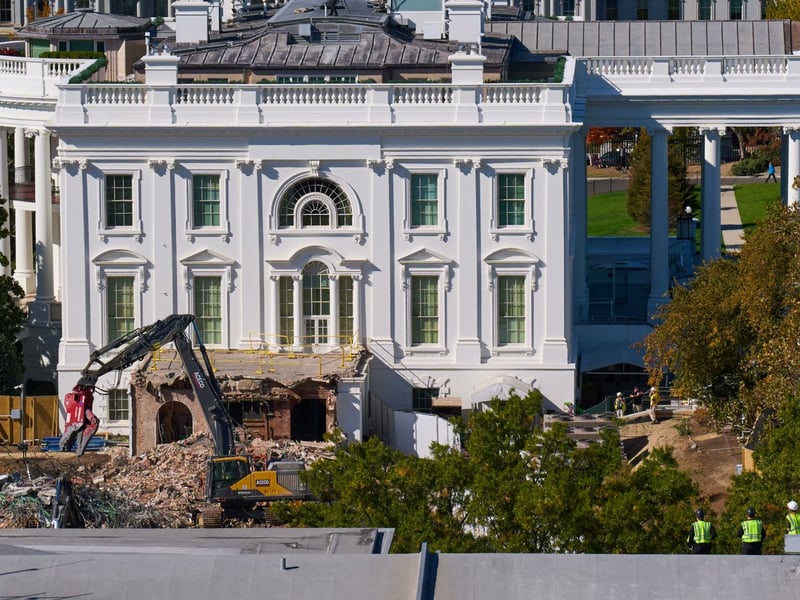
WASHINGTON (CN) — The Justice Department urged a federal judge to reject the National Trust for Historic Preservation’s effort to halt construction on President Donald Trump’s White House ballroom, arguing in a series of documents filed Monday that pausing the project would create significant security concerns.
The National Trust sued the Trump administration on Friday, arguing that the unilateral decisions to demolish the East Wing and begin construction on the 90,000-square foot ballroom were unlawful without congressional approval, review by federal oversight commissions, an environmental study or an opportunity for public comment.
In a 36-page opposition brief, the Justice Department argued that the ballroom project was just the latest in a long line of renovations at the White House meant to meet “modern needs,” specifically to receive ambassadors and other foreign dignitaries.
That line includes President James Monroe’s construction of the South Portico in 1824, President Woodrow Wilson’s approval of the Rose Garden in 1913, President Franklin Roosevelt’s construction of the East Wing and underground bomb shelter in 1942 and President Richard Nixon’s construction of the Brady Press Briefing Room in 1970.
“All changed the look and function of the president’s residence, sometimes substantially so,” the Justice Department said. “Many were controversial in their day. None were circumscribed by Congress or constrained in the manner plaintiff seeks.”
Along with the opposition brief, the Justice Department attached 11 exhibits that include declarations from Secret Service Deputy Director Matthew Quinn, National Park Service Liaison to the White House John Stanwich, National Park Service Comptroller Jessica Bowron and National Park Service Associate Regional Director of Lands and Planning Tammy Stidham.
Quinn stated he oversees the office responsible for managing the Secret Service’s role in the ballroom project and said the project contractor — the White House tapped Clark Construction and AECOM as the lead contractors — is in charge of providing temporary security and safety measures around the site, on which the service coordinates.
“While the contractor has completed most of these temporary security measures, improvements to the site are still needed before the Secret Service’s safety and security requirements can be met,” Quinn wrote. “Accordingly, any pause in construction, even temporarily, would leave the contractor’s obligation unfulfilled in this regard and consequently hamper the Secret Service’s ability to meet its statutory obligations and protective mission.”
The Justice Department also included the National Park Service’s environmental assessment and its resulting “Finding of No Significant Impact.”
According to the finding, dated Aug. 28, the park service concluded that while the construction project will come with some adverse impacts — such as an obstructed view of the White House during and after construction — the ballroom will remove previous security concerns associated with using temporary tents for large events.
“Successive administrations, including the current one, and existing planning documents have consistently recognized the need for a secure event space capable of hosting large official functions without reliance on temporary tents and associated infrastructure,” the park service said.
Stanwich added in his declaration that the use of tents for large events such as state dinners on the South Lawn have caused “substantial damage” to the turf on the White House grounds, which the park service then has to repair or remediate.
“The use of stakes to secure these tents also risks damaging irrigation systems and other NPS infrastructure elements on the ground,” Stanwich said.
He added that halting the construction would itself amount to an adverse impact on White House visitors, as they are currently unable to view historic sites such as the Vermeil Room, the China Room and the library.
Further, the East Colonnade, which connected the East Wing to the White House itself, will be reconstructed as part of the ballroom construction, Stanwich said.
“If progress on the project were halted, this would prolong these impacts to the experiences of park visitors,” Stanwich continued.
The park service also conducted an assessment regarding potential impacts on certain endangered and threatened specieswith habitats around D.C., including the endangered northern long-eared bat, the proposed endangered tricolored bat and the proposed threatened monarch butterfly.
It concluded the construction would have no effect on any federally listed species or their habitats, adding that when construction began on Nov. 14, active bat season had already ended, and that there were no designated critical habitats in or near the construction area.
The filings come as the Justice Department and the National Trust are set to argue Tuesday afternoon before U.S. District Judge Richard Leon, a George W. Bush appointee who will decide whether to grant the historical organization a temporary restraining order halting the ballroom’s construction.
 Follow @Ryan_Knappy
Subscribe to our free newsletters
Our weekly newsletter Closing Arguments offers the latest about ongoing trials, major litigation and rulings in courthouses around the U.S. and the world, while the monthly Under the Lights dishes the legal dirt from Hollywood, sports, Big Tech and the arts.