
 Search Articles


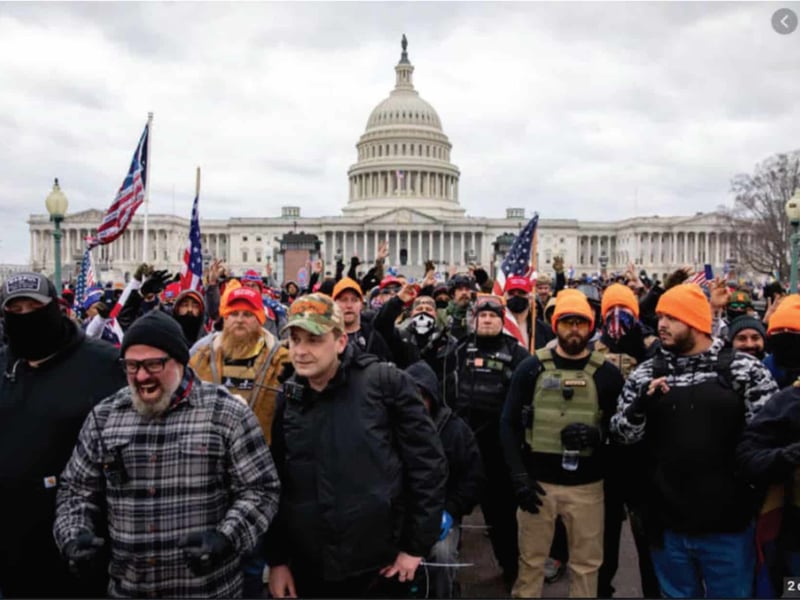
WASHINGTON (CN) — Federal prosecutors have begun dropping obstruction charges from the cases of certain Capitol riot defendants in the wake of the U.S. Supreme Court’s decision limiting the Justice Department’s former staple charge in the January 6, 2021, prosecutions.
In a 6-3 decision in June, the Supreme Court held that the federal government had wrongfully levied a felony charge of obstruction of an official proceeding against Jan. 6 defendants, finding that the statute only applies to conduct like document destruction.
The Justice Department has repeatedly pointed out that the high court’s decision would only apply to a small number of defendants whose only felony charge was obstruction of an official proceeding.
However, that small group of defendants also includes certain members of the extremist organizations the Oath Keepers and the Proud Boys, whose leaders were charged and convicted of seditious conspiracy.
Arthur Jackman — a Proud Boy from Florida who was seen at the U.S. Capitol with other leaders of the group who were convicted of seditious conspiracy, including Joseph Biggs and Zachary Rehl — is one such defendant.
Jackman faced seven charges, including obstruction of an official proceeding, entering a restricted building, disorderly conduct in a restricted building, entering the gallery of Congress, disorderly conduct in the Capitol, parading in the Capitol and theft of government property.
In a memorandum filed on Monday, the Justice Department informed the court that it would drop the obstruction charge against Jackman and his co-defendants Paul Rae, Edward George Jr., Nathan Tuck and Kevin Tuck. While the government still wishes to continue with an upcoming Sept. 9 trial, it indicated that plea offers had been made to Jackman and his co-defendants for their other pending charges.
Besides the soon-to-be-dismissed felony obstruction charge, Jackman only faces misdemeanors, while Rae, George and Nathan Tuck face other felonies for rioting, destruction of property and assaulting police.
Kellye SoRelle, lawyer for the Oath Keepers and former girlfriend of its leader, Stewart Rhodes, also agreed to plead guilty next month to charges excluding the obstruction count.
According to the Justice Department in its most recent monthly update, 1,178 individuals of the total 1,472 defendants charged in connection with the Capitol riot were not charged with obstruction of an official proceeding.
Of the remaining 259, 133 have already been sentenced — 76 of those were convicted on other felonies and 40 have already been released from prison. There are only 17 defendants of that 133 who were sentenced on just felony obstruction with certain misdemeanors and remain incarcerated.
The other 126 defendants are on pretrial release while awaiting sentencing or trials.
The Justice Department emphasized that there are zero cases where a defendant was only charged with obstruction of an official proceeding and every defendant faces some other felony or misdemeanor charges.
In total, just 2% of Capitol riot defendants could potentially benefit from the Supreme Court’s decision.
The obstruction charge, created under Title 18 U.S. Code Section 1512 (c)(2), became a mainstay in the Justice Department’s prosecution of the Capitol riot, regularly arguing that defendants violated the document-destruction statute by interfering with Congress as it attempted to certify the 2020 election.
Prosecutors argued that an “otherwise” clause in the statute expanded relevant conduct to include any action that interfered with an official proceeding.
The Supreme Court saw otherwise.
Chief Justice John Roberts wrote in the court’s majority opinion that the Justice Department had overstepped by applying Section 1512 to the Capitol riot, finding that the statute was limited to document destruction.
The George W. Bush appointee said that if Congress wanted the charge to apply to more than just evidence impairment, they would have said so when crafting the statue in the Sarbanes-Oxley Act in 2002 following the Enron scandal.
“It would be peculiar to conclude that in closing the Enron gap, Congress actually hid away in the second part of the third subsection of Section 1512 a catchall provision that reaches far beyond the document shredding and similar scenarios that prompted the legislation in the first place,” Roberts wrote.
While the high court’s decision primarily applies to Jan. 6 defendants, it is also expected to reverberate in Donald Trump’s federal election interference case brought by special counsel Jack Smith, in which two of his four charges are related to Section 1512.
The mandate in Trump’s case was recently returned to U.S. District Judge Tanya Chutkan following the high court’s decision to grant Trump broad presidential immunity, where she will have to conduct a “mini-trial” to determine which of Trump’s purported conduct constitute “official” vs. “unofficial” acts.
The Barack Obama appointee has yet to schedule any new hearings since the high court’s decision on July 1, but she will have to also consider whether the two obstruction-related charges can still stand in addition to conducting the mini-trial.
 Follow @Ryan_Knappy
Subscribe to our free newsletters
Our weekly newsletter Closing Arguments offers the latest about ongoing trials, major litigation and rulings in courthouses around the U.S. and the world, while the monthly Under the Lights dishes the legal dirt from Hollywood, sports, Big Tech and the arts.