
 Search Articles


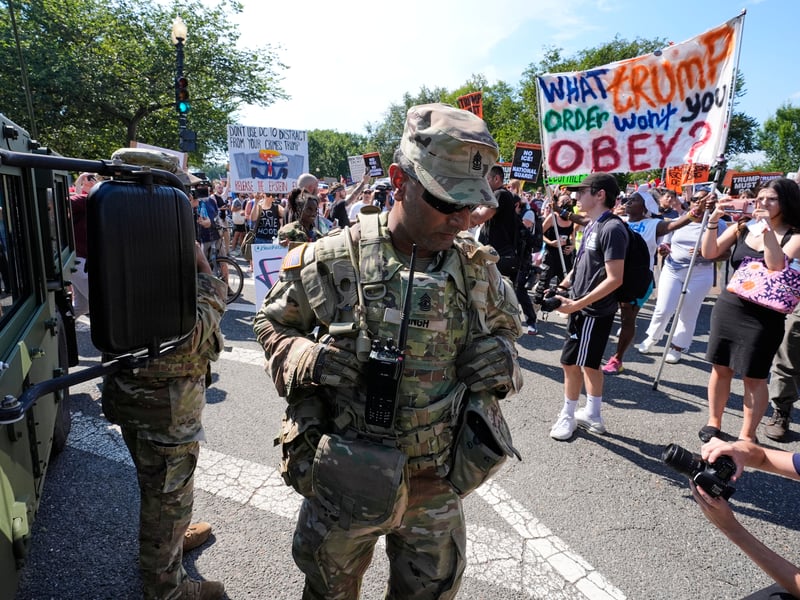
WASHINGTON (CN) — The Justice Department argued Friday that National Guard troops deployed in the nation’s capital could legally participate in law enforcement activities and suggested there are few limits as to what those activities could entail.
About 2,300 National Guard troops have patrolled Washington since President Donald Trump declared a crime emergency Aug. 11, focusing on “beautification” work and supporting local Metropolitan Police.
At a hearing before U.S. District Judge Jia Cobb, Justice Department attorney Eric Hamilton declined to specify limits on the Guard’s deployment, saying its presence has reduced crime and “is making D.C. safer.”
Hamilton pointed to Title 32 Section 502(f), which authorizes National Guard members to “be ordered to perform training or other duty,” which may include “[s]upport of operations or missions undertaken by the member’s unit at the request of the President of Secretary of Defense.”
Hamilton argued that the phrase “other duty” grants the president broad authority to assign the National Guard to law enforcement roles, since Congress set no specific limits on such missions.
Cobb, a Joe Biden appointee, questioned why the Justice Department deputized troops as Special Duty U.S. Marshals if they were not intended for police work. Hamilton said the move let them carry service weapons, including M4 rifles and M17 handguns.
Mitchell Reich of the D.C. Attorney General’s Office called that interpretation clearly wrong, noting D.C.’s 1889 Militia Code, modeled on similar state laws, lists “other duties” alongside drills, inspections, parades and escorts.
“If ‘other duties’ included setting up a domestic police force, it wouldn’t be induced along with parades,” Reich said.
He added that D.C. regularly requests National Guard deployments around Inauguration Day to act as crowd control, a role that does not require troops carry their service weapons.
Hamilton argued Trump’s deployment mirrors past uses of the D.C. National Guard, citing George W. Bush’s mobilization after the Sept. 11 attacks and Barack Obama’s 2010 deployment to assist Customs and Border Protection during Operation Phalanx.
Cobb ordered expedited discovery and scheduled Friday’s hearing to determine whether Guard troops have engaged in law enforcement despite their stated support role for the Metropolitan Police.
Schwalb filed the suit Sept. 4, arguing Trump’s deployment violates both the Home Rule Act and the Posse Comitatus Act — the same law U.S. District Judge Charles Breyer ruled Trump breached when sending troops to Los Angeles.
On Aug. 11, Trump invoked a provision of the 1973 Home Rule Act — which created D.C.’s local government — to take emergency control of the Metropolitan Police Department for 30 days.
Court filings last week showed the National Guard deployment could now extend through summer 2026, far beyond the current Nov. 30 deadline and the original Sept. 10 end date.
In an email, Brigadier General Leland Blanchard II, the mission’s interim commander, told officers to “plan and prepare for a long-term persistent presence” in Washington, possibly lasting through the “America 250” celebrations.
In a supplemental memorandum, Schwalb pointed to Blanchard’s communications as proof that the National Guard’s deployment amounts to a grave “incursion on the District’s sovereignty” that “constitutes proof of an irreparable harm.”
The Justice Department has argued that the D.C. National Guard has operated as a liaison with the out-of-District National Guard units and they remain under the “administrative command and control” of their states’ governors.
Further, Guard troops have continued in their support role to civil authorities and have not engaged any core law-enforcement functions, such as arrests, searches or seizures or other such activities, the Justice Department contends.
Hamilton slammed the lawsuit as a “deeply unfortunate political stunt,” arguing that D.C. Mayor Muriel Bowser’s Sept. 2 executive order establishing the “Safe and Beautiful Emergency Operations Center” to help coordinate operations with the National Guard showed the local government was on board with the deployment.
Reich rejected the implication that the Attorney General’s office had sat on its rights and said the suit was only brought once it became clear how many states were sending their National Guard contingents and how long the troops would remain in the city.
He pointed to Bowser’s Oct. 15 comments at the Fortune Most Powerful Women conference, where she said it is illegal “for the National Guard to police Americans on American soil.”
 Follow @Ryan_Knappy
Subscribe to our free newsletters
Our weekly newsletter Closing Arguments offers the latest about ongoing trials, major litigation and rulings in courthouses around the U.S. and the world, while the monthly Under the Lights dishes the legal dirt from Hollywood, sports, Big Tech and the arts.