
 Search Articles


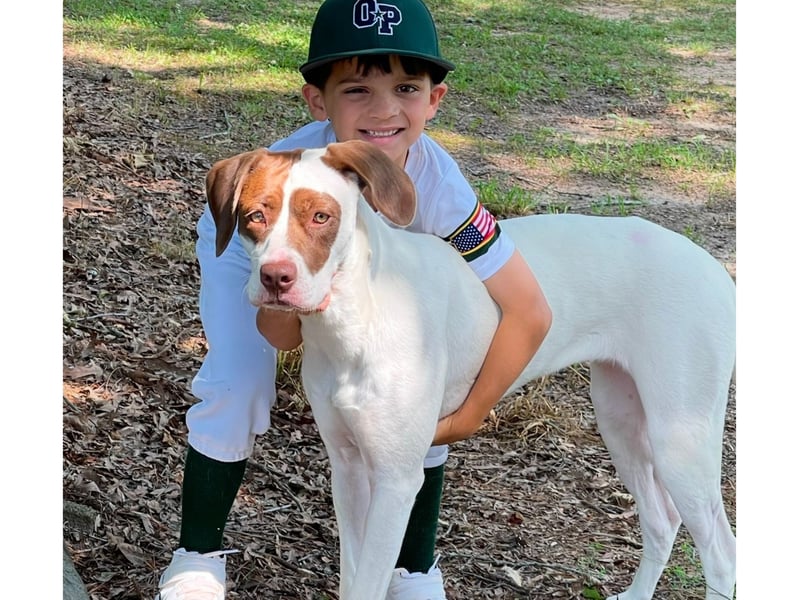
ATLANTA (CN) — What started as a typical December night for the Carr family changed in an instant after two police officers showed up in their front yard.
The officers were responding to a distress call in the area. As father Justin Carr went outside to speak with them, the family’s two dogs, Hank and Zeta, followed him out.
Justin’s wife Tessa was able to grab Hank’s collar — but Zeta wasn’t so lucky. She made it down the porch steps.
Within seconds, one of the officers had shot her in the head.
Inbodycam footage, officers can be heard telling Justin to grab the dog. Before he or Tessa could, they say the officer had already fired. Zeta was on her side, bleeding out.
“It felt like slow motion,” Tessa Carr said in an interview. “There were my three kids — ages 10, 9, and 7 — watching their family member twitch and fall and fight for her life.”
According to Cobb County guidelines, “shooting a domesticated animal should be a last resort,” only if an animal becomes aggressive and only after measures like pepper spray, batons or tasers. Officers should “avoid shooting the animal in the head” or “in view of the public, especially children.”
In spite of that, Cobb County Police Chief Stuart VanHoozer justified the officer’s actions, saying in a statement that Zeta was “perceived as a potential threat.” The officers, whose names have not been released, remain on the job.
The Carr family remains deeply troubled by the incident. In an interview, Tessa Carr said the officers had not used nonlethal tools like a taser or mace. She said Zeta was only barking. “What if my kids would have walked around the side of the house and the bullet missed or ricocheted? [What] if this officer would have hit Justin as he was following their orders?”
Carr was particularly bothered by the psychological impact on her children. “The people who they should turn to help for are now viewed as villains,” she said. “I am doing my best as a mother to undo the pain that this officer caused to my babies.” A “Justice for Zeta” Facebook page now has over 3,000 followers.
Incidents like this are common in the United States, an underlooked aspect of police violence known as canicide.
According to some estimates, police kill 10,000 pet dogs per year. There is no official national count.
Cases of police shooting dogs have risen dramatically in recent years, Sherry Ramsey, the director of Animal Cruelty Prosecutions for the U.S. Humane Society, said in a statement. Almost all of them could have been deescalated, she said.
“The worst thing is, there are a lot of these cases that are just absolutely unnecessary,” said Jim Crosby. A retired Florida cop, he now serves as director of the Canine Encounter Training program at the National Law Enforcement Center on Animal Abuse. He also designed the Law Enforcement Dog Encounter Training course, a program of the National Sheriff’s Association.
Sometimes, police-dog encounters can lead to human casualties. “Remember, there’s not just the animals that are at risk here,” Crosby said.
He cited an incident from Iowa in 2015, where an officer was responding to a domestic dispute. A couple was arguing in their front yard when their dog came running out of their house. The responding officer panicked, drew his weapon, slipped on the snow and ice and then accidentally shot and killed the mother in front of her four-year-old son.

“If the officer had done anything else, that woman would probably still be alive today,” Crosby said. “So, there is collateral damage that occurs in situations that weren’t really life-threatening.”
Despite the stakes, most police departments do not require animal-encounter training. Only California, Colorado, Illinois, Tennessee and Texas have state laws mandating dog-encounter training for law enforcement.
Crosby’s training courses — like other types of law-enforcement drills — focus on putting officers in realistic scenarios where they have to quickly evaluate situations and make decisions. Those skills can also pertain to human encounters, reducing the risk of fatal shootings in general.
The trainings focus not only on dog behavior but on deescalation tools. Pepper spray, he noted, is nearly 100% effective at deterring dogs. The goal, Crosby says, is to remind officers that “these tools are effective” and that “no, you don’t have to shoot Fluffy.”
In May, police in Sturgeon, Missouri shot and killed Teddy, a 13-pound deaf and blind Shih Tzu mix that had stumbled into a stranger’s yard. The city justified the officer’s lethal actions, claiming he saw Teddy “behaving strangely and displaying signs of possible injuries” that was “perceived to be rabid behavior.”
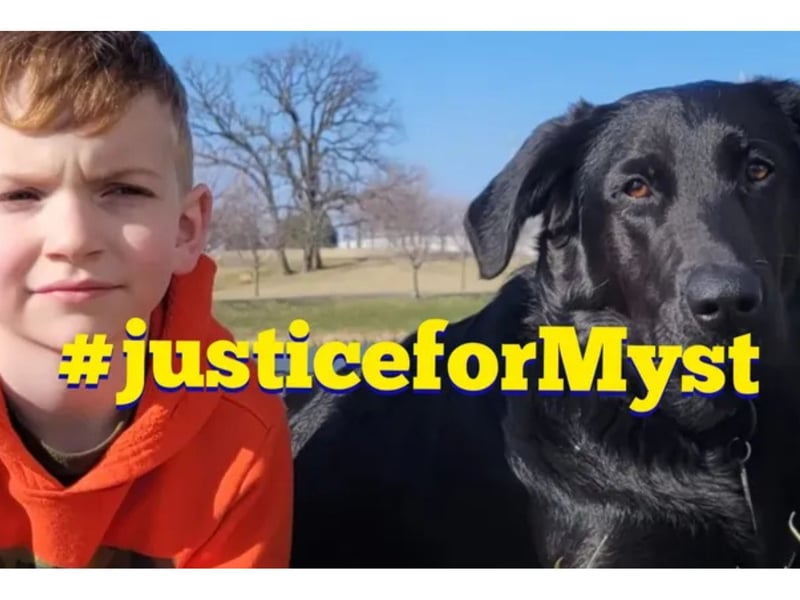
In August, police in Davenport, Iowa shot and killed Myst, a black Labrador, in front of her family. Her owner, Don Hesseltine, said the officer left the scene immediately after the shooting, which was later deemed lawful.
Videofootage of the incident shows Myst running alongside the family children when a police cruiser approaches. The officer instructs the children to put Myst inside the house. As they attempt to comply, the officer exits his vehicle and walks toward the property.
Myst approaches the officer and barks. The officer fires two shots. The dog retreats in pain, collapses and dies as her family screams.
“She was just trying to say hi,” one of the children can be heard saying in the video.
A2020 study found that officers shot more dogs in nonwhite majority census tracts compared to white ones.
Police-on-dog violence, in other words, maps closely to police-on-human violence. Since more than one-third of American households have a dog, officers are likely to encounter one when they approach or enter a residence.
There is little to no data on how often police officers are actually injured by someone’s pet dog. But police dogs bite thousands of citizens every year, according to research from The Marshall Project, a nonprofit newsroom focused on criminal justice.
To Crosby, the situation points to deeper problems with American policing. “We’ve got issues within the police community, where certain responses have become programmed that are maybe a bit more over the top than the way I was taught.”
Claudine Wilkins, an animal law expert, attorney and former prosecutor in Georgia, helps represent those affected by pet shootings in court. She actively works with Crosby to spread awareness about the need for better police training. But while dog-encounter training is available to police departments for free, most simply don’t use it, Wilkins said — leading them to face legal costs and bad publicity when tragedy happens.
Police do sometimes encounter truly dangerous dogs. Often, though, the dogs they kill are well-behaved family pets that only want to protect their homes and families from intruders.
Because officers are granted broad legal protections under threatening situations, and because dogs are legally considered property, many dog shootings do not lead to legal proceedings or disciplinary actions. But these incidents can sometimes lead to lawsuits, costing small police departments millions.
With or without lawsuits, these dog shootings leave families like the Carrs traumatized. “I wish officers knew that dogs as a whole are not a threat to them,” Tessa Carr said. “Dogs are not criminals and should not be treated as such.”
“Zeta was family,” Carr said. Weeks later, the family still can’t bring themselves to fold up or throw away her crate. “These tragedies are preventable, and I hope that Zeta’s story can bring awareness to these injustices,” she added. “More than anything, I don’t want another family to have to go through this unnecessary pain.”
 Follow @Megwiththenews
Subscribe to our free newsletters
Our weekly newsletter Closing Arguments offers the latest about ongoing trials, major litigation and rulings in courthouses around the U.S. and the world, while the monthly Under the Lights dishes the legal dirt from Hollywood, sports, Big Tech and the arts.