
 Search Articles


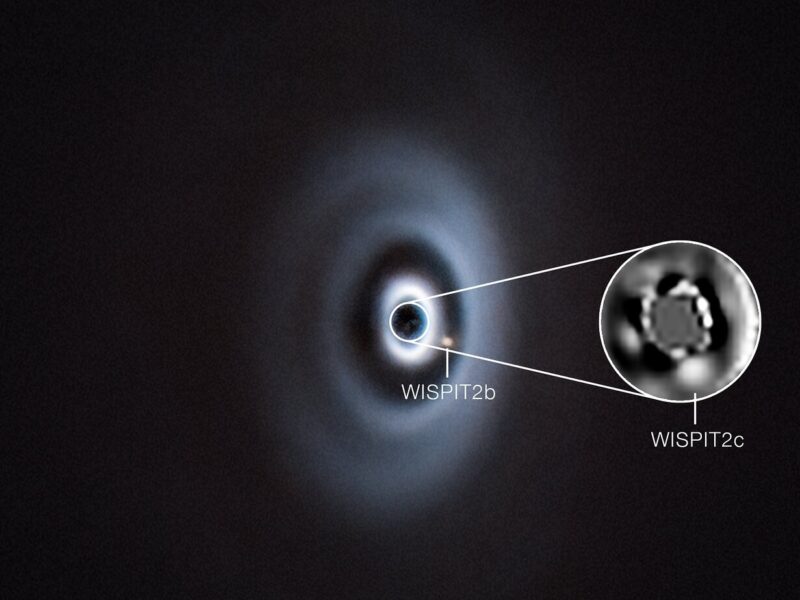
(CN) — Astronomers may be witnessing a scene similar to the birth of our own solar system after documenting a new planet forming around the disc surrounding a young star.
Astronomers in a study published in The Astrophysical Journal Letters on Tuesday first discovered the first planet last year forming around the young star, identified as WISPIT 2. But new research from European scientists confirmed the discovery of a second planet, the new study says.
The new discovery about the young solar system will provide researchers with new insight into how solar systems, including our own, develop and mature over time, the scientists said.
The formation of this young solar system is only the second of its kind that astronomers have been able to identify, according to the European Southern Observatory. However, unlike the first system, PDS 70, the new WISPIT 2 has an extended planet-forming disc with what researchers describe as distinct gaps and rings.
“WISPIT 2 is the best look into our own past that we have to date,” said Chloe Lawlor, the lead author of the study and an astrophysicist and doctoral student at the University of Galway, Ireland. “These structures suggest that more planets are currently forming, which we will eventually detect.”
The young star is said to be analogous to the Sun, the scientists wrote in the study. Despite its young age, the WISPIT 2 system functions on a much larger scale than our own solar system.
The system identifier, WISPIT, stands for Wide Separation Planets in Time. Both planets around WISPIT 2 are gas giants, similar to the outer planets in our own solar system.
WISPIT 2b, the first planet identified in the system last year, has a mass nearly five times that of Jupiter and orbits its central star at roughly 60 times the distance between Earth and the Sun, according to the observatory. WISPIT 2c, the latest discovery, is four times closer to the central star than WISPIT 2b and is twice as massive.
“WISPIT 2 gives us a critical laboratory not just to observe the formation of a single planet, but an entire planetary system,” said Christian Ginski, a study co-author and an astronomer at the University of Galway.
The main difference between the WISPIT 2 planets and the gas giants in our own solar system is that they are much younger, hotter and larger, Ginski said.
Both planets in the young solar system appear in clear gaps within the disc of dust and gas that forms around the star, often referred to as the circumstellar disc. These discs, which can also include asteroids and other objects, eventually form into planets.
The gaps in these discs are a result of each planet’s development as particles accumulate under pressure from gravity. The rings that scientists also observed are the leftover materials around the gaps — similar to the rings of Saturn but around a planet, Ginski said. The Kuiper Belt in our solar system is a remnant of our solar system’s own planet-forming disc, he said.
Astronomers say that there is at least one other gap in WISPIT 2’s disc.
“We suspect there may be a third planet carving out this gap, potentially of Saturn mass owing to the gaps being much narrower and shallower,” Lawlor said.
WISPIT 2c was discovered with the European Southern Observatory’s Very Large Telescope located in Chile. The astronomers used different instruments on the telescope, such as the SPHERE, to correct the blur caused by atmospheric turbulence and to block light from its central star. The astronomers also used the GRAVITY+ instrument to help confirm the planetary nature of WISPIT 2c.
“This detection of a new world in formation really showed the amazing potential of our current instrumentation,” said Richelle van Capelleveen, a doctoral student at the Leiden Observatory of the Netherlands and a leader of the team that discovered WISPIT 2b.
The researchers hope they may be able to directly image the planets when the European Southern Observatory’s Extremely Large Telescope is operational. The telescope, also located in Chile, is expected to begin its observations in 2030.
“With this new detection, WISPIT 2 becomes only the second system (after PDS 70) to host multiple directly imaged young giant planets in formation, making it a prime target for follow-up observations with the upcoming ELT,” astronomers wrote in the study. “This offers a rare opportunity to probe how early system architectures emerge … While the available data remain limited, these results bring us one step closer to making direct connections between the initial conditions of planet formation and the final architectures of planetary systems.”
Subscribe to our free newsletters
Our weekly newsletter Closing Arguments offers the latest about ongoing trials, major litigation and rulings in courthouses around the U.S. and the world, while the monthly Under the Lights dishes the legal dirt from Hollywood, sports, Big Tech and the arts.