
 Search Articles


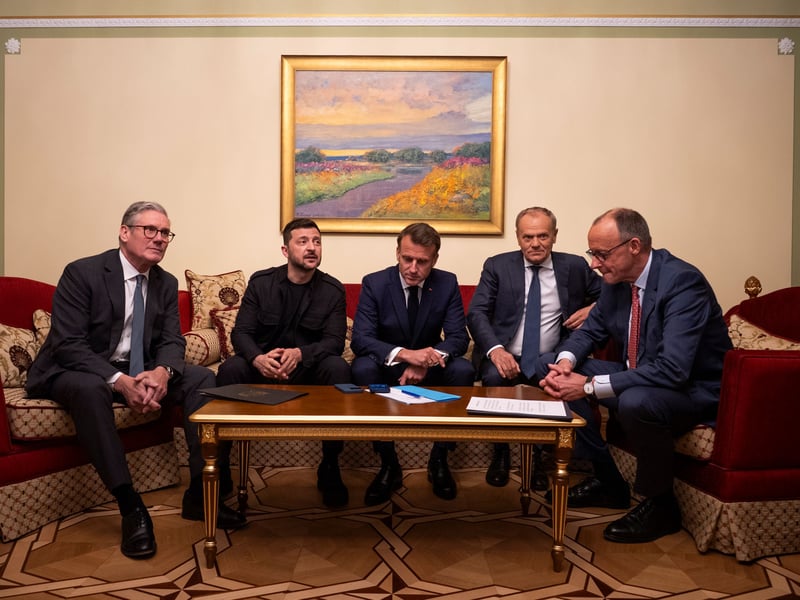
(CN) — Efforts to end the war in Ukraine through diplomacy are speeding up ahead of a proposed meeting in Istanbul on Thursday that could even see a dramatic encounter of Russian President Vladimir Putin, Ukrainian President Volodymyr Zelenskyy and U.S. President Donald Trump.
The prospects, though, of such a meeting taking place are far from certain, and the likelihood of major diplomatic breakthroughs remains poor with Kyiv and Moscow still showing they have the strength to carry on fighting on the battlefield and neither side willing to cede ground at the negotiating table over their opposing demands.
But the stakes are getting higher as the parties involved in the war — Kyiv, Moscow, Washington and European leaders — each strive to achieve an outcome they want.
A frenzy of diplomatic maneuvers was set into motion by a Saturday visit to Kyiv by an increasingly assertive quartet of European leaders: French President Emmanuel Macron, British Prime Minister Keir Starmer, German Chancellor Friedrich Merz and Polish Prime Minister Donald Tusk.
They took a train to Kyiv, where they were met by Zelenskyy as part of a show of unity to counter events taking place in Moscow. On Friday, Putin hosted numerous world leaders — including Chinese President Xi Jinping, Brazilian President Luiz Inácio Lula da Silva and the prime ministers of Slovakia and Hungary, EU members — on the occasion of the 80th anniversary of Victory Day, a holiday marking the Soviet Union’s win over Nazi Germany.
In Kyiv, the European leaders issued an ultimatum to Moscow: accept Zelenskyy’s offer of a 30-day ceasefire on Monday or face even tougher countermeasures.
“We now expect an equally clear response from Russia. There can be no negotiations while weapons are speaking,” Macron said on social media. “There can be no dialogue if, at the same time, civilians are being bombed. A ceasefire is needed now, so that talks can begin. For peace.”
The European leaders said they had the support of the U.S., too, in their demand for an immediate ceasefire.
But in a late-night news conference on Saturday marking the end of the Victory Day events, Putin rejected the European leaders’ demand and instead called on Ukraine to resume peace negotiations that were taking place in Istanbul in March 2022, just over a month after Russia invaded Ukraine. Those talks were terminated under pressure from Western leaders, including former U.S. President Joe Biden and former British Prime Minister Boris Johnson. Putin challenged Zelenskyy to resume those talks in Istanbul on Thursday.
“Russia is ready for negotiations without any preconditions,” Putin said.
Then, on Sunday night, Trump seemingly contradicted the statement by the European leaders by taking to social media and urging Zelenskyy to accept Putin’s offer to resume talks in Istanbul on Thursday and “negotiate a possible end to the bloodbath.”
“At least they will be able to determine whether or not a deal is possible, and if it is not, European leaders, and the U.S., will know where everything stands, and can proceed accordingly!” he wrote on Truth Social.
Shortly afterward, during his nightly video address, Zelenskyy laid down his own challenge: He said he would go to Turkey on Thursday but that he wanted to meet Putin in person.
On Monday, Dmitry Peskov, the Kremlin spokesman, rejected the pressure from European leaders.
“The language of ultimatums is unacceptable to Russia, it is not appropriate. You cannot talk to Russia in such a language,” Peskov told reporters during a briefing call, AFP reported. He did not say whether Putin planned to go to Istanbul.
Putin faces an International Criminal Court (ICC) arrest warrant for war crimes over accusations that Russia deported Ukrainian children to Russia. But Turkey, like Russia and the U.S., is not a signatory to the Rome Statute, the treaty that established the ICC. Therefore, Putin would likely feel safe traveling there.
On Monday, Trump said he might go to Istanbul for the talks. Trump lands in Saudi Arabia on Tuesday for his first major international trip.
“I was thinking about flying over. I don’t know where I’m going to be on Thursday,” Trump told White House reporters. “I’ve got so many meetings, but I was thinking about actually flying over there.”
He added: “There’s a possibility of it, I guess, if I think things can happen, but we’ve got to get it done.”
On Monday, European leaders insisted their ultimatum against Russia remained in effect. Germany said Russia would be hit with new sanctions unless it agreed to the ceasefire by the end of the day.
“The clock is ticking, we still have 12 hours until the end of the day, and if the ceasefire is not in place by then, the European side will [set in motion] preparations for sanctions,” said Stefan Kornelius, a spokesman for the new Merz-led German government.
Merz has taken a hawkish stance on the Ukraine war by ordering a major rearmament and saying he was ready to send Ukraine German-made Taurus long-range missiles. Former Chancellor Olaf Scholz barred their shipment to Kyiv, fearing their use would escalate tensions with Moscow.
In reality, the European powers have few options left because they have already imposed sweeping sanctions on Russia.
European leaders are considering imposing sanctions on nations that trade with Russia, but that option carries heavy risks because powers like China and India could hit back with their own. They also might decide to arm Ukraine with long-range missiles, such as the Taurus, and try to detain Russian ships deemed in violation of Western sanctions. But these options, too, are fraught with risk.
Even if Putin and Zelenskyy meet in Istanbul, expectations for progress in peace talks are extremely low because the two leaders have not budged in their opposing demands, and they have deep antipathy for each other.
Putin wants Ukraine to formally declare itself neutral, limit the size of its military, cede territories occupied by Russian troops and guarantee Russian speakers are protected. He also does not recognize Zelenskyy as Ukraine’s legitimate leader because he postponed elections.
Zelenskyy, meanwhile, insists his country can only be safe once it is part of NATO, and he refuses to give up Crimea and other regions occupied by Russia. Zelenskyy has called Putin a war criminal and dictator.
“Despite the limited prospects for an agreement, both leaders would use the meeting as a platform to portray the other side as the primary obstacle to peace, particularly in the eyes of the Trump administration, which holds leverage over both sides,” Teneo, a political risk firm, wrote in a briefing note.
Courthouse News reporter Cain Burdeau is based in the European Union.
 Follow @cainburdeau
Subscribe to our free newsletters
Our weekly newsletter Closing Arguments offers the latest about ongoing trials, major litigation and rulings in courthouses around the U.S. and the world, while the monthly Under the Lights dishes the legal dirt from Hollywood, sports, Big Tech and the arts.