
 Search Articles


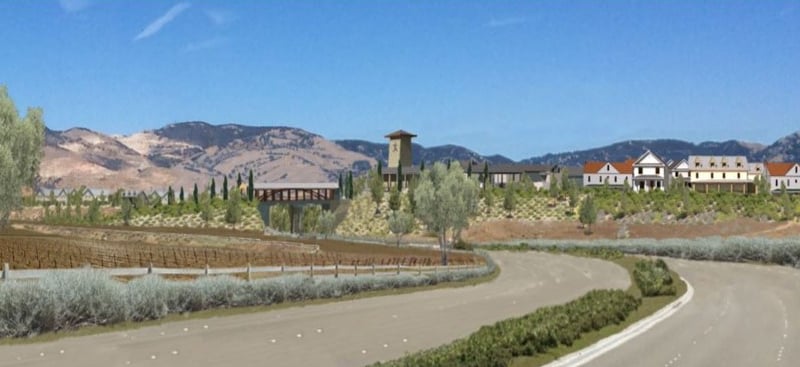
LOS ANGELES (CN) — Developers behind what promised to be an enormous and controversial project to build essentially a new city 65 miles north of downtown Los Angeles argued to the California Court of Appeals on Thursday that a lower court misunderstood the project when it ordered a halt in 2023.
The publicly traded Tejon Ranch Company currently has a large agriculture operation, but the ranch’s owner wants to get into the development game with its Tejon Ranch Centennial Project.
It has proposed building three separate large developments — two in Kern County and one at the northern end of L.A. County, the 12,000-acre Centennial project, a wildly ambitious plan comprising nearly 20,000 homes and more than 10 million square feet of commercial, retail and office space.
The Center for Biological Diversity and the California Native Plant Society sued the company and L.A. County in 2019 to stop the project, citing the danger the project poses to wildlife and fire risks development in the area posed.
In 2021 L.A. County Superior Court Judge Mitchell Beckoff ruled that the county’s environmental impact report for the project failed to fully analyze the greenhouse gas emissions produced by the project, especially its reliance on a cap-and-trade program to mitigate those emissions. In 2023, Beckoff ordered the county to set aside their approval of the project. The developers then appealed the court’s ruling.
On Thursday, Jennifer Hernandez of Holland & Knight, an attorney for Centennial Founders LLC, the developers of the project, argued that the cap-and-trade program was misunderstood.
“I think the issue is semantic and it also has to be contextual. The county’s findings also say the project has absolutely without qualification unmitigated annual impacts of 157,000 tons of GHG emissions,” Hernandez told a panel of three California Court of Appeal judges, using an acronym for greenhouse gas emissions.
“It says that’s from fossil fuel use and it says that combustion activity from fossil fuel use is one of the goals of the cap-and-trade program. It never says, Your Honor, that cap-and-trade is a mitigation requirement. It never nets out. It never says 157 goes away magically because of cap-and-trade," she added.
The project couldn’t go fully to net-zero, she said, but the cap-and-trade program tried to regulate what was feasible.
“This project went as far as we could make it go. We couldn’t solve for greenhouse gases globally. We couldn’t even solve for it countywide. It’s a problem, but we have made this project go as far as it could,” Hernandez said.
The cap-and-trade program, she added, is meant to mitigate fossil fuels, but since the project didn’t itself produce fossil fuels, they used the program to mitigate fossil fuels used by gas guzzling cars.
Even if one particular table in the report that seems to have confused decision makers and the public was just worded poorly as the company claims, “looking at it, it does suggest that in fact that there will be this dramatic reduction from cap-and-trade and the trial court said that needed to be redone. Why is it a bad thing to fix the EIR?” asked Associate Justice Gail Ruderman Feuer.
They’ll have to redo parts of the environmental impact report to conform with the California Environmental Quality Act to meet new wildfire mitigation requirements that didn’t apply in 2018, Hernandez said, but adding that it’s unfair to conclude, like the lower court did, that the county only tried to use cap-and-trade to comply with California’s environmental law. Instead, they wanted to use the program to simply reduce the use of fossil fuels.
“I would disagree with the characterization of most of it being accurate," Michelle Black of Carstens, Black & Minteer LLP, the Center for Biological Diversity’s attorney, said.
“The EIR states repeatedly that 96% of the project’s emissions are covered by cap-and-trade. That cap-and-trade program reduces the project’s emissions by 96%,” Black said. “When you see something that says 96% of the emissions are covered or reduced, you’re going to believe that, especially when it’s over and over in the findings in all of the descriptions in the hearings. I don’t think it was clear that that’s not necessarily what is meant by that statement.”
The two environmental groups also filed a cross appeal challenging that the environmental impact report failed to disclose how the project would affect wildlife in the area, especially mountain lions who transverse the area to move from one habitat to another, Black said.
There’s only been one mountain lion track found in the area in the last 15 years, Hernandez countered. The environmental groups are just arguing that the project will block the path of mountain lions because they want this project gone, she added.
L.A. County refused to study how the potential project could affect mountain lions, Black said. The only reason the one track from one mountain lion was found is because the animal apparently wandered into an area researchers were studying for an entirely different reason, she added.
The lower court also denied the project’s forward momentum because the environmental impact report’s conclusion that the project will reduce wildfire risks to the area wasn’t supported by further analysis.
Hernandez argued that reading of the report was incorrect, since the fire risks were all off-site, but the project and the community itself would be safe since they planned to build multiple fire stations.
“Having witnessed wildfire devastation on such a massive scale, Los Angeles County should think twice about building new cities in dangerous wildfire zones,” wrote John Buse, senior counsel at the Center for Biological Diversity, in a press release. “Wildfire risk is just one of many problems with this poorly planned project. Allowing Centennial to be built as proposed would cause irreparable harm to native grasslands that serve as precious habitat for rare plants and wildlife.”
The panel, consisting also of Presiding Justice Gonzalo Martinez and Associate Justice Natalie P. Stone, said they’d take both parties’ arguments under submission.
Tejon Ranch Company owns the largest piece of contiguous land in California, measuring some 270,000 acres straddling the border between Los Angeles and Kern counties, in a sparsely populated area. The ranch’s current agriculture operation ranges from raising cattle to growing almonds, pistachios, grapes and alfalfa.
Subscribe to our free newsletters
Our weekly newsletter Closing Arguments offers the latest about ongoing trials, major litigation and rulings in courthouses around the U.S. and the world, while the monthly Under the Lights dishes the legal dirt from Hollywood, sports, Big Tech and the arts.