
 Search Articles


WASHINGTON (CN) — As the country grapples with another mass shooting, gun advocates petitioned the Supreme Court on Thursday to loosen restrictions on weapons that have become synonymous with such tragedies.
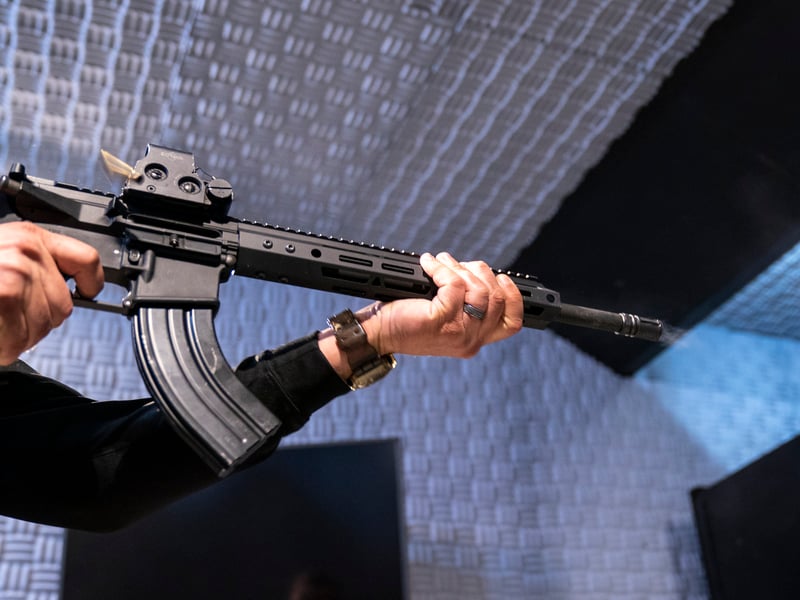
Like the gunmen in Uvalde, Buffalo, Parkland, Sutherland Springs, Las Vegas, Orlando and Sandy Hook, the 23-year-old who killed two children at a Minnesota Catholic school Wednesday used an AR-15-style semiautomatic rifle.
Short for ArmaLite Rifle, the AR-15’s high capacity design allows rapid fire, making it especially lethal in mass shootings. Gun advocates, however, call it “America’s Rifle,” arguing it is in “common use” by law-abiding citizens and deserves broad Second Amendment protection.
“The AR-15 platform rifle is the modern descendant of the rifles that were borne by the militiamen of the Revolution and the pioneers who struck out West in search of a better life,” gun owners and advocacy groups wrote in a petition before the Supreme Court. “The question can be fairly asked, if the Second Amendment does not protect it, what could it possibly protect?”
Assault weapons are banned in 10 states, according to Everytown Research, a gun control advocacy group. In June, the Supreme Court refused to review Maryland’s AR-15 ban, but gun advocates think Illinois’ law could prove more appealing to the justices.
Illinois banned assault weapons and large-capacity ammunition feeding devices after a gunman armed with a semiautomatic AR-15-style rifle and 30-round magazines fired 83 rounds into a Highland Park Fourth of July parade in 2022, killing seven and wounding 48 in under a minute.
The Protect Illinois Community Act targeted the gear favored by mass shooters: semiautomatic rifles with pistol grips or thumbhole stocks and detachable magazines, as well as firearms outfitted with flash suppressors, grenade launchers, barrel shrouds or other stocks that aid concealment.
Also under the state’s restrictions are semiautomatic pistols, shotguns and round-capacity limitations that cover firearms with magazines capable of holding over 10 rounds.
Gun owners who already possessed these weapons before the ban could keep their weapons if they were registered with the state. The law contained exemptions for law enforcement, members of the military and other professionals with firearm training.
Naperville, Chicago and Cook County adopted similar ordinances following the Highland Park shooting.
In six different challenges, gun owners, sellers and advocacy groups sought to block the new restrictions, but their efforts were dashed at every turn. Several courts declined to issue preliminary injunctions to pause the laws — and the Supreme Court declined the plaintiffs’ emergency appeal for the first time — before the Seventh Circuit consolidated the cases and denied injunctive relief to all the parties in a 2-1 ruling.
Six lawsuits by gun owners, sellers and advocacy groups aimed to halt Illinois’ new restrictions, but none succeeded. Courts repeatedly refused to issue preliminary injunctions, and the Supreme Court rejected the plaintiffs’ first emergency appeal. The Seventh Circuit then consolidated the cases and, in a 2-1 decision, denied injunctive relief to all challengers.
The high court again refused to take emergency action after the circuit ruling.
The third time around, the gun owners and advocacy groups returned to the Supreme Court with the benefit of a full briefing. They accused the Illinois legislature of ignoring the Supreme Court’s 2022 ruling in NYSRPA v. Bruen , which created a history-based test for firearm regulations.
But, again, the justices rejected gun owners’ appeal.
Despite the Supreme Court’s repeated refusal to review Illinois’ assault weapons ban, gun advocates took some hope in June when the justices also rejected a challenge to Maryland’s law.
Four justices need to vote in favor of granting a petition. In June, Justices Clarence Thomas, Samuel Alito and Neil Gorsuch said they would have reviewed Maryland’s ban.
Thomas, a George H.W. Bush appointee, criticized the court’s stance, lamenting that the justices have been avoiding questions on the legality of assault weapon bans for more than a decade.
“I would not wait to decide whether the government can ban the most popular rifle in America,” Thomas wrote in dissent. “That question is of critical importance to tens of millions of law-abiding AR–15 owners throughout the country.”
Justice Brett Kavanaugh, a Donald Trump appointee, could provide the critical vote needed to review the gun advocates’ challenge to Illinois’ ban.
When the high court denied the challenge to Maryland’s ban, Kavanaugh suggested that some justices may want to review the prohibitions in a different context.
“Opinions from other courts of appeals should assist this court’s ultimate decision making on the AR–15 issue,” Kavanaugh wrote. “Additional petitions for certiorari will likely be before this court shortly and, in my view, this court should and presumably will address the AR–15 issue soon, in the next term or two.”
The Illinois gun owners said this petition met Kavanaugh’s request.
“The Seventh Circuit’s decision confirms that this Court’s intervention is warranted to guarantee fundamental Second Amendment rights and to address the confusion in the lower courts over how to apply this Court’s precedent in arms bans cases—precedent that is straightforward but that the lower courts have proven incapable of applying correctly,” the gun owners wrote.
 Follow @KelseyReichmann
 Follow @kelseyreichmann.bsky.social
Subscribe to our free newsletters
Our weekly newsletter Closing Arguments offers the latest about ongoing trials, major litigation and rulings in courthouses around the U.S. and the world, while the monthly Under the Lights dishes the legal dirt from Hollywood, sports, Big Tech and the arts.