
 Search Articles


PORTLAND, Ore. (CN) — Whether federalized troops will deploy to Portland remains uncertain after a judge on Friday questioned whether an appeals court order demanded it.
“I want to give a lot of thought to the various arguments,” said U.S. District Judge Karin Immergut, adding that she would work as fast as she could to render a decision that honors the appeals court decision but incorporates the new information raised over the week — including a brief order filed late Friday afternoon after Immergut heard arguments from the state and the federal government.
On Monday, a split panel of the Ninth Circuit Court of Appeals overturned the first of two temporary restraining orders that the Donald Trump-appointed judge issued in early October. Immergut’s first order blocked the Trump administration’s bid to federalize and deploy 200 members of the Oregon National Guard to Portland.
In the late Friday order, the Ninth Circuit appeared to validate the state’s argument to keep in place the latter of the two temporary restraining orders.
The court paused its Monday order until 5 p.m. on Oct. 28, to “allow the completion of the pending en banc proceedings.” The order means regardless of how Immergut rules, no federalized Oregon troops will be deployed until at least Oct. 28, when the Ninth Circuit plans to vote on taking up the case en banc.
It also means that Immergut may hold off on ruling until after the Ninth Circuit deadline passes, as she grappled with how to proceed in ruling while issues remained pending in the appeals court.
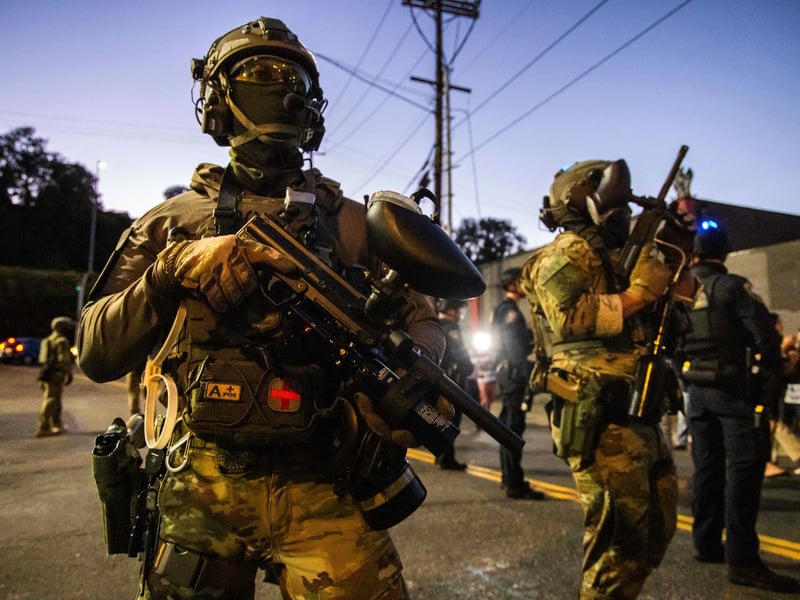
The National Guard deployment was sparked by a social media post from Trump in which he called for federal troops to protect “war-ravaged” Portland and its Immigration and Customs Enforcement facility, which has been the site of ongoing protests.
Immergut’s second temporary restraining order — the subject of Friday’s proceedings — blocked the deployment of any federalized National Guard members to the state. She issued it a day after the first order, in response to the Trump administration’s plan to send federalized National Guard members from California and Texas after Oregon’s troops were blocked.
The federal government appealed the first of the two orders to the Ninth Circuit. The panel held that Trump likely “lawfully exercised his statutory authority” when he authorized federalization of the Oregon National Guard.
The government argued Friday that Immergut was bound to that decision for the second order.
“The second TRO is based on the same rationale as the first,” Justice Department attorney Jacob Roth said.
He referred to the Ninth Circuit’s order, which said that both orders “rise or fall together on the merits of the issues raised in this motion for a stay pending appeal.”
“I just don’t know that there’s any way around that,” Roth said.
The city and state argue that a pending motion in the appeals court to rehear the case may render the decision invalid, but the government pushed back on that.
“I can’t say it’s not possible, but I don’t think that’s a basis for not following an appellate ruling,” Roth said.
However, the city and state remained steadfast that any action to dissolve or otherwise pause the second order would be premature. Shortly after the Ninth Circuit order was filed on Monday, a judge requested a vote on whether the case should be reheard en banc, and the state and city urged Immergut to wait until the appeals court had a chance to vote.
The Monday decision from the divided Ninth Circuit panel is “not sufficiently definite” and the call for an en banc vote was “unusually urgent,” argued Scott Kennedy, assistant Oregon Attorney General.
“If I refuse to stay the Oregon National Guard deployment, wouldn’t I be in direct contravention of what the Ninth Circuit ordered?” Immergut asked.
But Kennedy said that the Ninth Circuit order didn’t touch the complicated questions raised in the second temporary restraining order.
Dissolving the second order and allowing the deployment of federalized troops on the ground may create a “see-saw effect” and disrupt the status quo since the parties are set to go to trial on Wednesday, Kennedy argued.
“Even if the court dissolves the TRO now, it may spring back,” Kennedy said.
The Ninth Circuit panel’s decision is binding in the immediate effect, but Kennedy stressed that too many factors remain up in the air for Immergut to alter the situation.
But the federal government argued that the very nature of a temporary restraining order is to address issues that arise before trial, and altering the order on the eve of the trial is exactly what the Ninth Circuit intended to happen when it issued the order.
For the Trump administration, the question isn’t if federal troops will be deployed — it’s when.
“We already won this in the Ninth Circuit for now,” Roth said. “We’re just trying to give effect to that ruling and all we are asking for here is that it be done expeditiously.”
Immergut said she would take the matter under advisement and issue a decision on or before Monday.
Oregon Attorney General Dan Rayfield emphasized the stakes of the ruling for the state’s sovereignty, as well as for the Constitution and the safety of the communities.
“Regardless of how the court rules, this fight is not over,” Rayfield said in a statement. “We’re grateful the court is giving thoughtful consideration to the facts and to the new information that’s come to light.”
Subscribe to our free newsletters
Our weekly newsletter Closing Arguments offers the latest about ongoing trials, major litigation and rulings in courthouses around the U.S. and the world, while the monthly Under the Lights dishes the legal dirt from Hollywood, sports, Big Tech and the arts.