
 Search Articles


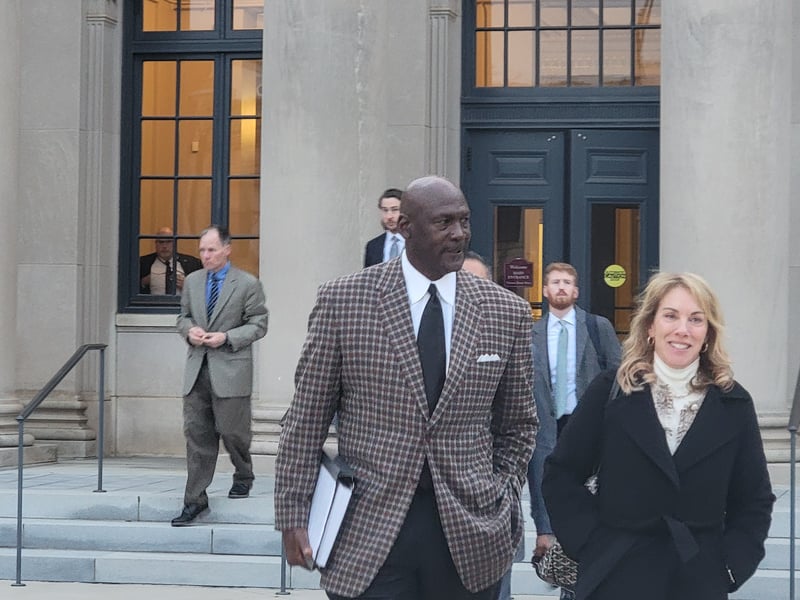
CHARLOTTE, N.C. (CN) — In opening arguments Monday, Front Row Motorsports and 23XI Racing — a team partially owned by basketball legend Michael Jordan — argued the trial will show that NASCAR prevented competition in the top-tier stock car racing market.
“[NASCAR and CEO Jim France] eliminated all the competition,” attorney Jeffrey Kessler, counsel for 23XI Racing and Front Row, told the jury. “They prohibited it. They blocked it.”
Kessler said NASCAR imposed exclusivity provisions in their contracts with premium racing tracks, causing them to remain empty when not in use for NASCAR races.
Denny Hamlin, co-owner of 23XI and driver for Joe Gibbs Racing, was the first witness to take the stand, crying as he described his path to becoming a professional racecar driver.
He told the court that he banded together in creating 23XI Racing with Curtis Polk and Michael Jordan as a retirement plan, and that the team bought up three racing charters — which provide teams guaranteed compensation and race entry — over the span of several years as other teams went out of business.
“There were 19 teams when the first charter agreement got signed in 2016,” Hamlin said. “11 of them don’t exist.”
The charter system, which is NASCAR’s version of a franchise, has the teams enter into a limited number of multi-year contracts to race under more profitable terms, or else be required to qualify for each Cup Series race. Disputes over the terms ultimately resulted in the plaintiffs not signing the 2025 charter agreements and spurred the suit. The 13 other racing teams signed the agreement.
The charter agreement terms aren’t fair, Hamlin said, adding that “there’s only one side going out of business.” Court recessed before NASCAR was able to cross-examine him.
The plaintiffs say NASCAR’s actions, like requiring teams to sit out of racing for a year when switching between leagues, were anticompetitive. The Cup Series’ Next Gen cars cost the teams $20 million apiece— a number compounded by the requirement that a team must have seven cars for each one it races. If a team wanted to get out of the Cup Series, NASCAR prevents the teams from racing the cars anywhere else, because it was worried about a copy-cat racing series challenging it, Kessler said.
“The evidence will show that most of the teams don’t make any money,” he said, adding that in 2024, 74% of the teams didn’t take home a profit. “They lose money.”
23XI Racing is an exception to this, he said, because of sponsors’ interest in being affiliated with Jordan.
“Bob [Jenkins, owner of Front Row Motorsports], unlike 23XI, has been running the team for decades,” Kessler said. “He has never made an operating profit.”
But attorney John Stephenson Jr., representing NASCAR and France, assured the 9-member jury that NASCAR paid teams every penny owed to them in the nine years that the 2016 charter agreements were in place.
“This case is not about anticompetitive conduct,” he said, adding that the restrictions on the tracks are protecting the industry that NASCAR is developing with the teams, and the Next Gen car was created in response to the teams’ concerns about the cost of manufacturing, and lowered the production cost by 40 to 45%. He said NASCAR is protecting its patents in not allowing the cars to be raced elsewhere and the charter system is a financial asset for the teams, as their value has skyrocketed to $45 million.
The teams never complained that these decisions were anticompetitive before the lawsuit, and they approached the 2025 charter renewal process with the intent to “negotiate through litigation,” Stephenson said, putting pressure on NASCAR by publicizing how poorly the talks were going.
“If the charter system is so bad, if the charter system is inherently anticompetitive, why are they negotiating for it to go on forever?” He asked. One of the terms the teams tried to secure in the contract renewal process was permanent charters.
The teams make over a billion dollars annually, between NASCAR’s payments of $431 million and an average of $640 million from sponsors, Stephenson said, adding that as some team owners are otherwise wealthy, that some are “in it to race to win.”
Jurors are tasked with determining if NASCAR maintained its monopsony — when a single buyer of services controls the market — by using anticompetitive conduct, and if so, if the plaintiff teams were hurt by that behavior.
Shortly before trial, U.S. District Judge Kenneth Bell, a Donald Trump appointee, ended NASCAR’s counterclaims against the teams, saying that the company failed to prove that it suffered an antitrust injury or that the teams unreasonably restrained the stock car racing market.
He also denied NASCAR’s attempt to dismiss the suit because of the statute of limitations over a handful of racing track contracts, and affirmed that NASCAR has a 100% market share in premier stock car racing. NASCAR has and exercises monopsony power over the racing market, Bell added.
Both sides have voiced a willingness to settle, but have been unable to come to mutually agreeable terms.
The teams sued NASCAR in October 2024, claiming NASCAR has a monopsony on the premium stock car racing industry and is forcing teams to sign anticompetitive contracts. They claimed they were pressured to sign the contract in a night after years of unsuccessful negotiations, and that doing so would have required them to release claims against NASCAR.
Trial is expected to last two weeks. A representative for NASCAR did not respond to a request for comment.
“No comment,” Jordan said after the hearing. “They told me to shut up.”
 Follow @SKHaulenbeek
 Follow @shaulenbeek.bsky.social
Subscribe to our free newsletters
Our weekly newsletter Closing Arguments offers the latest about ongoing trials, major litigation and rulings in courthouses around the U.S. and the world, while the monthly Under the Lights dishes the legal dirt from Hollywood, sports, Big Tech and the arts.