
 Search Articles


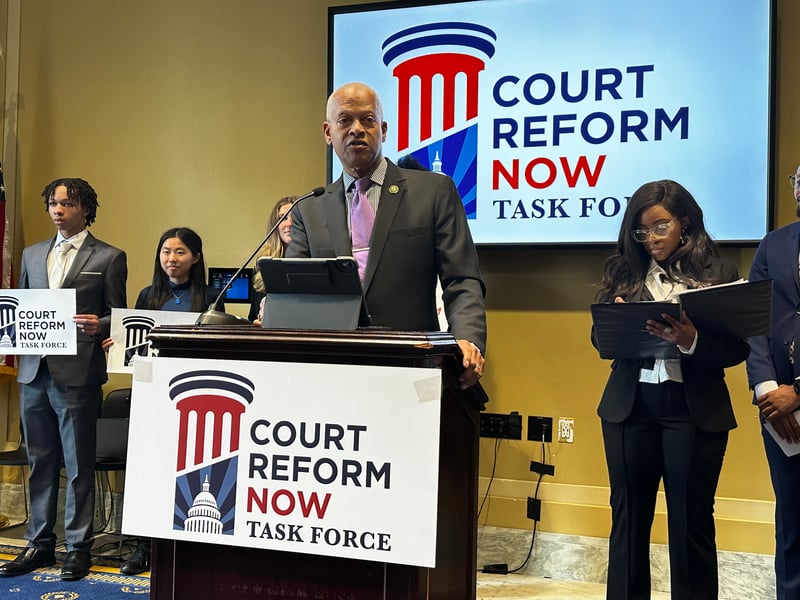
WASHINGTON (CN) — A group of congressional Democrats on Friday implored the Supreme Court to consider recommendations from the country’s leading legal association that it alter its existing code of judicial ethics to include a strict enforcement mechanism.
In a letter to Chief Justice John Roberts, obtained by Courthouse News, the coalition of House lawmakers led by Georgia Representative Hank Johnson argued that it would be “irresponsible” for the high court to ignore pleas from Congress and legal experts to address deficiencies in its current ethical standards.
“It is unacceptable for the judiciary of a country that has historically been viewed as a bellwether for democracy to fail to establish even the bare minimum of ethical conduct under the law for the individuals chosen to be the final arbiters of questions inherent to who we are as a society,” the letter read.
The group of Democrats cited a resolution passed last week by the American Bar Association’s house of delegates, which called on the Supreme Court to modify its 2023 ethics code to include an “appropriate enforcement mechanism” that would bring the high court’s standards in line with those established for lower court judges by the U.S. Judicial Conference.
“This clarion call from the leaders of American jurisprudence demonstrates exactly why we as a country must have a Supreme Court that is trusted and respected by all Americans,” wrote the lawmakers.
In its resolution, approved at the organization’s midyear meeting in Phoenix, the American Bar Association argued that the Supreme Court’s existing code of conduct — adopted after the court faced months of scrutiny for ethical malfeasance by some of its justices — was “aspirational rather than mandatory” and that it has no system for enforcement.
Though the Supreme Court has said that its 2023 ethics code is modeled on the Judicial Conference standards for lower courts, the resolution pointed to key differences in the high court’s version that water down some provisions. For example, the American Bar Association noted that while the Judicial Conference code requires judges to recuse themselves from proceedings where their impartiality could be questioned, the Supreme Court appears to make recusal optional, saying that justices merely “should” disqualify themselves in such cases.
The high court’s standards also appear to eliminate language from the Judicial Conference code that instructs judges to expect constant public scrutiny and to “freely and willingly” accept restrictions that “might be viewed as burdensome by the ordinary citizen.”
“These differences raise the implication that the Justices are unwilling to publicly acknowledge any obligation either to take action when necessary to maintain the judiciary’s ‘high standards of conduct’ or to accept any restrictions they consider burdensome,” the association wrote.
The resolution recommended that the Supreme Court alter its existing ethics code to impose limits on gift-giving to the justices, suggesting an annual limit of $1,000, which it argued was a “generous amount” but small compared with the hundreds of thousands of dollars in gifts reportedly provided to justices over the years.
And the American Bar Association further called on the high court to adopt a solid enforcement mechanism for its code of conduct, such as a panel of lower court judges who could adjudicate ethics complaints. A similar system could be used to consider recusal, the group suggested.
Democrats on Friday, urging Roberts to follow through on the association’s recommendations, positioned a binding ethics code for the justices as a linchpin for improving public trust in the judiciary and confirming the court’s impartiality.
“It would be irresponsible for the Supreme Court to fail to act now, particularly at a time when trust and faith in the judgment of our nation’s highest court must be at its zenith,” the lawmakers said. “We commend and associate ourselves with the ABA’s official recognition that without a binding code of conduct with an enforcement mechanism for all federal judges and Justices, trust in our judiciary may further erode.”
Friday’s letter to the court is just the latest chapter in Democrats’ efforts to clamp down on ethical violations among the justices — a push that has advanced in fits and starts since 2023, when reports emerged that Justice Clarence Thomas failed to report luxury vacations and other gifts bankrolled by conservative megadonor Harlan Crow on his annual financial disclosures.
Since then, a cascade of new information has emerged about unreported gifts and travel lavished on Thomas and Justice Samuel Alito, who received similar hospitality from conservative legal activist Leonard Leo.
After initially resisting calls to do so, the court in late 2023 adopted a code of ethical standards, but critics have long said that it falls short thanks to its lack of a binding enforcement mechanism.
While they held the Senate majority, Democrats made some progress on legislating Supreme Court ethics reform but were ultimately unable to pass any bills aimed at addressing what some legal experts have said is an ethics crisis at the high court.
Senate Republicans last year blocked Rhode Island Senator Sheldon Whitehouse’s Supreme Court Ethics, Recusal and Transparency Act, a measure that would have used Congress’ oversight authority to force the justices to adopt a binding code of conduct. Similar to the American Bar Association’s recommendations, Whitehouse’s bill also would have established transparency standards for recusal and set up a review panel to consider ethics complaints against the high court.
In the Republican-controlled House, Democrats including Johnson sponsored legislation to implement 18-year term limits for Supreme Court justices. That bill, though, never saw the light of day, despite an endorsement last summer by then-President Joe Biden.
The push for stricter ethics at the high court has long been a political nonstarter for Republicans, who have accused Democrats of vindictively trying to punish the justices for rulings they dislike — and with the GOP in control of Congress and President Donald Trump back in the White House, progress on the issue appears unlikely for the time being.
 Follow @BenjaminSWeiss
Subscribe to our free newsletters
Our weekly newsletter Closing Arguments offers the latest about ongoing trials, major litigation and rulings in courthouses around the U.S. and the world, while the monthly Under the Lights dishes the legal dirt from Hollywood, sports, Big Tech and the arts.