
 Search Articles


WASHINGTON (CN) — Congressional Democrats on Tuesday slammed a Trump administration action laying the groundwork for a federal crackdown on anti-fascist activity, with one lawmaker arguing that it represented a move to a “Taliban-like” approach toward democratic norms.
But despite strong words of opposition from some Democratic lawmakers, they offered only a few concrete steps to use their platform to oppose a directive which they framed as yet another overreach of executive authority.
President Donald Trump issued National Security Presidential Memorandum 7, titled “Countering Domestic Terrorism and Organized Political Violence,” on Sept. 25. The memo comes amid mounting backlash to the assassination of conservative commentator Charlie Kirk. NSPM-7 directs the National Joint Terrorism Task Force to develop a “comprehensive national strategy” to investigate and prosecute political violence and intimidation.
The directive also orders federal law enforcement to probe “institutional and individual funders” of such activity, including non-governmental organizations.
The White House memo comes as President Donald Trump and other Republicans have accused the left of fomenting political violence such as Kirk’s assassination and last week’s shooting at an Immigration and Customs Enforcement facility in Dallas. In keeping with those claims, the directive laid out ideological threads the administration sees as “animating” such activity.
Among those threads were anti-Americanism and anti-capitalism, as well as “extremism on migration, race and gender.” The White House also pointed to “hostility to those who hold traditional American views on family, religion and morality” as other ideological animators. The Trump administration did not define what it considers to be “traditional” views on those matters.
On Capitol Hill, Democrats panned the White House directive.
“That’s obviously trying to create a thought crime,” said Maryland Representative Jamie Raskin, the top Democrat on the House Judiciary Committee. “That’s completely incompatible with the First Amendment.”
Some people, Raskin told Courthouse News on the Capitol steps Tuesday morning, would consider “traditional” American values to be a “commitment to democracy, freedom, the Constitution and the Bill of Rights.”
“Some people want tradition to mean loyalty to a leader, or to racism or authoritarianism,” Raskin added. “I suppose people can have different points of views about which American traditions we should be cherishing.”
He also pushed back on the White House’s framing of “domestic terrorism,” pointing out that the term does not have a statutory legal definition. He argued there are “specific crimes” that can be prosecuted but that targeting what he chalked up to protected speech was tantamount to “thought crimes.”
“They’re essentially fingerpainting on the Constitution by claiming the right to define some nebulous groups of people as domestic terrorists, enemies of the government,” the lawmaker said.
Georgia Representative Hank Johnson concurred, offering sharp criticism of the NSPM-7 directive which he called an “edict coming from an authoritarian” which threatens free speech, the free press and freedom of assembly.
“In this country, we have a movement toward kind of like a Taliban-style, religious-based, ideologically pure metric upon which we judge everything,” said Johnson. “And, of course, that Taliban extremism is foreign to American democracy.”
California Representative Ro Khanna, one of the first lawmakers to address NSPM-7, wrote in a post on X on Monday night that the directive was a “greater infringement on freedoms” than the 2001 Patriot Act, a law which dramatically expanded U.S. government surveillance capabilities following the 9/11 terrorist attacks.
Vermont Representative Becca Balint, meanwhile, did not mince words when asked about the White House directive’s framing of “traditional” American views on family and morality.
“Oh, for fuck’s sake,” she scoffed. “I mean, honestly, queer people, trans people in this country, they just want to live their lives free from fear and attack.”
Balint slammed what she saw as the Trump administration targeting the LGBTQ community for being a “threat to American marriages.”
“I can tell you that in my own community, what I see are the majority of heterosexual marriages falling apart — and my marriage is going strong,” she quipped. “I am not responsible for their family.”
Michigan Senator Elissa Slotkin told Courthouse News that she had not yet read the White House directive but said that she was concerned about anyone looking to blame political violence on one side.
“I think a lot of what came out after the assassination of Charlie Kirk is that some people in leadership believe that freedom of speech is only for some people, and freedom of expression is only good and safe and democratic if it’s someone who shares their views,” Slotkin said.
The Michigan Democrat pointed out that her state had just experienced a mass shooting at a Mormon church, citing reports that the shooter had come from a “very conservative, certainly Trump-voting family.”
“I think political violence is a scourge on both sides,” she said.
Senate Minority Whip Dick Durbin, who was also not previously aware of the memo, dismissed its language as a “well-worn Republican position on the question of values.”
But while Democrats had tough rebukes to the White House’s national security directive, they offered fewer options for opposing the move in Congress.
Raskin affirmed lawmakers’ role in the process, pointing out that the president does not have the authority to make laws. “That’s a myth that the Trump administration would like to propound, but his job is to take care that the laws we pass are faithfully executed.”
The top Democrat said that Congress should use its oversight function to “rein that in” and make sure that the White House respects judicial decisions when federal courts strike down administration actions. “We have to act affirmatively to defend the rights and freedoms of the people,” he added.
Raskin did not point to any specific actions lawmakers should take to conduct oversight on the Trump administration’s national security memo. Democrats, though, are limited in their options given their minorities in both the House and Senate.
Johnson said that Democrats needed to work “with we, the people” in the absence of a governing majority.
“We have a rubber stamp Congress under Republicans, and we’ve got a complicit Supreme Court that are going along with a reckless and authoritarian executive,” said the Georgia congressman. “There’s no part of the government that is left to confront it, other than minority Democrats and the people of this country — that’s where the real power lies.”
Asked whether Democrats should be making more public statements opposing measures such as NSPM-7, Johnson contended that they already were, but that lawmakers were being “drowned out by media narratives that are promoting other issues.”
Johnson also contended that the pace of administration actions also muddied the waters.
“There are two or three shocks to the conscience that come every day,” he said. “People are consuming that information, all the while coming to grips with the notion that freedom is slipping away — and so Democrats will continue to address these issues along with all the other shocks that come from Trump’s actions on a daily basis.”
Slotkin said that congressional oversight on the White House memo “might be interesting,” but reiterated that she had yet to read it.
Balint, for her part, said Democrats should continue to “lean in” on First Amendment issues, pointing to the suspension and subsequent reinstatement of late-night host Jimmy Kimmel’s talk show after his comments about Kirk’s assassination earlier this month.
“The restricting of First Amendment rights animates people across the political spectrum,” she said, pointing to comments made by Texas Senator Ted Cruz criticizing Kimmel’s suspension.
“I think we have to continue to lean in on this issue about what happens under autocrats,” Balint explained. “They go after our organizations, our education, our news outlets, and that’s what we’re seeing.”
Asked whether messaging should be Democrats’ primary focus for opposing directives such as NSPM-7, Balint said it should be the “first and foremost” priority but that lawmakers should also pursue opposition through the judiciary.
In a statement to Courthouse News on Tuesday, White House spokesperson Abigail Jackson said that Trump’s executive actions would address “left-wing violence” and put and end to illegal activity.
“Left-wing organizations have fueled violent riots, organized attacks against law enforcement officers, coordinated illegal doxing campaigns, arranged drop points for weapons and riot materials, and more,” she said. “The Trump administration will get to the bottom of this vast network inciting violence in American communities.”
The Trump administration’s domestic terrorism directive came just days before the president announced that he would federalize the Oregon National Guard for 60 days amid protests at ICE processing facilities in Portland. Trump has framed the city as “under siege” by domestic terrorists.
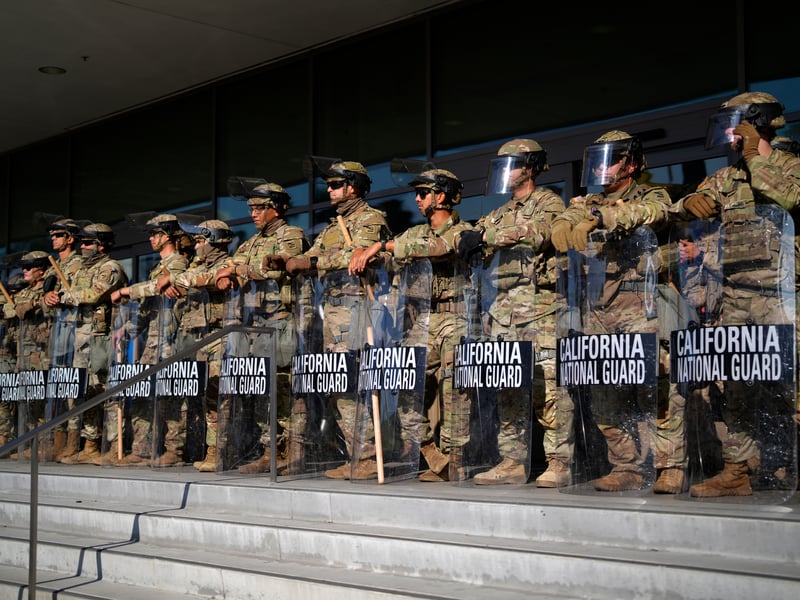
Oregon has sued the administration to stop the National Guard deployment. A federal judge ruled this month that Trump’s deployment of National Guard troops to Los Angeles over the summer violated the law.
But during a speech to military leaders on Tuesday, Trump signaled that further domestic military action could be in the works. He pointed to an executive order signed last month standing up a National Guard quick reaction force available for “rapid nationwide deployment.”
“This is going to be a big thing for the people in this room, because it’s the enemy from within and we have to handle it before it gets out of control,” Trump told the gathering of top military brass.
 Follow @BenjaminSWeiss
Subscribe to our free newsletters
Our weekly newsletter Closing Arguments offers the latest about ongoing trials, major litigation and rulings in courthouses around the U.S. and the world, while the monthly Under the Lights dishes the legal dirt from Hollywood, sports, Big Tech and the arts.