
 Search Articles


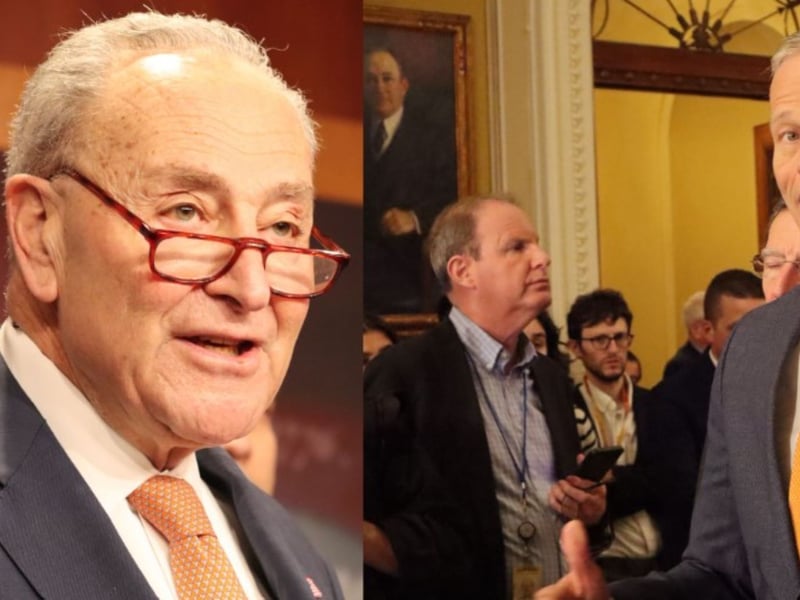
WASHINGTON (CN) — Congressional Democrats on Tuesday unveiled legislation they say is a response to an illegal effort by President Donald Trump and his allies to unilaterally dismantle federal agencies.
But as Democrats took their most concrete steps yet to oppose meddling by the White House and billionaire Elon Musk, Republicans positioned the administration’s actions as an above-board review of how certain agencies spend government cash.
Democrats in Congress have fumed for months about Musk and his White House-sanctioned Department of Government Efficiency, a commission which the Trump administration has said is aimed at trimming the fat off federal programs. Lawmakers sounded the alarm over the weekend after reports emerged that Musk aides had tried to gain access to sensitive information at the U.S. Agency for International Development.
Other Musk affiliates reportedly managed to secure access to confidential payment systems at the Treasury Department.
The White House has defended Musk and his surrogates, labeling the billionaire a “special government employee,” though he is not being paid for his work.
Members of Congress, such as Senate Minority Leader Chuck Schumer, have accused Musk and the Trump administration of behaving like a “shadow government,” slashing government programs behind closed doors and without congressional approval. Some lawmakers have pointed out that agencies such as USAID are codified into law and cannot be dismantled without the green light from Capitol Hill.
Democrats attempted to put those complaints into practice Tuesday, unveiling legislation which Schumer and House Minority Leader Hakeem Jeffries have said would counter unelected Musk aides running roughshod on federal agencies.
“DOGE is not a real government agency,” Schumer said during a news conference Tuesday afternoon. “It has no authority to make spending decisions, to shut down programs or to ignore federal law. This is not debatable.”
Entitled the “Stop the Steal Act” — an ironic nod to election denial claims pushed by Trump — the Democrats’ measure would, among other things, deny special government employees access to sensitive agency information. The measure would also block access to such information from anyone with “conflicts of interest or lack of appropriate clearance,” Schumer said, and would add personal tax information to existing privacy protections.
“Democracy doesn’t work in the shadows,” the Democratic leader said. “Democracy doesn’t skirt the rule of law, and it doesn’t give special privilege to the ideas and needs of a group of ultra-wealthy people at the expense of American families.”
Jeffries concurred, adding that Musk’s efforts to access confidential information at the Treasury Department was “unacceptable, unconscionable and un-American.”
As of Tuesday afternoon, the text of the “Stop the Steal Act” was not publicly available. A spokesperson for Schumer’s office did not immediately respond to a request for comment.
It’s unlikely that Democrats, who are in the minority in both the House and Senate, could secure the votes necessary to pass such a bill — and even less likely that Trump would sign it into law. But legislation isn’t Democrats’ only option for recourse against Musk and the White House, he told reporters.
One method Democrats could use to take the Trump administration to task is “just bringing this to light,” Schumer said. “We’ve had some success there already,” he added, pointing to lawmakers’ efforts to raise public awareness about the White House’s federal funding freeze and tariffs against Mexico and Canada.
“There was an outcry, and Trump had to back off,” the New York Democrat said.
Litigation and congressional oversight, such as so-called “shadow hearings” in the Senate, could be other options for Democratic recourse against Musk and Trump, Schumer posited. The Democratic leader did not raise the possibility that his colleagues could try to slow-walk the White House’s remaining cabinet appointees — though some Senate Democrats are reportedly considering the prospect.
While Democrats continued to sound the alarm about what they see as executive overreach from the Trump administration and its billionaire adviser, Republicans offered a lukewarm rebuke to those charges.
Asked by Courthouse News during a news conference Tuesday whether he believed that the White House had legal authority to shutter federal agencies, such as USAID, without congressional approval, Senate Majority Leader John Thune said that Trump and Musk are merely trying to determine whether federal cash was being “spent wisely.”
“My understanding is that I don’t think they’re closing an agency,” Thune said of USAID. “But I do think they have a right to review funding, how those decisions are made and what priorities are being funded. I think that’s probably true of any administration when they come in.”
Thune pointed to comments made Monday by Secretary of State Marco Rubio, who said Congress has been seeking spending information from USAID “for a very long time.”
“It’s in need of reform,” the South Dakota Republican said. “It’s in need of transparency and greater accountability, and I think that’s what the administration is trying to achieve.”
Thune did not directly say whether he believed that Trump had authority to shutter a federal agency without the go-ahead from Congress.
But while the GOP leader sought to downplay speculation about USAID’s future, the White House on Tuesday reportedly placed all the agency’s Washington staff on leave, further fueling concerns that the Trump administration is readying to shutter the agency.
Musk, for his part, has referred to USAID as a “criminal organization” and accused the agency of misappropriating federal funds. In a Monday post on X, he said that he and his allies had spent the weekend feeding USAID into a “wood chipper.”
Musk has since suggested that the agency’s activities could be subsumed into the State Department.
 Follow @BenjaminSWeiss
Subscribe to our free newsletters
Our weekly newsletter Closing Arguments offers the latest about ongoing trials, major litigation and rulings in courthouses around the U.S. and the world, while the monthly Under the Lights dishes the legal dirt from Hollywood, sports, Big Tech and the arts.