
 Search Articles


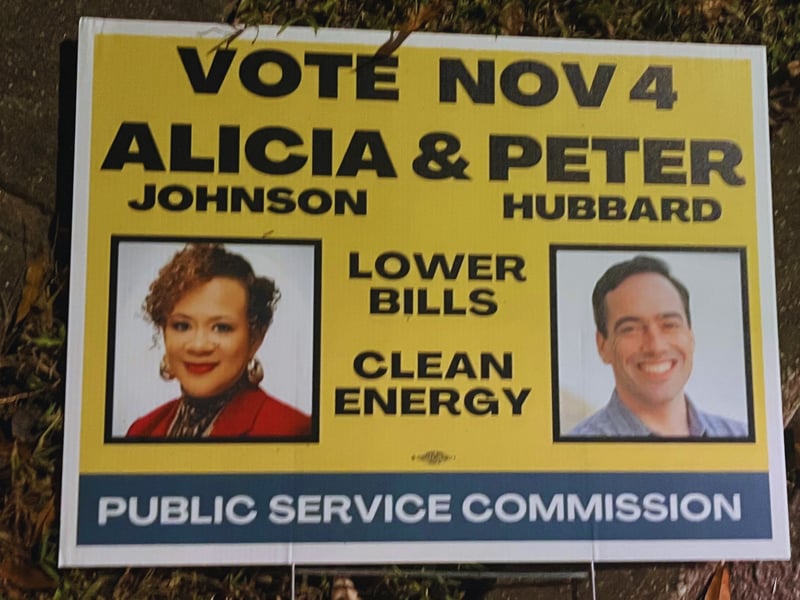
ATLANTA (CN) — Democrats landed their first non-federal statewide wins in nearly 20 years in Tuesday’s race for two seats on the Georgia Public Service Commission.
The two Democratic candidates, Alicia Johnson and Peter Hubbard, each secured victories with over 62% of the vote, according to results from the Georgia Secretary of State’s website. They faced off against two Republican incumbents, Vice President Fitz Johnson and Tim Echols, who has served on the commission since 2011.
Tuesday’s election marked the first time in nearly five years Georgians were able to vote for public service commissioners, due to delays caused by a federal lawsuit that challenged the state’s voting system.
With pivotal races in next year’s election — including every statewide office and the Senate seat of Democrat Jon Ossoff, who is seeking reelection — Tuesday’s results could signal changing tides in the swing state that elected Trump in 2024.
Nearly 1.5 million voters cast their ballots in the public service commission and municipal races across the state. The large turnout was largely fueled by concerns from residents over rising utility rates, which are controlled by the commission, along with statewide energy policy.
The wins add two Democratic voices to what was an all-Republican, five-member board. Fitz Johnson and Echols faced criticism for the board’s approval of six rate hikes since late 2022, increasing the average Georgia Power residential customer’s monthly bill by about $43.
In a statement, Alicia Johnson said she will support energy policy that benefits the public rather than catering to the interests of powerful energy companies like Georgia Power. The state’s largest electric utility, with 2.8 million customers, is requesting the commission’s approval to add 10,000 megawatts of power generation capacity over the next five years.
“This victory isn’t just mine, it’s ours. It’s for the single mother choosing between groceries and her power bill, the senior trying to keep the lights on, and the young voter who showed up believing that their voice matters,” Johnson said in a news release.
The Georgia Public Service Commission has gained attention as the state is becoming the fastest-growing market for data center construction in the U.S. Residents are concerned Georgia Power’s demands to create more capacity will use up resources and lead to further spike rates.
Concerns about climate change and support for clean energy initiatives also boosted Democratic engagement and support for Hubbard, a renewable energy advocate and solar developer.
“Affordability is front and center in voters’ minds, and today they overwhelmingly said they’re tired of subsidizing corporate interests at the expense of their families,” Hubbard said in a statement. “As I serve out my first term on the Public Service Commission, I will work tirelessly to lower utility costs, to bring more clean, reliable energy resources to this state, and to refocus the commission’s work on the public interest.”
Last year, renewable resources accounted for just 12% of Georgia’s total in-state electricity generation, mostly from solar energy and biomass from wood, according to the U.S. Energy Information Administration.
The commission green-lit new gas-fired turbines last year. Earlier this year, they approved a Georgia Power plan to keep coal plants open past their previously approved retirement dates.
“I voted for Peter Hubbard and Alicia Johnson because the incumbent commissioners have acted as a rubber stamp for every profit maximizing move that Georgia Power is pushing to profit off of their monopoly status,” James Bale, a 33-year-old resident, told Courthouse News.
“They have failed to adequately plan for and lead on the energy transition to renewables, which are now the cheapest form of deployable energy, despite living in a geography with immense potential for solar power,” he added.
Mobilization efforts from Georgia’s Democratic Party to gain influence in what is mostly a red state also drove turnout, including a $250,000 late ad buy. The Democratic National Committee spent heavily to promote the candidates and get-out-the-vote efforts.
“This victory is a direct response to Trump’s cost-raising agenda that is squeezing pocketbooks in Georgia and across the country,” Democratic National Committee Chair Ken Martin said in a statement.
Fitz Johnson and Echols each received most of their campaign funding, since January 2024, from individuals and companies with financial stakes in commission decisions.
According to the Energy and Policy Institute, Johnson raised $200,325 for his campaign between August and Jan. 1, 2024. Of that total, 87%, came from people or businesses connected to utility-regulated entities, including Georgia Power executives, Southern Company subsidiaries, and their lawyers. The same entities contributed 61% to the $360,786.29 Echols raised for his campaign.
Echols’ challenger, Alicia Johnson, raised $23,187 with no contributions from regulated-entity sources that the Energy and Policy Institute could identify in its analysis of campaign finance filings. The Savannah native received mostly individual donations, as well as contributions from two Washington-based political action committees — the Jane Fonda Climate PAC and Climate Action PAC. Meanwhile, Hubbard raised nearly $25,000 in contributions, with $1,505 associated with regulated companies.
 Follow @Megwiththenews
Subscribe to our free newsletters
Our weekly newsletter Closing Arguments offers the latest about ongoing trials, major litigation and rulings in courthouses around the U.S. and the world, while the monthly Under the Lights dishes the legal dirt from Hollywood, sports, Big Tech and the arts.