
 Search Articles


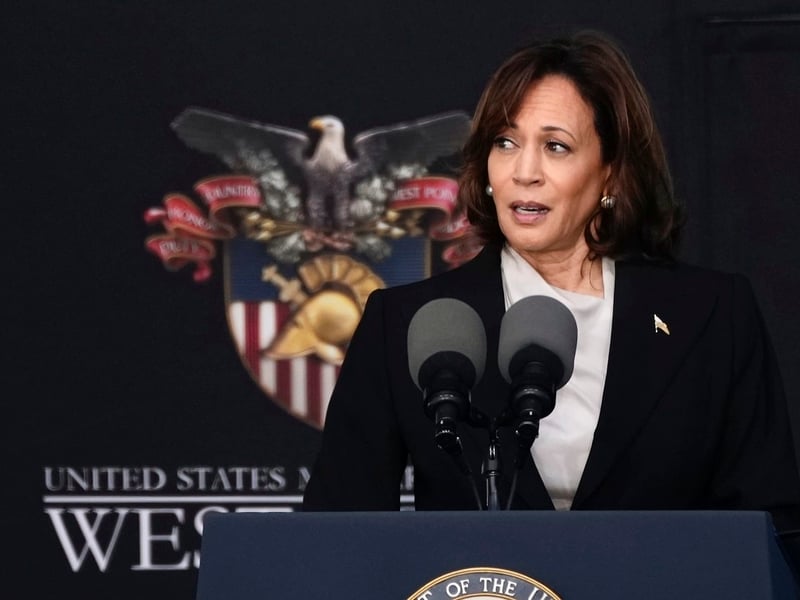
WASHINGTON (CN) — Following President Joe Biden’s decision this past weekend not to seek a second term, Vice President Kamala Harris has been all but confirmed as the Democratic choice to run against GOP nominee Donald Trump in November.
With less than a month until the Democratic National Convention in Chicago, Harris has been placed in an unprecedented position where she must officially secure the nomination and launch her own campaign for president at breakneck speed.
Following his withdrawal, Biden endorsed Harris to run in his place as the Democratic nominee, along with all 50 Democratic state party chairs, former House Speaker Nancy Pelosi and many would-be rivals including California Governor Gavin Newsom, Pennsylvania Governor Josh Shapiro, Arizona Senator Mark Kelly, among others.
While she has yet to select a running mate, she is likely to choose from one of the aforementioned rivals, which also may include Kentucky Governor Andy Beshear, North Carolina Governor Roy Cooper and Illinois Governor J.B. Pritzker.
Of the party’s 4,699 delegates, Harris must secure a majority, approximately 1,976 delegates, in order to receive the party’s nomination. According to an unofficial running survey by The Associated Press, 3,284 delegates have thrown their support behind Harris, with only 39 remaining delegates across several states currently undecided.
Members of the DNC’s Rules Committee met Wednesday to lay out the timeline for those delegates to cast their votes for Harris or any other possible candidates in the first open convention in decades.
The last open DNC and RNC occurred in 1952, where both parties needed multiple ballots to nominate Adlai Stevenson and Dwight D. Eisenhower, respectively, as their nominees.
In the decades since, the parties have shifted the nomination process, granting more importance to presidential primaries in selecting a nominee and binding delegates to their outcomes.
Anyone aiming to run against Harris for this year’s nomination must announce their candidacy by 6 p.m. on July 27.
Those candidates must then show by July 30 that they meet the three qualifications required to be considered for the nomination: a declaration of candidacy; that they meet party and legal qualifications to be president; and that they have secured 300 delegate signatures, with no more than 50 from one state’s delegation.
Depending on how many candidates qualify will determine whether virtual voting begins Aug. 1 or Aug. 3. In the likely event that just one candidate qualifies, delegates will begin voting virtually — a pandemic-era change repeatedly lauded by members in Wednesday’s meeting — on Aug. 1, otherwise the voting would begin Aug. 3.
During the first round of voting, a candidate must win a majority of the 3,949 pledged delegates, or 1,976. In the event voting moves on to a second round, an additional 747 delegates — known as automatic or “superdelegates” — enter the process, and a candidate must win a majority of that total, or 2,351.
Certain members, such as Rhode Island Representative June Speakman, asked whether delegates who had signed pledges to vote for Biden at the convention would be locked to that promise. Pat Moore, the DNC’s legal counsel, said that the language in such pledges allow delegates to “vote their conscience” and therefore can choose whichever nominee they wish.
The members specifically highlighted the need to have nominated candidates for president and vice president by Aug. 7, in order to meet a deadline set by Ohio lawmakers for a candidate to have their names placed on the state’s ballot.
Moore repeatedly emphasized the importance of meeting Ohio’s deadline to stave off any potential legal challenges Republicans may attempt, as many have threatened in the days since Biden announced his withdrawal.
“Republicans will do what they do, sue,” Moore said during Wednesday’s meeting, specifically mentioning House Speaker Mike Johnson and the Heritage Foundation as likely litigators.
In a statement laying out the committee’s decision, Democratic National Convention Committee chair Minyon Moore lauded the steps the members had decided on and expressed hope they would defeat any possible litigation.
“We are confident that the process we’ve laid out is secure, democratic and critical to our defense against bad-faith litigation coming from Republicans and dark money groups as they once again put partisan games about the will of American voters,” Moore said.
He warned that without due caution, the party could face a repeat of the 2020 election, where Republicans and Trump filed a wave of frivolous lawsuits challenging the results claiming election fraud.
“Trump and Republicans will challenge the results, if we aren’t careful before the election we could face lawsuits post-election,” Moore said. “Our mission is too important.”
 Follow @Ryan_Knappy
Subscribe to our free newsletters
Our weekly newsletter Closing Arguments offers the latest about ongoing trials, major litigation and rulings in courthouses around the U.S. and the world, while the monthly Under the Lights dishes the legal dirt from Hollywood, sports, Big Tech and the arts.