
 Search Articles


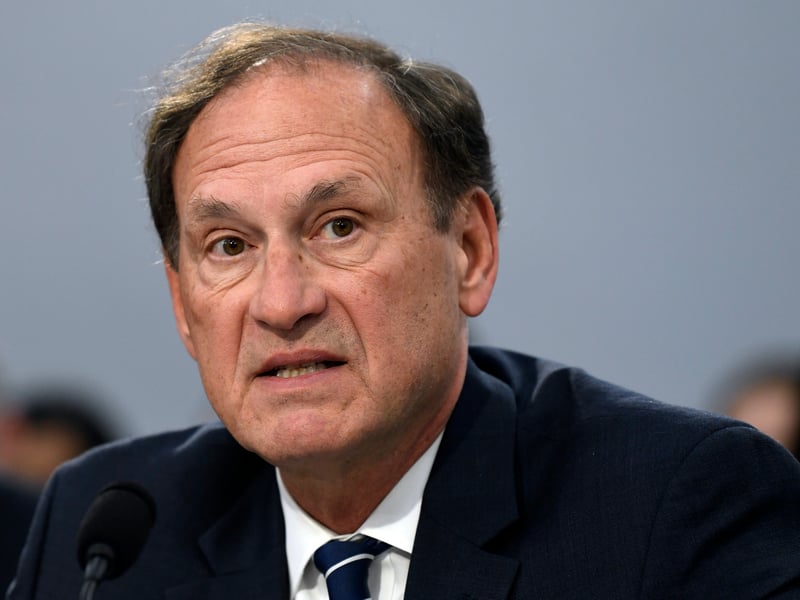
WASHINGTON (CN) — House Democrats on Friday pressured Chief Justice John Roberts to weigh in on reports that he had removed Justice Samuel Alito as the lead opinion author for a Supreme Court case involving the Jan. 6, 2021, Capitol riot, and questioned why the jurist was allowed to participate in the ruling at all.
In a letter to the high court’s chief, Maryland Representative Jamie Raskin and New York Representative Alexandria Ocasio-Cortez took issue with Roberts’ apparent decision to replace Alito on the majority opinion for the case Fischer v. United States , calling it a “half measure” in the face of swirling questions about the justice’s impartiality.
The New York Times reported last month that the chief justice removed Alito from the opinion in May 2023 amid swirling controversy over an upside-down American flag — a symbol co-opted by the “Stop the Steal” election denial movement — which flew outside his Virginia home in the days following the Capitol riot. The flag display, which the justice has since said was done by his wife, prompted calls from lawmakers and legal advocates on Alito to recuse himself from cases related to Jan. 6.
Both Alito and Justice Clarence Thomas, who faced similar scrutiny over his own wife’s support of efforts to overturn the results of the 2020 presidential election, refused to step back from such deliberations.
Roberts’ move to replace Alito on the Fischer opinion “strongly suggests” that the chief justice viewed the flag display as a potential conflict of interest, Raskin and Ocasio-Cortez argued. And by simply removing the justice from the majority ruling rather than requiring his recusal, the lawmakers said, Roberts allowed the Supreme Court to violate federal law and the Constitution.
The move also runs afoul of the court’s year-old code of conduct, which instructs justices to disqualify themselves from a proceeding in which their impartiality “might reasonably be questioned,” the Democrats wrote.
Roberts has previously argued it isn’t up to a chief justice to decide when a colleague should step back from a case. Responding to calls from House Democrats to require Thomas to recuse himself from Jan. 6 cases, Roberts — through his attorney — contended that each justice has an independent duty to decide whether their participation in a case could pose a conflict of interest. Neither the chief justice nor the U.S. Judicial Conference can make such a determination, he said.
But Raskin and Ocasio-Cortez were not satisfied with that explanation.
“The notion that individual Justices can decide for themselves whether their own conduct violates the Constitution, federal law or the court’s code of conduct is untenable in our republic and clearly violates the fundamental and original principle of due process that ‘no man can be a judge in his own case,’” the lawmakers said.
The Democrats demanded that Roberts verify The New York Times’ reporting, asking him to explain whether he made the decision to remove Alito as lead author of the Fischer opinion and his rationale for such a move. The lawmakers also questioned whether the chief justice had discussed the prospect of recusal with either Alito or Thomas.
Roberts’ cooperation will help inform potential legislation that will clarify that Supreme Court justices “are bound by our Constitution and our laws,” Raskin and Ocasio-Cortez said.
Congressional Democrats have for more than a year railed on what they frame as rampant ethical malfeasance among the high court’s justices, stemming from reports last spring that both Thomas and Alito failed to report high-value gifts and vacations provided to them from wealthy conservative benefactors.
Lawmakers have positioned these reports as part of an influence operation on the court aimed at achieving conservative policy outcomes through the judiciary rather than the legislative process.
And those revelations, along with subsequent reports about the justices’ conduct, have led to a raft of legislation aimed at clamping down on the Supreme Court.
Georgia Representative Hank Johnson, a leading court reform voice in the House, has unveiled a bill that would implement 18-year term limits for the justices and create a system by which every president can appoint two new members to the bench. In the Senate, Rhode Island Senator Sheldon Whitehouse’s Supreme Court Ethics, Recusal and Transparency Act would force the high court to adopt an enforceable ethics code and would establish an independent review board for ethics complaints against the justices.
The White House has come out in favor of both of these measures, with President Joe Biden saying in a July address that the ethical crisis at the Supreme Court “undermines the public’s confidence in the court’s decisions.”
 Follow @BenjaminSWeiss
Subscribe to our free newsletters
Our weekly newsletter Closing Arguments offers the latest about ongoing trials, major litigation and rulings in courthouses around the U.S. and the world, while the monthly Under the Lights dishes the legal dirt from Hollywood, sports, Big Tech and the arts.