Search Articles


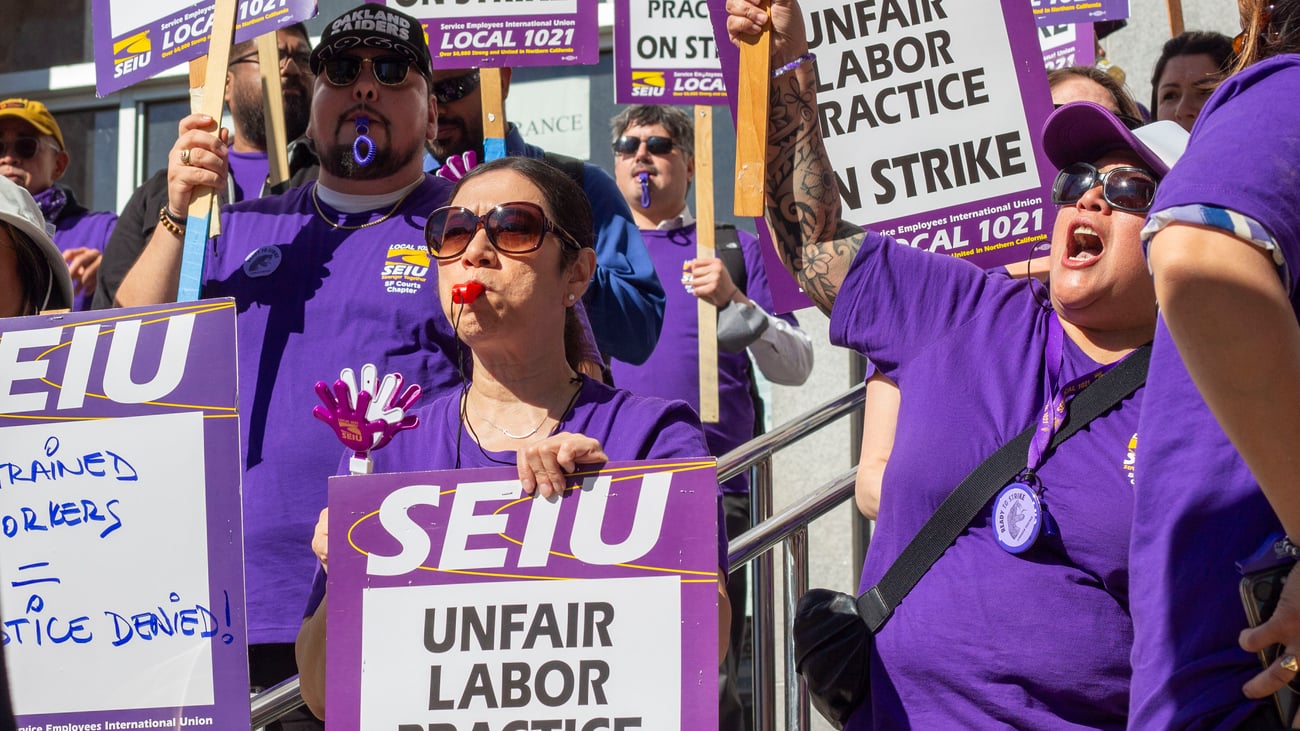
RICHMOND, Va. (CN) — Virginia Governor Abigail Spanberger vetoed a statewide collective bargaining bill Thursday to the chagrin of workers and her own party.
“I remain committed to continuing to work with the General Assembly, unions, localities, and public servants across the Commonwealth to develop a public sector collective bargaining system that works for Virginia,” the Democrat said in her veto explanation. “However, I believe additional amendments are needed to the enrolled bill currently before me."
The Democratic-controlled General Assembly passed legislation that would remove the prohibition on collective bargaining for state employees and mandate a collective bargaining right for local employees. Local employees currently have to wait for their local government or school board to opt in to collective bargaining.
“Governor Abigail Spanberger today betrayed half a million of Virginia’s public service workers by going back on her campaign promise to support collective bargaining rights for the people who keep our Commonwealth and communities running every day,” the Virginia Public Sector Labor Coalition, a lobbying group that represents large unions like the Virginia Education Association and the American Federation of State, County and Municipal Employees, said in a statement. “Instead of aligning herself with General Assembly Democrats who unanimously supported this bill, Spanberger instead vetoed the bill just as her predecessor Glenn Youngkin did, sending Virginia workers the crystal clear message that they are no better off than they were under a Republican governor.”
The legislature rejected Spanberger’s sweeping amendments that labor unions claim weakened the bill. The original version removed a requirement that would have forced local governments or schools to hold votes to allow employees to unionize. The bill also creates a Public Employee Relations Board and codifies employees’ right to negotiate on certain issues, including staffing, working conditions and benefits.
Spanberger had offered over a dozen amendments, including seeking to delay the implementation of collective bargaining rights for local government employees from 2028 to 2030.
She also wanted to give governor-appointed members of the Public Employee Relations Board a much larger role in negotiations and remove language requiring the board to include at least two union representatives.
“I put forth amendments which would have required the state to set up a system allowing state employees, home care workers and higher education service employees to enter into collective bargaining agreements first, in order to demonstrate the efficacy of this new system, with public employees in localities following closely after,” Spanberger said. “While preserving the enrolled bill’s focus on allowing public employees to achieve collective bargaining, my amendments would have also provided additional flexibility for public employers to take into account existing local budget timelines and processes.”
Labor unions argued that the governor’s amendments, which delay the implementation of collective bargaining rights for local government employees until after her term ends, inserted a killswitch that would allow future governors to end collective bargaining without legislative support.
Virginia Republicans welcomed the veto. They warned that the government would pass the cost of accommodating collective bargaining onto taxpayers.
“After getting slammed by Republicans for the spineless attempt to dodge the fallout and dump the consequences on the next administration, the governor has finally vetoed the collective bargaining bill,” state Senate Minority Leader Ryan McDougle said in a statement. “This is a massive victory for Virginians."
Kurt Detrick, the incoming president of Virginia Professional Fire Fighters, called the veto a disappointment at a press conference on Thursday.
“We could not be more disappointed in the actions of this governor with this veto. Our firefighters and paramedics deserve the dignity and respect of a voice and seat at the table through collective bargaining,” Detrick said. “We can’t take this as anything but an absolute act of betrayal."
Detrick said the veto especially hurts firefighters who hoped to negotiate for better staffing and equipment.
“We have counties that still put one firefighter on a fire truck. It’s 2026,” Detrick said. “Whenever we have the right number of equipment of firefighters and paramedics on a fire truck or an ambulance, the right number of fire trucks in a station and in a community, it protects the community and makes everybody safer.”
Groups like the Service Employees International Union expressed particular disappointment after campaigning for Spanberger in the gubernatorial election last fall.
“Workers want leaders who understand that dignity is not negotiable and that collective bargaining is not a privilege — it is a right. Governor Spanberger looked workers in the eye, met with our members, affirmed her support and made a promise,” SEIU International President April Verrett, SEIU Virginia 512 President LaNoral Thomas and SEIU 32BJ Executive Vice President Jaime Contreras, said in a statement. “Today, she broke it.”
Democrats tried, and failed, to pass the same bill under Republican Governor Glenn Youngkin. Virginia’s history of prohibiting public sector employees from unionizing dates to Black nurses at the University of Virginia Hospital who staged a walkout over their low wages in 1943 and were subsequently fired. Virginia remained one of three states to have a blanket ban on collective bargaining until 2020.
“We still have the support of our friends in the General Assembly,” Andrew Panetlis, 4th District vice president for the International Association of Fire Fighters, said at the press conference. “We’re going to keep pushing forward with this legislation until it becomes a reality.”
Subscribe to our free newsletters
Our weekly newsletter Closing Arguments offers the latest about ongoing trials, major litigation and rulings in courthouses around the U.S. and the world, while the monthly Under the Lights dishes the legal dirt from Hollywood, sports, Big Tech and the arts.