
 Search Articles


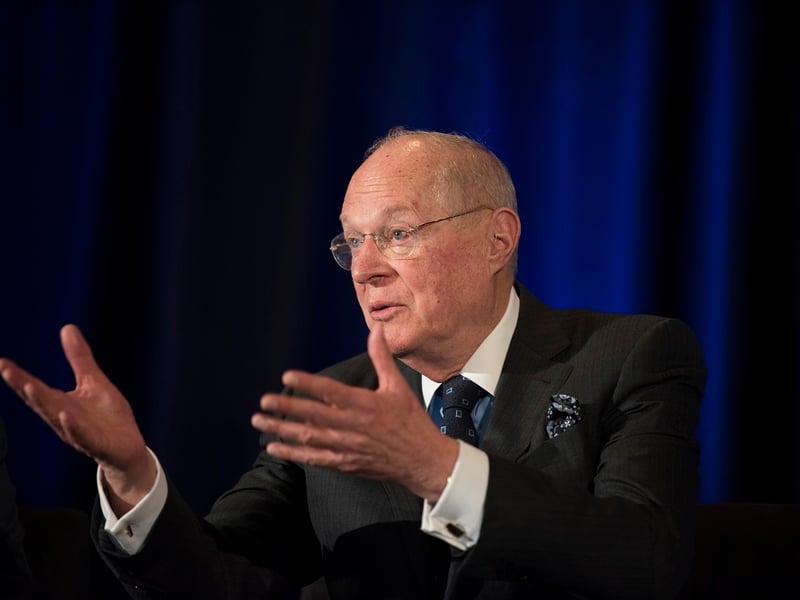
WASHINGTON (CN) — A panel of international judges, headlined by former Supreme Court Justice Anthony Kennedy, warned that the Trump administration’s increasing efforts to curb the federal judiciary’s independence echoed those of authoritarian regimes in a forum Thursday.
The forum, hosted by Speak Up for Justice, included judges from Venezuela and South Africa, as well as several U.S. district judges from New Jersey and Pennsylvania, all of whom expressed concern that growing hostility toward federal judges by politicians and the public put the rule of law at risk.
Thursday’s forum comes amid growing tensions between President Donald Trump, Congressional Republicans and their coequal branch of government.
Several lawmakers have moved to strip federal judges of their national injunction powers andimpeach certain “disloyal” judges, while the Justice Department on Tuesday sued the full federal bench at the U.S. District of Maryland over efforts to freeze the administration’s summary deportations to allow for judicial review.
Kennedy, a Ronald Reagan appointee who retired in 2018 and was succeeded by Brett Kavanaugh, emphasized that federal judges, and the Supreme Court justices in particular, hold a central role in the United States’ civil discourse.
“Many in the rest of the world look to the United States to see what democracy is, to see what democracy ought to be,” Kennedy said. “And if they see a hostile, fractious discourse, if they see a discourse that uses identity politics, rather than talk about issues, democracy is at risk, freedom is at risk. Aristotle said that freedom can die, democracy can die, and he was right.
He added that, as tensions in the Middle East simmer following the government’s controversial strikes on several Iranian nuclear facilities on Saturday, the judiciary should stand up for the rule of law.
“Peace is what gives us the opportunity to make democracy stronger, to make freedom greater for ourselves and the rest of the world,” Kennedy said. “We must always say no to tyranny and yes to truth.”
Eleazar Saldivia, a former federal judge of the Anzoátegui State Circuit in Venezuela, described how he was persecuted by Hugo Chavez’s government and forced to flee the country after he ordered the release of arrested student protestors in 2014.
Following his ruling, then-governor of Anzoátegui Aristóbulo Istúriz called Saldivia directly and ordered him to reverse his ruling or else face severe consequences. When he refused, his security detail was rescinded, and he was followed by armed civilian militias.
“What happened in Venezuela was a deliberate strategy to silence independent voices, politicize appointments and intimidate the judiciary into submission,” Saldivia said. “The destruction of the judiciary’s independence was slow and calculated, achieved not through military forces but through laws, decrees, executive orders and courts that no longer served the people of Venezuela, with Chavez acting as chief architect of the negative PR machine against us.”
Saldivia added that since he fled the country, the judiciary has become a “tool for darkness” in Venezuela.
Former South African Justice Richard Goldstone, a member of the country’s Supreme Court during the apartheid regime and later invited by Nelson Mandela to form the Constitutional Court of South Africa after the regime’s fall, said that America’s undermining of judicial independence threatens its leadership of the democratic world.
“The rule of law is the foundation of democracy,” Goldstone said. “It’s a principle that requires all institutions in a state and all who live in it be accountable to and governed by the law. The rule of law cannot operate without an independent judiciary that is respected by the other two branches of government, the executive and the legislative.”
He called it ironic that the “oppressive and racist” apartheid regime — which he helped undermine by tempering the worst effects of the country’s racial laws — respected the independence of its judges, albeit for political reasons, as the international community increasingly called for the dismantling of apartheid in the ’80s and ’90s. While the U.S. had been a leading figure in the regime’s dismantling, it has since shirked its responsibility, Goldstone said.
“The influence of the United States in countries that are now placing the rule of law in jeopardy has been severely weakened by the present administration in Washington,” Goldstone said. “There have been personal attacks on the independence of some judges who have ruled against the administration. Those judge have carried out their solemn duties and complied with their oaths of office.”
 Follow @Ryan_Knappy
Subscribe to our free newsletters
Our weekly newsletter Closing Arguments offers the latest about ongoing trials, major litigation and rulings in courthouses around the U.S. and the world, while the monthly Under the Lights dishes the legal dirt from Hollywood, sports, Big Tech and the arts.