
 Search Articles


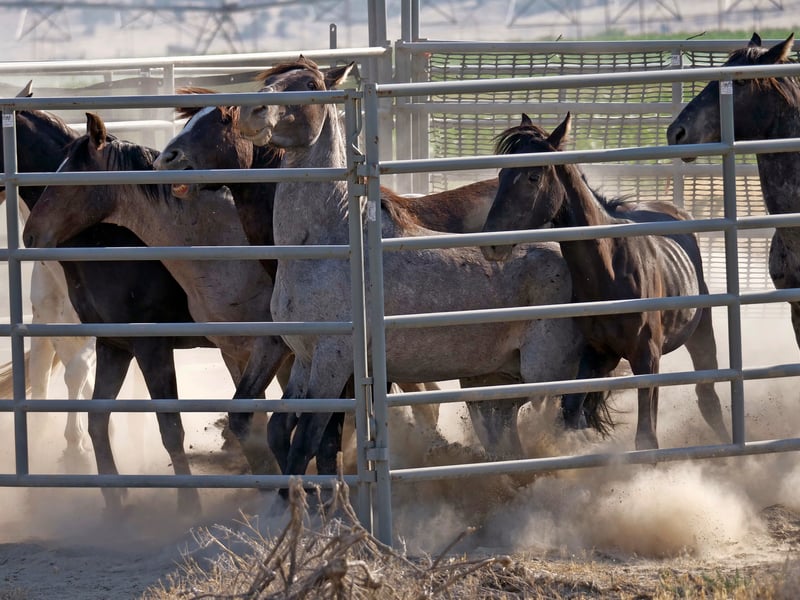
LAS VEGAS (CN) — A Ninth Circuit panel wrangled Wednesday with how quickly the federal government must enact a plan to gather and remove excess horses in Nevada.
Attorneys on either side of the bullpen argued different definitions for the word “immediate.” The lawyer for ranchers said a plan written by the federal Bureau of Land Management needed a time frame attached to it. An attorney for the government countered that the logistics required for implementing the gather and removal plans ruled out the quick implementation sought by the ranchers.
The question reached the Ninth Circuit after a lower court ruled in favor of the government, determining the gather and removal plans would occur as promptly as reasonably possible. That meant they complied with the Wild Free-Roaming Horses and Burros Act.
The panel made no decision Wednesday.
Representing the ranchers, attorney Alan Schroeder said the bureau’s plans have no timeline. Its implementation should be expeditious, not over 10 years as stated in the plan.
“These things can’t all be done like yesterday,” said U.S. Circuit Judge Mark Bennett, a Donald Trump appointee.
U.S. Circuit Judge Gabriel Sanchez, appointed by Joe Biden, echoed the sentiment. He said the bureau’s plan includes language about moving quickly to remove excess horses, asking if that met the law’s standard.
“Are we arguing the difference between ‘prompt’ and ‘expeditious’?” Sanchez added.
Bennett also raised the specter of the U.S. Supreme Court’s 2024 Loper Bright v. Raimondo decision. He said the ruling instructed judges to avoid decisions that involve themselves in policymaking.
“And you’re saying, as I understand you, that we need to tell the agency, ‘You need to set a number,’” Bennett added, questioning the consistency of the argument with Loper Bright.
Schroeder argued that once the bureau made its plan, it needed to act on it. He pointed to a potential timeline that would direct the plan’s implementation for the initial gather.
Attorney Tamara Rountree, representing the government, argued the Horses and Burros Act requires no timeline for the bureau to enact its plan.
Rountree added that the 10 years stated in the plan isn’t specific to the initial gather phase. Instead, it’s for the entire plan, which includes population control.
Bennett returned to the word “immediate,” noting the law calls for the immediate removal of excess animals from a range.
That led Rountree to counter with two examples of immediacy. In the first, she’s told the courthouse is on fire and must leave immediately. In the second, a judge tells her to leave immediately. However, she’s required to take her belongings before leaving and potentially could visit the restroom before exiting the building.
“’Immediately’ oddly escapes specificity,” she added.
U.S. District Judge John Holcomb, a Trump appointee on the panel, asked whether the plan’s inclusion of urgency to act met the law’s standard. Rountree agreed, saying an examination of the plan was key, not when “hooves” are on the ground.
She demurred when asked about a time frame for the initial gather, saying too many variables existed.
“Doesn’t that lend credence to what the ranchers are saying?” Sanchez asked.
Rountree said the bureau must first put personnel in the field. It then must identify the lame, sick and older animals. She declined to put a time frame on those acts, adding that no requirement to make one exists.
“It’s just not required by the statute,” she added.
Subscribe to our free newsletters
Our weekly newsletter Closing Arguments offers the latest about ongoing trials, major litigation and rulings in courthouses around the U.S. and the world, while the monthly Under the Lights dishes the legal dirt from Hollywood, sports, Big Tech and the arts.