
 Search Articles


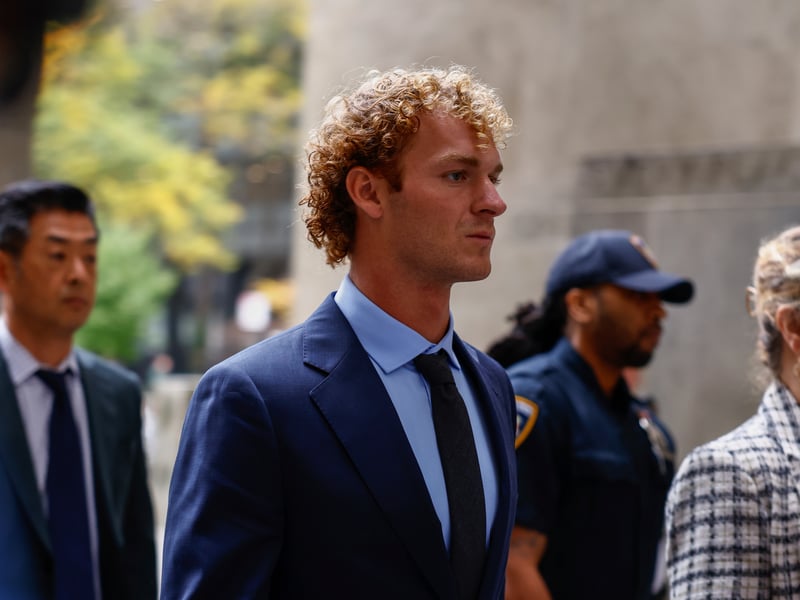
MANHATTAN (CN) — Daniel Penny’s attorneys on Monday tried to paint the U.S. Marine Corps veteran as a good Samaritan with a “softer side” in the closing arguments of his manslaughter trial in New York City.
Penny, 26, is charged for the on-camera killing of Jordan Neely, a homeless Black man who died after Penny was seen choking him on the floor of an uptown Manhattan F subway last year.
Inviting a jury of Manhattanites to use their imagination, Penny’s attorney Steven Raiser encouraged them to picture themselves on Penny’s subway car on May 1, 2023 — the day that Neely stormed onto the train and started shouting at straphangers.
“It was a crowded car,” Raiser said. “Imagine for a moment that you’re on that train too, strangers brought together by fate, much like you are here.”
To set the scene, Raiser used a slideshow of photos from the subway accompanied by train sound effects — audio that was not in evidence, prompting an unsuccessful objection from prosecutors.
Raiser recounted witness testimony that described Neely as “violent and desperate” and “filled with rage.” Emphasizing Neely’s history of mental illness and use of synthetic cannabinoids, Raiser reminded the jury how terrified some subway riders were when Neely yelled his erratic threats.
“‘I truly thought I was going to die,’” Raiser recalled witness Caedryn Schrunk saying in her November testimony.
Raiser harked back to another witness, who described Neely as “lunging, getting right up into people’s faces.” That behavior prompted Penny, then 24, to call on his Marine Corps training and restrain Neely around the neck from behind, Raiser claimed.
“All of those riders and more, Daniel Penny was the one who moved to protect them. Why? Because he had something the others didn’t, something unique to him: his training,” Raiser said.
Witnesses who testified against Penny, Raiser said, did so because they were scared of repercussions from pro-Neely protestors, who could be heard demonstrating from inside the courtroom on Monday.
Lamenting the “broken system” that allowed for a person like Neely to slip through the cracks, Raiser accused state prosecutors of “scapegoating” Penny for institutional failures. He also attributed the poor response time of police and EMS, which supposedly took about seven and 20 minutes respectively, as perhaps playing a role in Neely’s demise.
Raiser then took it a step further, suggesting that Penny wasn’t responsible for Neely’s death at all. He leaned on the analysis of his defense expert, forensic pathologist Dr. Satish Chundru, who concluded that Neely actually died as a result of complications from his sickle cell trait — not from Penny’s chokehold, as the city medical examiner had determined.
That doubt, Raiser said, should be enough to acquit Penny on both counts: second-degree manslaughter and criminally negligent homicide.
“They failed to prove their case, period,” Raiser said of the prosecutors.
Assistant District Attorney Dafna Yoran painted a different picture of the evidence, however. In closing for the prosecution, Yoran said that common sense defies the defense’s logic.
“Everyone is aware that if you hold someone in a tight chokehold, as the defendant did for six minutes, that you might kill them,” Yoran said.
Yoran acknowledged that Penny’s intentions may have been laudable, but told jurors that Penny recklessly used “way too much force for way too long,” resulting in Neely’s “needless” death. While the subway riders may have been afraid of him, Yoran reminded the jury that witnesses unanimously agreed that Neely never laid his hands on anybody.
“No one had to die on May 1, 2023,” Yoran said. “Jordan Neely did enter the car, the subway car, in an extremely threatening manner, but so much less than deadly physical force would have done the job of protecting the passengers from Mr. Neely. Daniel Penny, the defendant, could have easily restrained Mr. Neely without choking him to death.”
Yoran suggested that Penny “didn’t recognize his humanity” that day on the train. She pointed to Penny’s filmed interview with detectives, where he referred to Neely twice as a “crackhead.”
She also accused Penny of lying during that interview. Penny told detectives that he let go of Neely’s neck as soon as two bystanders stepped in to help. But video shows Penny continue to hold on well after the pair of intervenors arrived and until Neely went completely limp.
“He literally had Mr. Neely’s life in his hands,” Yoran said.
Yoran will finish her closing argument tomorrow after a technical issue from Penny’s team delayed Monday’s start by more than 90 minutes. Unlike in federal court, prosecutors present their closings last in New York state criminal cases.
The jury is expected to start deliberating on Tuesday. Penny faces up to 15 years if he’s convicted on the top count of manslaughter. Criminally negligent homicide carries a lighter maximum sentence, and Penny can only be convicted on one of the two counts.
There is no minimum sentence for either charge.
 Follow @Uebey
 Follow @uebey.bsky.social
Subscribe to our free newsletters
Our weekly newsletter Closing Arguments offers the latest about ongoing trials, major litigation and rulings in courthouses around the U.S. and the world, while the monthly Under the Lights dishes the legal dirt from Hollywood, sports, Big Tech and the arts.