
 Search Articles


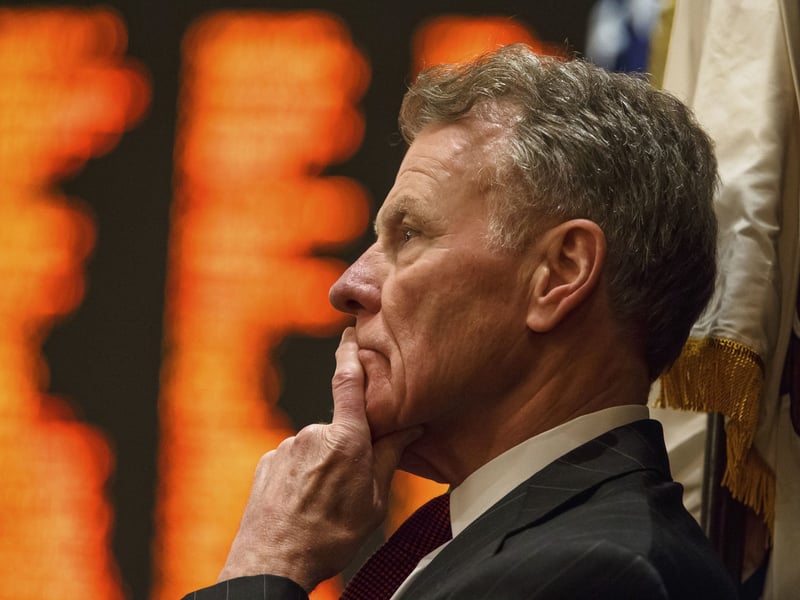
CHICAGO (CN) — Defense attorneys kicked off their case Wednesday in the ongoing federal corruption trial of ex-Illinois House Speaker Mike Madigan. Federal prosecutors formally rested their case in chief shortly after trial proceedings began Wednesday morning.
The government exhausted its witness and evidence list on Tuesday, but didn’t rest until reading a final factual stipulation to jurors.
Madigan’s co-defendant Mike McClain — a longtime ally of the ex-speaker as well as a veteran lobbyist in Springfield — presented his own case Wednesday to the jury ahead of Madigan’s turn. McClain’s attorneys called a single witness to the stand Wednesday, the now-retired AT&T lobbyist Steve Selcke.
The former lobbyist said he spent 25 years working for AT&T Illinois and its predecessors before retiring in March 2019. Before that, he said he spent nearly another two decades working in state government, including for the administrations of Republican former Illinois governors Jim Thompson and Jim Edgar. Selcke was part of the AT&T Illinois team that was working in the state legislature in 2017 to relieve the company of its Carrier of Last Resort, or COLR, obligations.
The obligation mandated that AT&T had to provide and maintain landline service to certain Illinois residents who requested it, even as fewer customers overall were using landline services. Illinois lawmakers passed a bill in 2017 that helped AT&T shrug off COLR obligations, and jurors saw evidence last week — while the government was still presenting its own case — that AT&T’s legislative affairs team was keen to win the support of Madigan’s office.
As part of the effort to secure Madigan’s support, prosecutors say AT&T higherups offered a $22,500 do-nothing job to Democratic ex-state representative Eddie Acevedo, to be paid via the consulting firm of another longtime Madigan ally named Tom Cullen. Jurors have seen evidence corroborating that the Acevedo family consulting firm Apex Strategy received multiple $2,500 checks from Cullen’s firm in 2017.
Jurors have also seen a Feb. 14, 2017, email from McClain to AT&T lobbyist Bob Barry, asking if there was “even a small contract” for Acevedo. A separate email from then-AT&T Illinois President Paul La Schiazza two days later informed AT&T’s legislative team that Madigan had assigned McClain to work on the company’s COLR relief efforts as a “special project.”
McClain’s attorney John Mitchell tried to reframe this evidence. He had Selcke confirm on the stand it isn’t unusual for lobbyists to help lawmakers with “requests” to build up relationships, or to consider job recommendations. Selcke brought up helping with a youth sporting event, or working out a service payment plan for an elected official’s financially struggling constituent, as examples of legislator requests lobbyists might address.
Selcke also confirmed AT&T tried to lobby the speaker’s office in 2017, and that he knew McClain and Madigan were close. But he told Mitchell he wasn’t aware of McClain ever threatening Madigan would kill the COLR bill if Acevedo didn’t get his contract.
In exchange for the $22,500 contract, Acevedo was ostensibly meant to prepare a report on the “political dynamics of the Latino Caucus of the General Assembly and the City of Chicago.” Prosecutors say Acevedo never made that report, which Cullen himself called “busy work” on the stand last week.
Selcke said Wednesday that such a report would have benefitted AT&T, but also told Mitchell “I don’t recall ever getting any report … relative to Mr. Acevedo’s contract.”
Acevedo, when testifying Monday and Tuesday, asserted that he attended hearings and meetings on AT&T’s behalf. He also testified that he “always filled in Steve Selcke on what was happening.”
Madigan’s own attorney Todd Pugh, when he took his turn questioning Selcke on Wednesday, asked if there was anything unusual about Madigan putting McClain on AT&T’s COLR relief issue. He suggested the then-speaker liked to have people he trusted keeping an eye on legislative issues.
“I did not view it as unusual, I saw it as a positive.” Selcke responded.
Pugh also asked if Acevedo’s contract had any impact on the COLR relief bill eventually passing the state legislature — and overcoming a gubernatorial veto — in July 2017.
“In my mind it didn’t have any impact on our responsibility to go get votes” for the relief bill, Selcke responded. Though he added there was concern over “rocking the boat” with the speaker’s office.
Pugh suggested that at the time AT&T may not have even knew there was a boat to be rocked. Selcke disagreed.
“We knew there was a boat. There was a boat, the boat being the speaker’s office,” Selcke said.
Federal prosecutor Julia Schwartz picked up this thread when she questioned Selcke on cross-examination. Selcke told Schwartz that Acevedo tended to annoy state Republicans with his partisanship, and that he had a tendency to become “belligerent” and “loose-lipped” when he drank too much. He agreed with the federal prosecutor that these were not good traits for a lobbyist, and jurors have seen other 2017 communications showing AT&T officials specifically didn’t want to hire Acevedo for lobbying work.
Schwartz asked Selcke if he or other AT&T officials were concerned Madigan would put up an “impediment” to the COLR relief bill if Acevedo wasn’t hired, despite his personal issues. Selcke agreed it was a concern.
“It was best not to, I used the term rock the boat, with the speaker’s office,” he said.
Selcke testified as a government witness during La Schiazza’s related federal corruption trial this past September. That trial ended in a hung jury.
 Follow @djbyrnes1
Subscribe to our free newsletters
Our weekly newsletter Closing Arguments offers the latest about ongoing trials, major litigation and rulings in courthouses around the U.S. and the world, while the monthly Under the Lights dishes the legal dirt from Hollywood, sports, Big Tech and the arts.