
 Search Articles


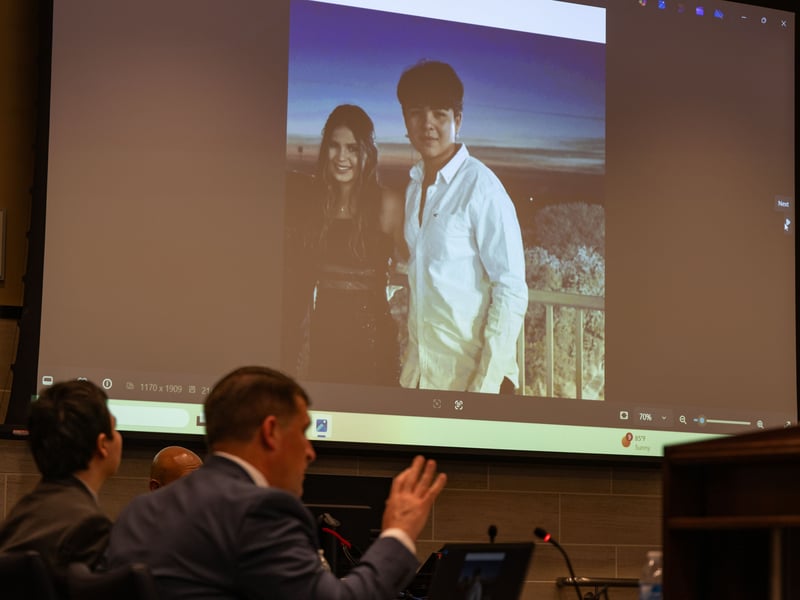
WOODLAND, Calif. (CN) — There’s no question that a former UC Davis student accused of fatally stabbing two people and injuring a third has schizophrenia.
What attorneys disagree about in the case of Carlos Dominguez is how his mental illness affected him when authorities say he committed those crimes in the city of Davis.
Jurors in the case have listened to testimony for weeks in the murder trial and, on Friday, heard closing arguments from the attorneys. Dominguez, 22, faces two counts of murder and a count of attempted murder in the spring 2023 slayings of David Breaux, 50, and Karim Abou Najm, 20, as well as the stabbing of an unhoused woman.
Jury deliberations began that afternoon.
Speaking to jurors, Deputy District Attorney Matt De Moura acknowledged Dominguez’s schizophrenia while telling them he’s also lucid and able to form intent — a key element if they’re to convict.
“That is what this case is about, ladies and gentlemen,” De Moura added. “They didn’t threaten Mr. Dominguez. They didn’t have weapons. They simply existed and went about their lives until they were no longer able to.”
Dominguez, who testified in his defense at trial, said he saw shadow figures or shadow-shapeshifters, who at times gestured and laughed at him. He told jurors he had no memory of the stabbings but did remember the moments leading up to them.
De Moura pointed to the number of times he said Dominguez stabbed his victims: 31 times for Breaux and 52 times for Najm, the latter having most of the wounds near the heart. In each stabbing, Dominguez chose remote, dark areas with few potential witnesses nearby.
“He has plenty of time to consider, should I do this or not?” De Moura said.
The prosecutor also referenced a poem written by Dominguez titled “Knife in my hand,” which the former UC Davis student called metaphorical. De Moura argued that Dominguez chose to buy a hunting knife online, not some other type of knife, and used that blade in the stabbings.
“You have to slit through the shell, almost like a poem,” De Moura added, paraphrasing Dominguez’s verse. “Like a metaphor? I don’t think so.”
Attorney Dan Hutchinson, Dominugez’s public defender, blasted prosecutors over that claim, along with several others, during his closing argument. He went through a list of what he called falsehoods that the prosecution and law enforcement made during the investigation and trial.
“Does anyone think that Johnny Cash really wanted to shoot a man in Reno just to watch him die?” Hutchinson asked, drawing a line between his client’s poem and the famous “Folsom Prison Blues” song. “This is nonsense.”
Hutchinson called the investigation and prosecution of Dominguez “amateur hour,” noting that arguments made by attorneys aren’t evidence. Prosecutors focused on the number of stab wounds the victims had because their legal theory had no evidence to support it.
“It was just throwing everything against the wall and seeing if something would stick, because they have nothing,” Hutchinson said.
A handful of medical experts testified that Dominguez suffered from schizophrenia at the time of the stabbings. However, Hutchinson argued prosecutors wanted jurors to believe his client remained lucid at the time and had an intent to kill.
They partially did that by misstating evidence, like saying no blood was found at Dominguez’s home after his arrest. Hiding evidence of blood would have shown culpability.
But blood was found at the home, Hutchinson said.
Deputy District Attorney Frits Van Der Hoek made that assertion at points throughout the trial, leading Hutchinson to argue prosecutorial error. Friday morning, before the jury arrived, Yolo County Superior Judge Sam McAdam formally admonished Van Der Hoek over the issue.
Hutchinson made no mention of that admonition during closing argument, though he kept hammering what he called the falsehoods made by authorities.
Prosecutors wanted the jury to believe that failing out of school, anger issues and his former girlfriend opting against meeting him in April 2023 led Dominguez to kill.
“Their theory is that caused him to kill,” Hutchinson said, referring to the girlfriend. “Where is this coming from?
“Yes, he killed two people, and he injured another, and he’s accepted that,” Hutchinson said near his argument’s end. “It was a disease, and he did not believe he was hurting people.”
Subscribe to our free newsletters
Our weekly newsletter Closing Arguments offers the latest about ongoing trials, major litigation and rulings in courthouses around the U.S. and the world, while the monthly Under the Lights dishes the legal dirt from Hollywood, sports, Big Tech and the arts.