
 Search Articles


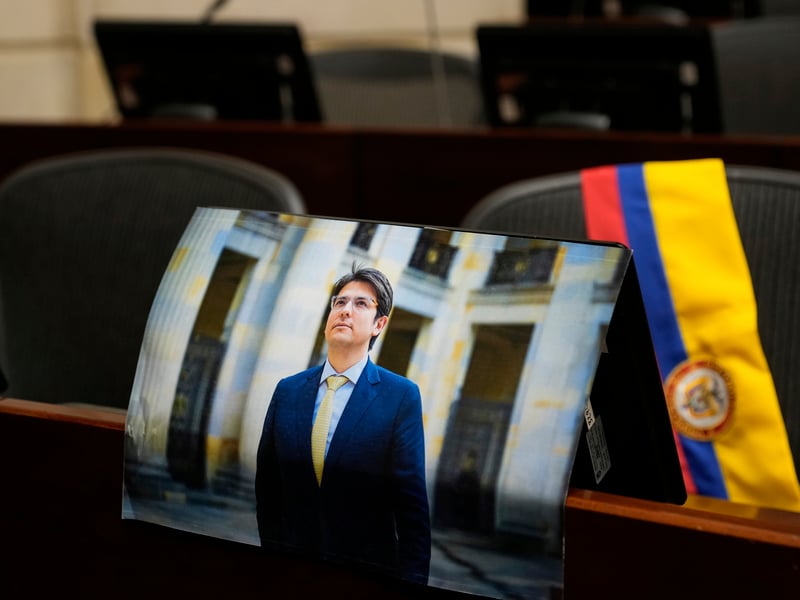
(CN) — Miguel Uribe Turbay, 39, a Colombian senator and presidential hopeful, died after two months of intensive care following an attack where he was shot three times during a political rally.
His death, a peak of political violence that had not been seen in Colombia for decades, sparked outrage and concern across the political spectrum ahead of next year’s presidential elections.
“They killed hope,” tweeted Álvaro Uribe, former president of Colombia who is serving 12 years under house arrest for fraud and bribery, which he recently deemed as “neo-communist censorship.”
By many in the opposition, the killing of Uribe Turbay is read as a political attack. Although there have been several arrests under suspicion of involvement in the case, there has been no confirmation about the intellectual authors of the murder.
Shortly after the news, U.S. Secretary of State Marco Rubio joined the politicians who lamented the senator’s death.
“The United States stands in solidarity with his family, the Colombian people, both in mourning and demanding justice for those responsible,” he posted on X.
Uribe Turbay belonged to a family with a history crossed by politics and violence. Grandson of a former president and son of a woman kidnapped by order of Pablo Escobar and later killed during a botched rescue attempt, he kickstarted his political career during his young years, gaining his first seat at 25 for Bogota’s city council.
He went on to be the secretary of mayorship in Bogota in 2016 and won a seat in Senate in 2022. He was, from early on, an opponent of incumbent President Gustavo Petro and his leadership. His main criticism as a lawmaker was the fragile security in Colombia, and the slippery peace policies that followed decades of a ravaging armed conflict in the country.
He announced his presidential candidacy in March within Centro Democrático, a conservative party.
Uribe Turbay was shot three times, twice in his head and once in a leg, and has been in intensive care since the attack two months ago. A few days ago, the hospital he was in announced he had suffered a hemorrhage. He died shortly after.
So far, six individuals have been indicted in connection with the assassination of Uribe Turbay. The first arrest was a 15-year-old boy accused of carrying out the shooting who was apprehended after being wounded by security personnel. He was charged with attempted homicide and illegal possession of a firearm. A video showed him shouting that he had done it out of need — hired by a local drug dealer.
His cooperation with authorities led to the arrest of Carlos Eduardo Mora, a Colombian-Venezuelan who had scouted the area beforehand, and Katerine Andrea Martínez, alias “Gabriela,” who is accused of coordinating logistics and providing the weapon to the shooter. Gabriela’s testimony also bolstered the theory that dissident armed groups may have been involved.
The following arrests included William Fernando González Cruz, alias “El Hermano,” accused of helping other perpetrators escape and attempting to cover their tracks by selling a phone used in the attack. Elder José Arteaga, alias “El Costeño” or “Chipi,” believed to be the operational mastermind linking the intellectual and material suspects, was captured following a tip-off. Finally, Cristian Camilo González Ardila surrendered voluntarily, suspected of being part of the escape plan.
The suspects are being held in a secure facility due to the case’s high profile. Authorities have stated that at least two more arrests are expected related to logistical support for the attack.
Sergio Guzmán, head of Colombia Risk Analysis, a political risk consultancy group, said that the killing reminded him of “a country we thought had been left behind.”
“We’re still a violent country, where we can’t live at peace,” he said.
However, Guzmán pointed out, approval of Petro’s administration has only increased in the past two months since the shooting.
The killing of Uribe Turbay came at a critical moment for Colombia. The country will face elections next May to replace Petro, a left-leaning president finishing out his four-year term in office. Although his administration has shown some positive results — like the decline in poverty rates, which stand a little above 30% — it has failed to eliminate violence in the country, the main concern of voters who have struggled to cope with armed conflict for decades.
“Polarization ahead of the elections will keep increasing,” he said. “There will be more divisions, more hate rhetoric — and more risk for candidates.”
Colombia has long led the global production of cocaine, spanning a network of powerful drug lords from the country connected with others across the world. Although a peace agreement was signed in 2016 with the bigger guerrilla groups, several dissident groups emerged since. They have largely left the political ideology behind, focusing on the international drug market as well as its derived crimes in the enforcing of illicit financial circuits, trafficking, distribution, smuggling and the arms business.
However, Uribe Turbay’s shooting raised alarms in the country, with the return of a level of political violence that had been unseen in years.
On Monday, hours after the news of Uribe Turbay’s passing had been broadcasted on news outlets across the world, Petro posted a long message on X: “My condolences to the family of Senator Miguel Uribe Turbay, and to all Colombians. Life is above any ideology.”
Petro claimed Colombia has been winning the battle against violence for decades, but “death still surprises us and strikes us.”
“The investigation has to be deeper," he wrote. “[Our] government must condemn it and help [it].” Petro also said that his political movement has never gone after opponents.
“Rest in peace, love of my life,” posted Uribe Turbay’s wife, María Claudia Tarazona, when she announced his death on social media. He is survived by his wife, their son and three stepdaughters.
 Follow @luciacholakian
Subscribe to our free newsletters
Our weekly newsletter Closing Arguments offers the latest about ongoing trials, major litigation and rulings in courthouses around the U.S. and the world, while the monthly Under the Lights dishes the legal dirt from Hollywood, sports, Big Tech and the arts.